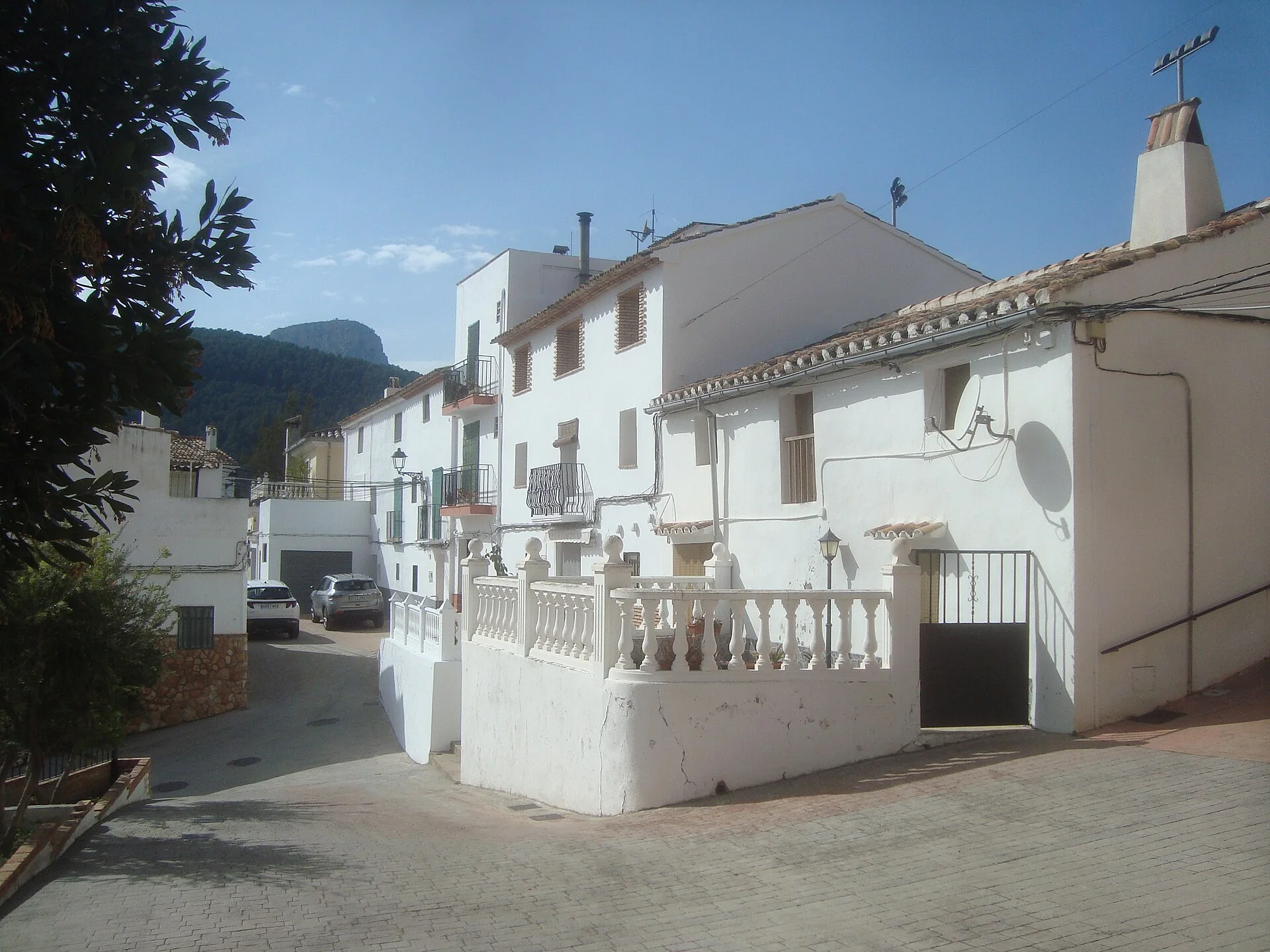
Vallat is a small Alto Mijares municipality where water explains much of the visit. The urban walk connects San Juan Evangelista church, a viewpoint, Fuente de la Salud and the public wash house. Outside the centre, the Mijares and Villahermosa rivers shape woodland, springs and natural pools. The compact scale encourages an unhurried visit, but it does not make all these places a single marked trail. This guide separates the urban itinerary from outdoor excursions and relies on active public tourism sources.
The church, viewpoint and whitewashed houses
The eighteenth-century parish church of San Juan Evangelista is the main reference in the centre. Regional tourism information describes a broad, simple building with stone flooring. A viewpoint immediately behind the church helps visitors understand how the settlement occupies the slope. Higher up, Santa Cruz is associated with local religious events. Casa Abadía also appears in the Provincial Council’s heritage inventory, although the listing does not guarantee interior access.
Narrow streets, steep surfaces and whitewashed façades retain the appearance of a rural settlement. The photograph on this page shows one of these streets and the surrounding relief; it does not show the Mijares River. Park without obstructing doors or access, because these narrow streets remain residential spaces.
Fuente de la Salud and the wash house
Fuente de la Salud is among Vallat’s best documented places. Castellón Tourism dates it to 1930, during the term of mayor Matías Campos. It was designed to provide a dependable supply of drinking water for local activity and residents. The scheme created a broad space with wide steps and side benches, not merely a spout for filling water jugs. Residents contributed to the work, and a woman from the family known as the Morenos donated the bronze lion figure decorating the outlet.
The public wash house stands beside the fountain. Their proximity makes it possible to interpret household water supply, labour and community life together. This is living heritage rather than scenery: keep the area clean, do not interfere with the outlet and observe any municipal instructions about using the water.
Pools, springs and two rivers
The regional tourism portal names Roca del Molino pool, Vidal pool and Peña Negra, as well as Ramírez and La Señora springs. The Provincial Council calls Roca del Molino the village’s natural swimming pool and places it outside the settlement in the direction of the river. This identifies the type and location of the site, but it does not guarantee safe bathing every day. Flow, water quality, flood risk and restrictions change; read current signs and official notices before entering the water.
The Mijares and Villahermosa rivers support riverside vegetation and cooler environments. Responsible visitors take all rubbish away, light no fires and remain outside closed land or hydraulic facilities. After storms, an apparently calm pool can carry a current or receive a sudden rise from upstream.
What Salto del Agua actually is
Salto del Agua is connected with Vallat’s former power station. The regional source describes it more precisely as an old channel belonging to the plant: the visible fall depends on water being released from its reservoir. It should not be advertised as a permanent waterfall. The site provides useful evidence of how hydraulic infrastructure changed the landscape; local history also associates construction of the power station with population growth in the 1960s.
Observe it only from permitted, safe ground. Channels, reservoirs and conduits can involve sudden flow changes, steep drops and operating equipment. This guide does not recommend entering the channel or approaching unprotected edges.
A realistic route
- Begin at San Juan Evangelista church and use the viewpoint behind it to read the setting.
- Walk through the whitewashed streets to Fuente de la Salud and the wash house, interpreting them as one water-supply ensemble.
- Continue towards Santa Cruz only if the slope and weather suit everyone in the group.
- Choose one confirmed outdoor site, such as Roca del Molino, rather than attempting to link every pool.
- Treat Salto del Agua as conditional on access and hydraulic operation, never as a guaranteed permanent cascade.
Documented customs include the distribution of bread rolls for San Antonio Abad and former games of handball against the old school wall. They provide insight into community life, not a guaranteed events calendar. For food, consult current local businesses and opening hours instead of assigning Vallat a generic list of mountain dishes.
Official sources and nearby guides
- Comunitat Valenciana Tourism: what to see in Vallat
- Castellón Tourism: Vallat profile
- Castellón Provincial Council: Fuente de la Salud
- Castellón Provincial Council: Roca del Molino pool
Independent onward ideas include Torrechiva, Villamalur and Villahermosa del Río, or the full municipality guide finder. They are separate destinations requiring road travel.
The editing date records changes to the text, not a new check of opening hours, telephone numbers or accessibility. Specific verification dates, where recorded, appear beside the relevant information.