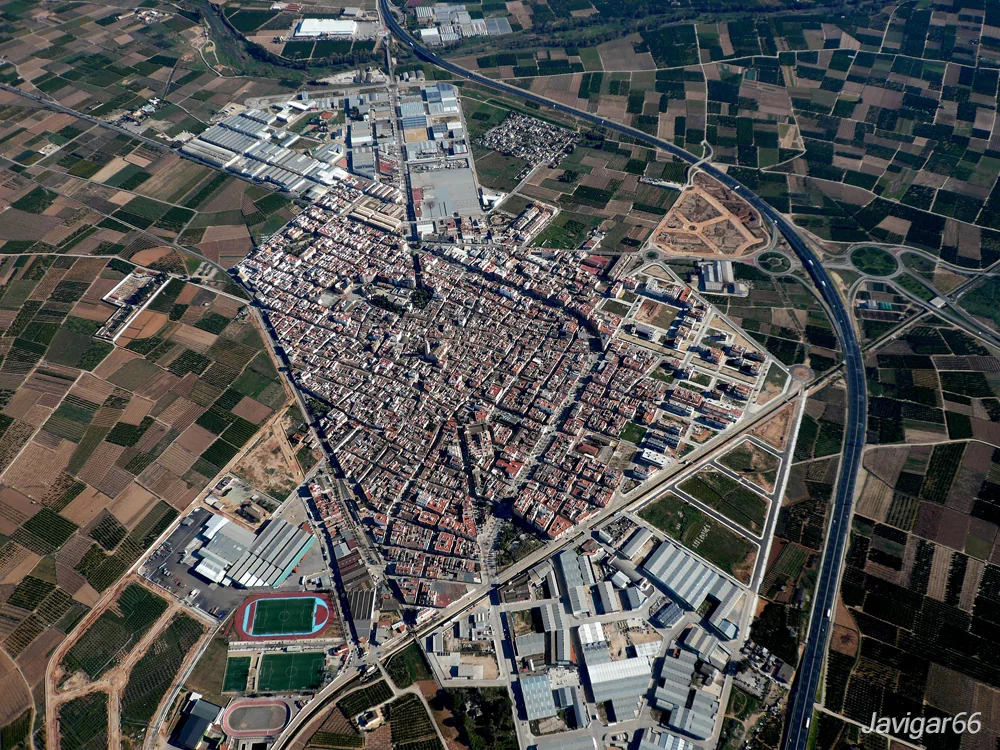
La Alcudia is best understood through two intersecting themes: the urban heritage around Sant Andreu church and the water systems that transformed its farmland. The aerial photograph shows how the town, industrial estates, transport routes and cultivated land fit together. At street level, the detail becomes clearer: Baroque and Neoclassical architecture, the remains of a friary, a contemporary cultural centre and named hydraulic structures with documented dates.
What to see in La Alcudia
Church of Sant Andreu Apòstol
The parish church, built across the eighteenth and nineteenth centuries, combines a classically influenced plan with Baroque decoration and a Neoclassical façade. The town council highlights Josep Vergara’s fresco cycle on the life of Saint Andrew, the chapel of the Mare de Déu de l’Oreto and the tall bell tower. These features reward careful observation even when the interior is closed. Religious services take priority, and any interior visit should be checked against current local information.
The Convent and Calvary
Parts of the church from the former Sant Pere d’Alcàntara friary, built in 1743, still remain. The former complex is now associated with the Calvary and its cypress trees. This is a different kind of stop from Sant Andreu: its value lies in showing how a religious site changed and remained part of the town’s memory, rather than in monumental scale. Respect closed areas and do not assume that ruins or enclosed sections are accessible unless local signs explicitly say so.
Casa de la Cultura
Opened in 1987, the Casa de la Cultura adds a contemporary layer to the route. Designed by Calza Agreda, it contains a theatre and exhibition hall. Its iron dome was painted by local artist Manolo Boix with the work Al·legoria de la Ribera. Events and exhibitions change, so consult the municipal programme if you want to combine the heritage walk with a cultural activity.
The water story: waterwheel and aqueduct
In 1842, the Sant Antoni and Santa Bàrbara waterwheels were installed in the Séquia Reial del Xúquer irrigation canal. Sant Antoni is preserved as the central feature of Parc de la Sénia, a complex opened in 1982 as a tribute to farm workers. Santa Bàrbara supplied La Mota, also called the Santa Bàrbara aqueduct, which was built in the same year to distribute irrigation water across a substantial area. This documented relationship is more accurate than a vague claim about “heritage linked to the Júcar river”: the specific local story concerns the canal and the engineering used to raise and carry its water.
The park interprets channels, pools, aqueducts and crops without requiring access to private farms. To explore any other part of the network, stay on public paths and check current conditions. Water infrastructure can include drops, open channels and slippery surfaces, so it should not be treated as an unrestricted playground.
Suggested route
- Historic centre: start at Sant Andreu and examine the façade, bell tower and surrounding streets.
- Friary memory: continue to the Convent and Calvary, remaining within clearly accessible areas.
- Present-day culture: include Casa de la Cultura when its hours or programme suit the visit.
- Water landscape: travel to Parc de la Sénia to complete the agricultural and hydraulic story.
The final stop is separate from the main heritage walk and may require extra time. Do not assume the whole route is conveniently walkable without checking distances, temperature and the mobility of the group. A shorter visit can focus on Sant Andreu, the Convent and the centre.
Nature and food
València Turisme places the municipality between the Magro river to the north and the Séquia Reial del Xúquer to the south, and identifies Els Fornals as a natural site. Conditions in agricultural areas change with rain and farm work, so check municipal notices before treating it as a fixed excursion. Valencian rice dishes are prominent in local cooking. The provincial tourism page also names carabassa santa, a traditional Holy Week preparation; it is seasonal and should not be expected year-round.
Practical advice
- Check the town council’s programme and opening information rather than treating hours as permanent.
- Respect worship and avoid interior sightseeing during services.
- Take water and sun protection for the hydraulic section, where shade may be limited.
- Never cross irrigation channels or enter farmland except on authorised public routes.
La Alcudia has a clear story of its own: from a major parish church to the engineering that changed irrigation, with a historic friary and an active cultural building in between. That continuity between heritage, water and everyday life is what makes the visit distinctive.
Related guides
Official sources and verification
The editing date records changes to the text, not a new check of opening hours, telephone numbers or accessibility. Specific verification dates, where recorded, appear beside the relevant information.