Benimodo has considerably more specific heritage than its former template suggested. The centre contains a church with several historical phases, 20th-century civic architecture, fountains and ceramic devotional panels. Outside the centre are industrial remains, archaeological sites and two municipal protected landscapes with very different characteristics. A sensible visit combines an urban walk with, if time and conditions allow, one separate excursion to either the Ullals del Riu Verd springs or Barranc i Coves del Truig. This avoids confusing the flat irrigated plain with the mountainous western edge of the municipality.
What to see in Benimodo
La Puríssima Concepció parish church
The parish church is the principal historic reference in the centre. Benimodo Town Council explains that the present building was erected in the 18th century over an earlier church, thought to have been built in the 16th century on a former mosque. This layered account is more accurate than assigning the whole structure to one date. Inside are an anonymous carved crucifix attributed to the 18th century and a 1909 portrait of Rector Soria by Francisco Pons Arnau. Two Corinthian wooden columns survive from an altarpiece made by Manuel Vergara in 1735, while bells are dated 1729, 1742 and 1798.
The building remains a place of worship. Restored artworks do not imply permanent visitor opening. Anyone wishing to see the interior should consult the parish or council and avoid disrupting services.
Plaça Major, Plaça de Machí and ceramic panels
València Turisme describes narrow streets leading to the two principal squares. Plaça de Machí contains the building known locally as La Imprenta, while both squares have century-old fountains. The council also documents devotional ceramic panels from the late 18th and early 19th centuries across the older streets. Their subjects include the Sants de la Pedra, Saint Philip Benizi, Saint Anthony Abbot, Saint Vincent Ferrer, Our Lady of Mount Carmel, Christ of Zalameda and Saint Barbara. These panels belong to façades and should be observed from public space without intruding on homes.
The former Republican Casino
Built in 1931, the Republican Casino is among Benimodo’s most representative buildings. The municipal heritage page describes an eclectic design with influences from architectural historicism, Rationalism and Art Deco. It gives the route a civic chapter distinct from the church and agricultural landscape. Current use and admission should be checked; an interesting exterior does not make the interior an unrestricted attraction.
Former schools and the Art Deco cemetery
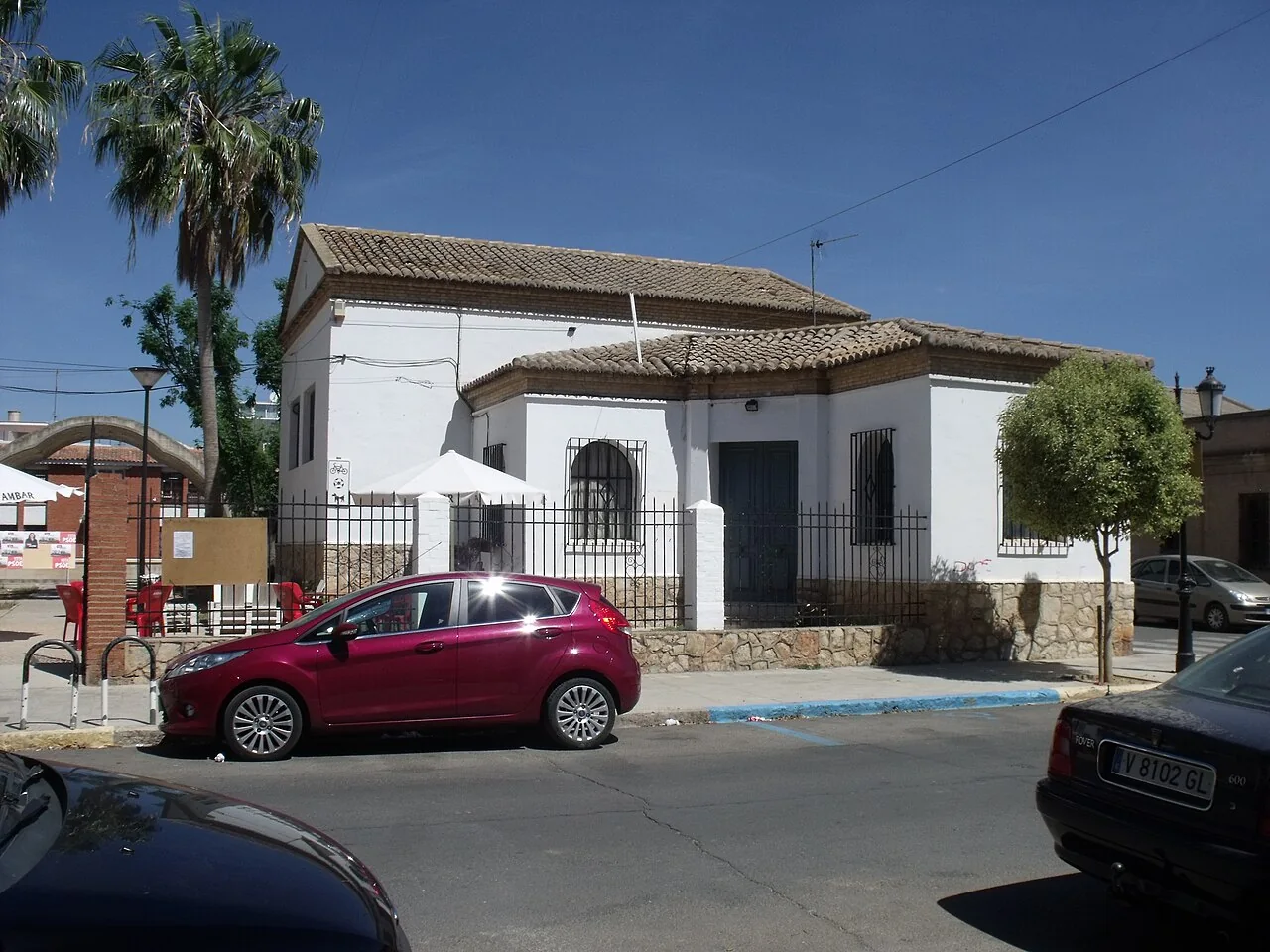
The photograph on this page shows the former public schools, built in 1934. It is not a generic view of the town but a building specifically included in the municipal heritage account. The municipal cemetery belongs to the same broad period: constructed in 1924, it was designed by Carlos Carbonell Pañella in the Art Deco tradition. Visitors adding it to their route should respect its funerary purpose and observe opening arrangements.
Working and industrial heritage
Benimodo’s story continues beyond its squares. The council lists the 1929 Ocheda oil mill, 1933 Ressalany engine house and 1950 rice mill as examples of industrial architecture. They help explain the transformation of an agricultural economy and should not be advertised automatically as museums. Confirm location, ownership and whether each structure can be seen from a public road before searching for it.
Two protected landscapes with different conditions
Ullals del Riu Verd
The Ullals are a protected wetland where groundwater emerges at surface level and forms the River Verd, a tributary of the Júcar. The council highlights its ecological value and the presence of the Spanish toothcarp, or samaruc, together with other threatened species. This calls for a low-impact visit: remain on permitted access, take waste away, do not enter the water and do not disturb plants or wildlife. Access may change because of conservation work, rainfall or maintenance.
Barranc i Coves del Truig
The second Municipal Natural Area occupies rugged mountain terrain and differs markedly from the springs. It combines characteristic vegetation with a Bronze Age archaeological site. Archaeological material must never be touched or removed, and the presence of caves does not mean unrestricted caving is appropriate. Check the authorised route, wildfire risk and weather before setting out. The council documents other archaeological locations as well, but naming a site does not guarantee visible remains or public access.
Food, music and festivals
València Turisme identifies arròs amb fesols i naps as the best-known local dish. Municipal information also records a distinctive musical heritage, including the Jota and Bolero de Benimodo, popular songs, religious goigs and a town anthem. Patron saint festivities take place in August in honour of Saint Philip, Saint Bernard the Martyr and the Divina Aurora. Programmes change each year, and a documented dish is not necessarily available in every local business every day.
Useful questions
What exactly does the photograph show?
Benimodo’s former public schools, dated to 1934 by the council and identified as such in the Wikimedia Commons record.
Can the entire route be walked?
The urban section can. The two natural areas are separate outings that require checking transport, access, surfaces and environmental conditions.
Are the buildings open inside?
Do not assume so. The church, Casino, former schools and industrial structures have different uses and access arrangements. The council is the appropriate source for current information.
Related guides
Official sources and image credit
The editing date records changes to the text, not a new check of opening hours, telephone numbers or accessibility. Specific verification dates, where recorded, appear beside the relevant information.