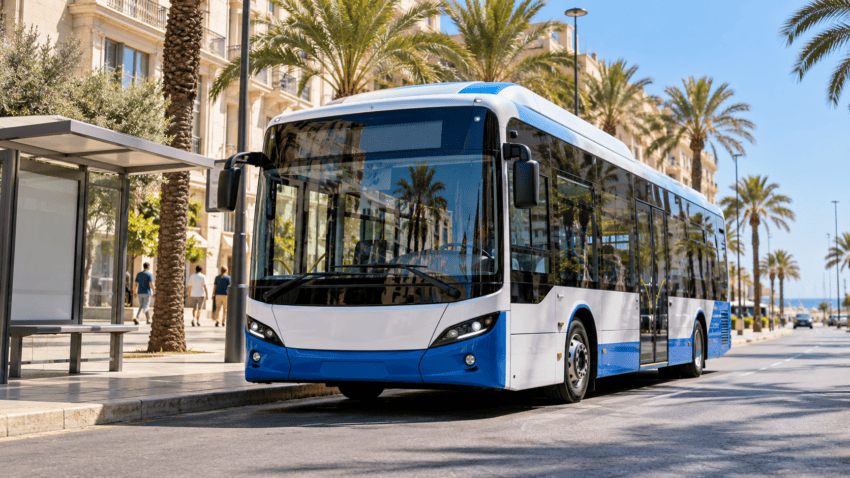
Alicante’s urban bus renewal has nearly halved the average age of its fleet, but the city still does not systematically show what its mobility investment achieves. That is the mixed verdict for Alicante in a Spanish Court of Audit report published in the Official State Gazette this week.
The report puts the city’s sustainable public transport measures in 2023 and 2024 at €22.4 million. They included 23 accessible electric buses and charging points, an increase to 25 hybrid vehicles, new shelters, real-time waiting displays, mobile payments and an on-demand service for rural districts.
The work reduced the average vehicle age from 12.23 years at the end of 2022 to 6.81 years two years later. Auditors also recorded a wider network and more passengers during a period shaped by the post-pandemic recovery, fare discounts and population growth.
Investment has moved faster than evaluation
The central criticism concerns not fleet modernisation but the way its effectiveness is checked afterwards. Alicante included indicators in its Sustainable Urban Mobility Plan, yet did not carry out the follow-up needed to establish whether measures met their goals and to correct them where necessary. The plan also predates Spain’s Climate Change Act and has not been updated to meet its minimum requirements.
The audit identifies a further gap: Alicante was the only one of the nine large cities examined without a Sustainable Energy and Climate Action Plan. It also found that the latest reports from external oversight bodies had not been published on the city’s website.
Contracts under scrutiny
The parliamentary resolution accompanying the report specifically urges Alicante to build safeguards into contracts so suppliers deliver vehicles on time. Along with six other cities, it is also asked to apply greater rigour when planning, awarding and supervising contracts, in order to prevent delays, extensions, extra costs, suspensions and compensation payments.
The findings do not negate the work already completed. They recognise that electrification, accessibility and passenger information have improved since 2022. What remains is a shift from listing projects to measuring effects: journey times, actual route use, emissions cuts, timetable reliability and whether services meet the needs of neighbourhoods and outlying rural areas.
The next test will be the city’s response: an updated mobility plan, published performance indicators and more precise contractual controls. Those steps should show whether the €22.4 million changed only the fleet or also the day-to-day quality of the service.