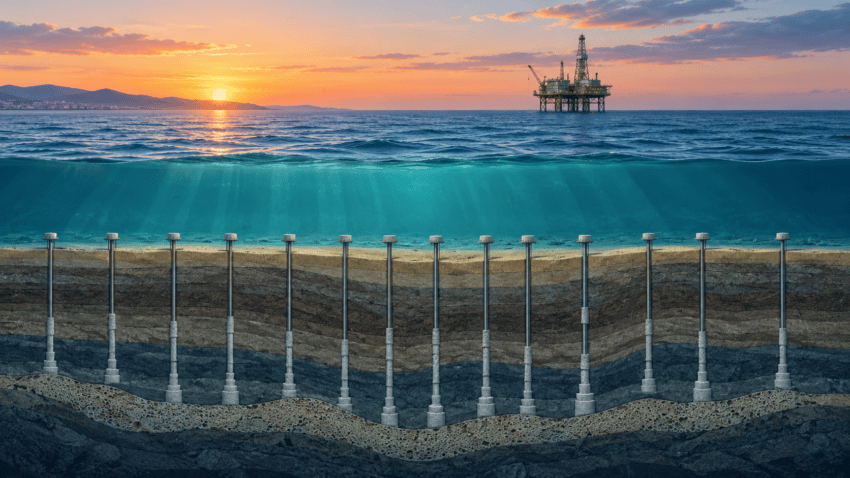
All 13 wells at the Castor gas storage facility off the coast of Vinaròs have now been permanently sealed. Enagás says the most sensitive subsea operation in the closure is complete at an estimated cost of €241 million. The offshore platform and the onshore plant remain in place, however, and will require a later dismantling phase.
Workers installed three plugs in each well, combining mechanical barriers with cement. They then cut the well conductors more than three metres below the seabed, leaving no associated pipes protruding from it. The company says the system isolates the geological formations crossed by the wells and blocks any route for fluids to move between layers or into the sea. The announced cost remains an estimate until the final certificates are issued.
The physical closure comes 13 years after the Spanish government halted gas injection following the earthquakes recorded in September and October 2013. The largest reached magnitude 4.2. When the state ordered Castor’s dismantling in 2019, it cited the findings of a study by MIT and Harvard: resuming operations would retain a seismic risk and could trigger earthquakes significantly larger than those that led to the facility being mothballed.
What has been closed — and what remains offshore
Castor was designed to store gas in a former oil field about 1,700 metres underground. Eight of its 13 wells were production wells, four were used for monitoring and one for fluid reinjection. The offshore structure stands 21.6 kilometres from the coast and is linked by a 30.3-kilometre pipeline to the operations plant within the municipality of Vinaròs.
Permanent well sealing therefore does not mean the entire complex has disappeared. Two surface platforms connected by a walkway remain, as do the onshore facility, the pipeline and a fibre-optic line. Enagás describes the completed work as preparation for that final stage, but its announcement gives neither a timetable nor a budget for removing those components.
The well operation was governed by the environmental approval issued in 2023 and the implementation permit granted in April 2025. Their conditions included seismic monitoring, seawater checks and specific safety measures. Enagás says every permanent plug has been approved by an independent well examiner, as required under offshore safety rules.
Removing the two platforms, the onshore plant, the pipeline and the fibre-optic line will be the visible end of the complex. Until that work has approval, a timetable and a final cost, Castor will remain closed beneath the sea but not fully dismantled.