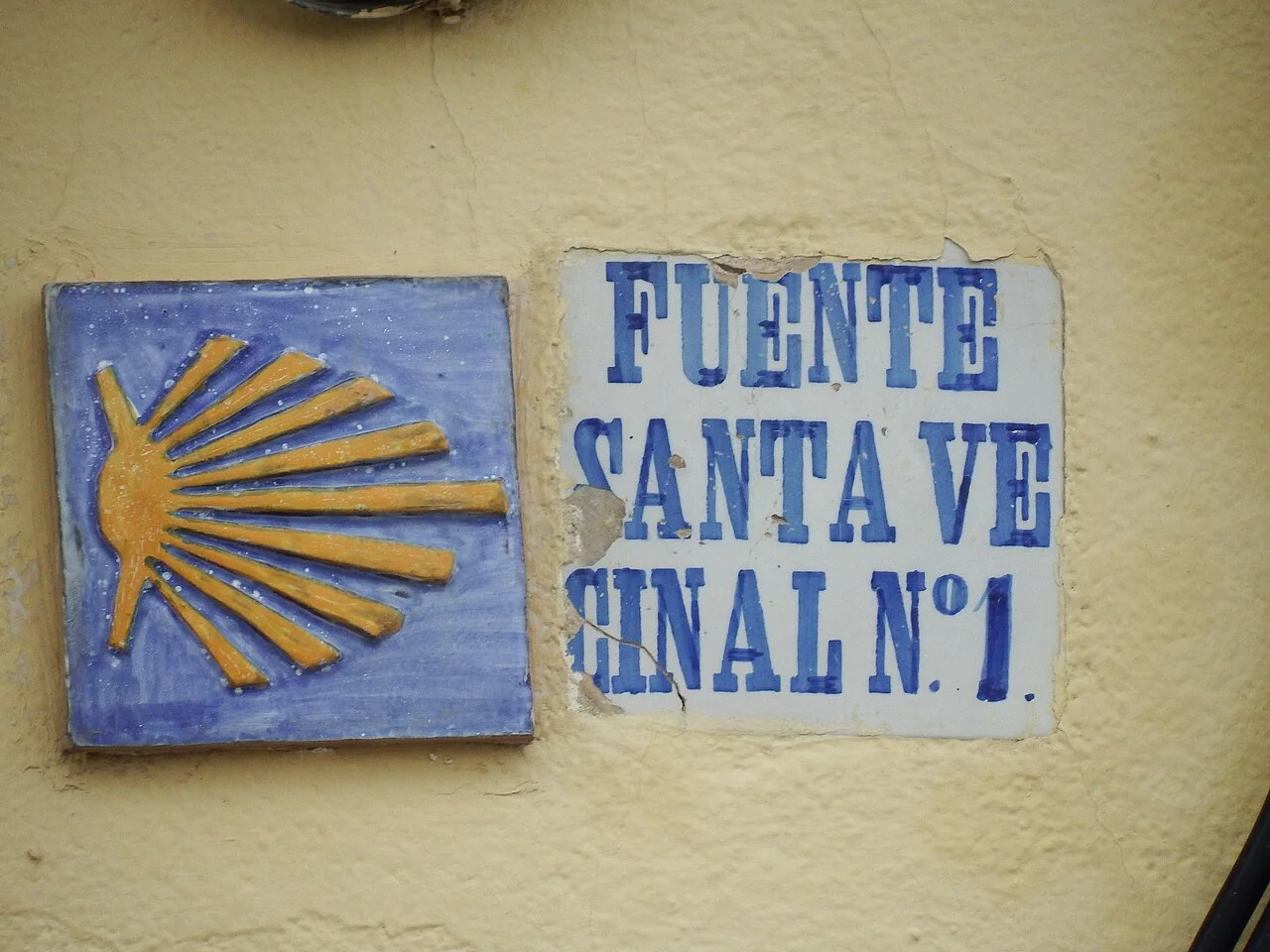
Novelé —Novetlè in Valencian and officially— is a small La Costera municipality at the foot of the Vernissa range, very close to Xàtiva. Its urban route has precise references: Mare de Déu del Roser church, the former Tallada palace, the washhouse and several ceramic panels. The photograph does not show a historic centre; it shows a Fuente Santa sign beside the shell symbol of the Way of Saint James.
What to see in Novelé
Mare de Déu del Roser parish church
Turisme La Costera dates the church to the sixteenth century and places it in the square formerly occupied by the Tallada palace. To the right of its façade is an eighteenth-century ceramic panel depicting the Trinity, Saint Bartholomew and Saint Mary Magdalene. The exterior and panel can be seen from the square; interior access depends on worship and a confirmed opening.
Tallada farmhouse or palace
The regional tourism authority describes the Tallada farmhouse, also known as the seigneurial palace, as a restored eighteenth-century building in public use. València Turisme identifies it as the Town Hall. Its origin connects with the Tallada family, who bought the land in the fifteenth century. Administrative use does not make every room a visitor attraction, so ask before entering.
Restored washhouse
The disused public washhouse was restored with a mosaic of Cristo del Perdón. It explains everyday work and water use without resorting to generic “hydraulic heritage”. Observe its condition, do not climb on basins or roofs and keep the space clear.
Ceramic street panels
Alongside the eighteenth-century panel at the church, the Valencian tourism site records two nineteenth-century panels on Carrer Pintor Simarro Oltra and Carrer Trasagrario. View them from public space and respect the façades. The Fuente Santa sign in the photograph is a different object: a wayfinding marker, not one of these devotional panels.
Origins of the Tallada settlement
Regional information traces Novetlè to the fifteenth century. The Tallada family bought an estate, built a church and six houses and settled families from Sagres farmhouse, who cultivated the land alongside the Moorish population. This history makes the settlement legible at its true scale: square, church, former lordly residence and homes, without assigning it castles or monumental corridors from neighbouring places.
Vernissa and Penya de Sant Dídac
The Vernissa range forms the backdrop. Turisme La Costera proposes the climb to Penya de Sant Dídac, where ruins of a chapel remain, and notes views across Costera de Ranes and Pla de Xàtiva. However, València Turisme’s provincial route states that Penya de Sant Dídac, Penya Alta and Serreta Bolvens are within Xàtiva municipality near Bixquert. Routes may start close to Novelé, but those peaks should not be presented unambiguously as Novelé heritage.
A ninety-minute urban route
- Start in the square. View the church and ceramic panel on its façade.
- Identify Tallada palace. Connect the present Town Hall with the settlement’s seigneurial origin.
- Find the washhouse. Observe its restoration and Cristo del Perdón mosaic.
- Walk along Pintor Simarro Oltra and Trasagrario. Locate panels from public space and finish near the route signs.
The urban walk need not fill a whole day. A Vernissa climb is a separate activity requiring footwear, water, mapping and suitable weather.
Festivals and practical information
Patronal festivities take place in the final week of August for Divina Aurora, Cristo del Perdón, Sant Dídac and Mare de Déu del Roser; the Cristo del Perdón procession is a regional highlight. Programmes change annually and must be checked. Novelé adjoins Xàtiva’s urban environment but retains its own identity. Park without blocking access, avoid peak heat and never follow an isolated shell or sign without a complete map. The municipality’s value lies in compact, documented heritage.
A route marker confirms direction only within a complete signed itinerary; it does not establish that every nearby path is public or maintained. For the mountain extension, check the municipal boundary, trail condition and return time. For the urban visit, ordinary footwear is sufficient, but residents’ doorways and administrative offices must remain unobstructed.
Related guides and data
Official sources and checks
The editing date records changes to the text, not a new check of opening hours, telephone numbers or accessibility. Specific verification dates, where recorded, appear beside the relevant information.