Torrella is a small municipality in La Costera near Xàtiva. Its almost level territory supports a focused visit: a church built after the 1748 earthquake, a museum combining local archaeology and ethnology, Mirador de la Costera and the Calle Baix garden. The village scale makes walking practical but does not justify invented mountain routes, permanent opening claims or unsupported interpretations of old marks.
A visible inscription without a secure attribution
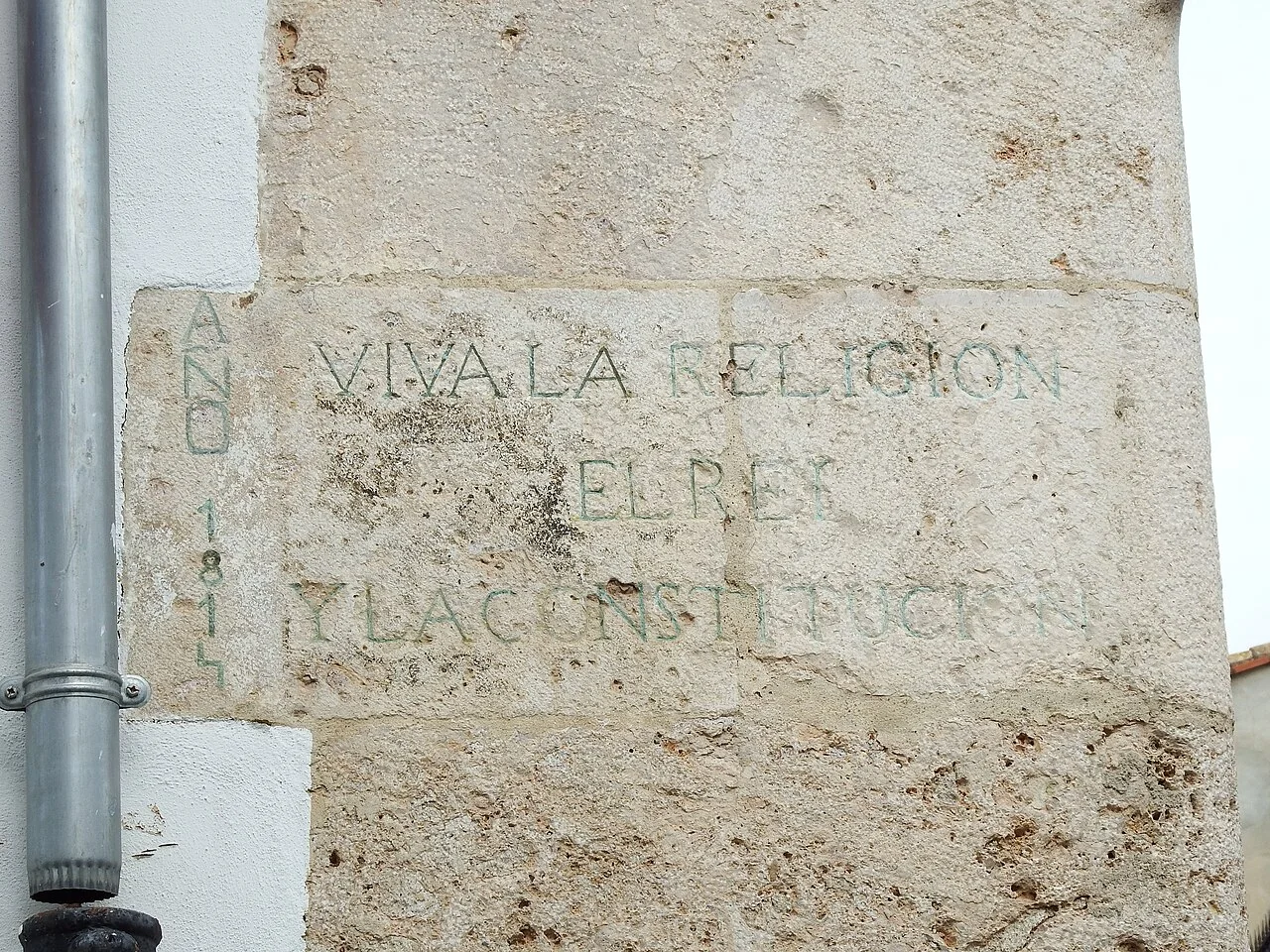
The main photograph is a close view of faded lettering on stone blocks, not a town panorama. Parts of the Spanish words for “religion”, “king” and “constitution” remain legible. Wikimedia describes the file only as one of a group of Torrella photographs taken in August 2024. It gives no date for the lettering, author, building or political context.
The image can therefore document a surviving street detail but cannot prove a link to the Liberal Triennium, a war or a particular movement. Missing words should not be reconstructed as fact. View the wall from public space without touching its surface or entering property.
Mare de Déu dels Àngels after the 1748 earthquake
València Turisme states that Mare de Déu dels Àngels parish church was built after the earthquake of 1748. It describes a typical Neoclassical building with a rectangular plan, one central nave and six small surrounding chapels. Those details explain its form without adding undocumented architects, altarpieces or construction dates.
The exterior belongs naturally in the urban walk. Interior access depends on worship and current opening because a parish is not a permanently staffed visitor monument. Services require silence and respect for any photography restrictions.
An ethnological and archaeological museum
Torrella Municipal Ethnological Museum opened in 1981. The Provincial Council’s official museum guide classifies it as both ethnological and archaeological and places it at 10 Mossén Ricard Climent. Finds from the municipality introduce several historical periods rather than offering only a generic collection of farm tools.
The guide lists Iberian, Roman, Jewish and Arabic coins; fragments of amphorae; burials; cups and vessels; fossils; and a carved stone coat of arms from the sixteenth century. This range is the museum’s distinctive value, connecting occupation, material culture and community memory in one small collection.
The 2020 guide gave weekday morning visiting hours, but timetables age. Contact the council before travel, ask whether booking is required and check accessibility. An object included in the collection catalogue is not necessarily on display during every visit.
Viewpoint, garden and orange fields
Mirador de la Costera and the Calle Baix garden appear in the provincial list of visitor places. The viewpoint positions Torrella within a district visually dominated by Xàtiva and surrounding relief; the garden provides a pause inside the settlement. Weather, vegetation and maintenance affect the view, so a clear panorama cannot be promised every day.
The provincial profile places the village 135 metres above sea level and describes an almost flat municipal area. Loma Vella and Barranco de Hoya are its principal landform references. The local economy relies mainly on growing and marketing oranges. These groves are working private land rather than public parks: remain on authorised routes and do not enter plots for photographs or fruit.
Food as a documented tradition, not a daily menu
València Turisme names baked rice, paella, arnadí, fogases and sweet-potato pastries as local foods. They are useful specific references but do not prove that every business serves them each day. Confirm season, establishment and booking if one dish matters to the visit; sweets may be tied to festivals or advance orders.
A short, verifiable sequence
- Begin at Mare de Déu dels Àngels and read the church structure from outside.
- Visit the museum only after confirming opening or an appointment.
- Walk through the Calle Baix garden and village streets without assigning more meaning to the inscription than its record supports.
- Finish at Mirador de la Costera when access and visibility are suitable.
The provincial source places Torrella about six kilometres from Xàtiva, making a separate combined trip reasonable once road time is checked. There is no need to fill a day with undefined “nature” or advertise Loma Vella and the ravine as approved trails without an official route.
Official sources and nearby guides
For a separate onward visit, see the cultural guide to Xàtiva or the guides to Llanera de Ranes and Cerdà, or return to the municipality finder.
The editing date records changes to the text, not a new check of opening hours, telephone numbers or accessibility. Specific verification dates, where recorded, appear beside the relevant information.