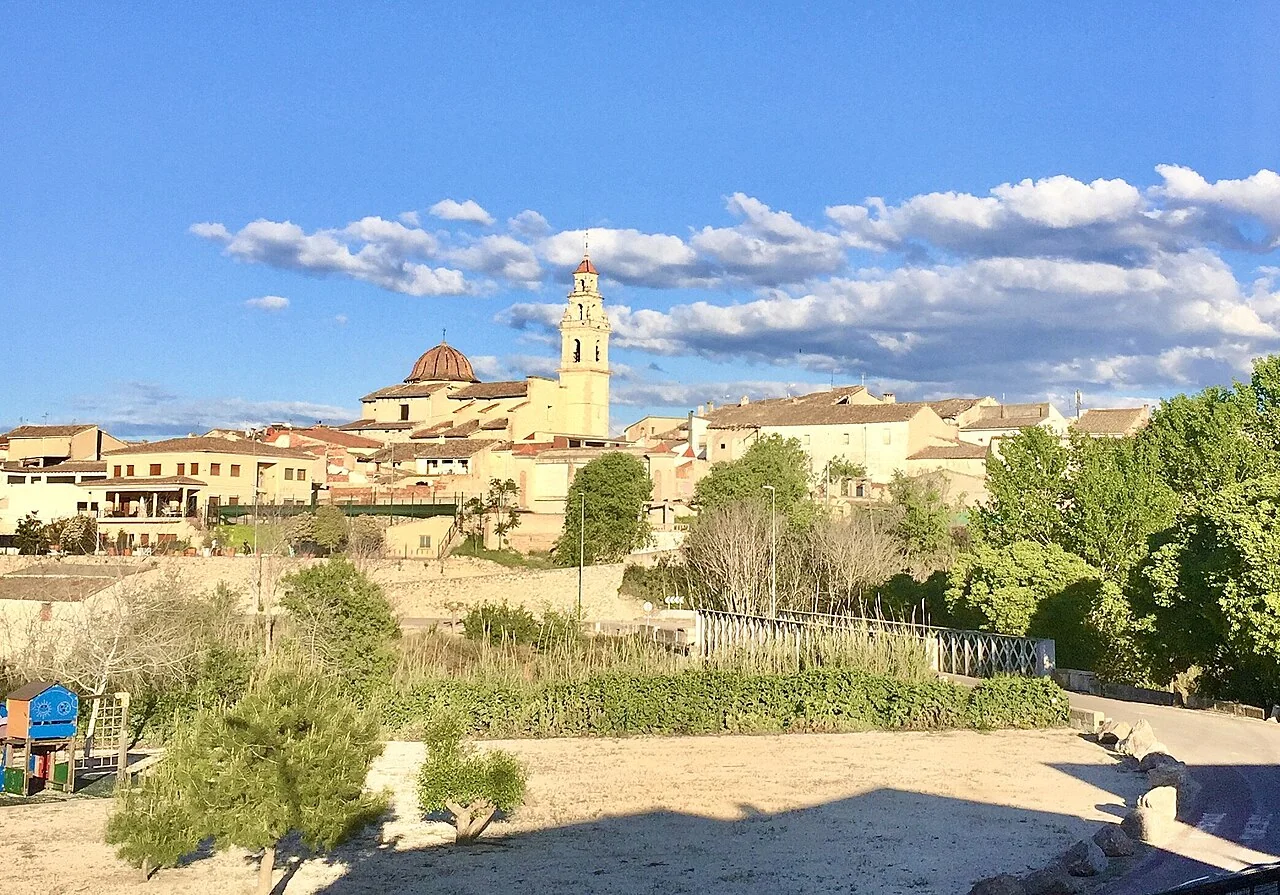
Montaverner occupies a distinctive Vall d’Albaida position where the Albaida and Clariano rivers meet. This geography explains its two bridges, four-spout washhouse, river park and waterside routes. Sant Joan and Sant Jaume church, the former Convent and devotional tile panels stand in the settlement; Colata and the Calvary extend the visit. The photograph shows the village and church from the river area rather than a generic street.
Heritage in central Montaverner
Sant Joan and Sant Jaume Apòstol church
The district guide dates the building to the eighteenth century and links it to Dr Josep Esplugues. It was raised over a former Almohad tower and a Gothic post-conquest parish dedicated to Saint James. The church has one nave with chapels between buttresses. Inside, a fragment of Roman funerary inscription is reused as the support for the holy-water stoup. This is a specific archaeological reuse, not evidence that the church itself is Roman.
The lintelled main doorway with pilasters, bell tower and sundial are visible outside. The provincial profile also records devotional ceramic panels around the village. Observe them from public space without touching façades; church entry depends on worship and actual opening.
The Convent
The Mompó-Soriano family built this institution in the post-war decades of the 1940s and 1950s. It educated children from Montaverner and neighbouring municipalities with the Capuchin Tertiary Sisters of the Holy Family and the Amoris Opus Secular Institute. Two floors are arranged around a central courtyard and well, with a convent-style garden behind.
The façade combines pinnacles, pointed windows and a central 1945 panel made from 42 pieces of glazed polychrome ceramic. Describing the building does not guarantee access to its courtyard or garden. Respect its current use and confirm any interior visit.
Two bridges and two rivers
The River Albaida passes beneath Pont Curt, while the Clariano, also called the Ontinyent river, passes beneath Pont Llarg. They join downstream near the four-spout fountain and washhouse. Distinguishing them turns an undefined “river landscape” into a meaningful reading of the village’s historic position.
Use only designated crossings and banks. Never descend into the channel, cross a barrier or assume a section is passable after rain. Mediterranean rivers can change rapidly; check warnings and remain safely back from the water.
Four-spout fountain washhouse
The washhouse contains three basins made from flat, dressed stone slabs. Overflow from the fountain continues through the washhouse to irrigate Colata’s plots. It is hydraulic heritage rather than a swimming place or proof of drinking water. Keep the basins clean and do not obstruct access.
River park and fountains-and-river route
The river park reuses a former road workers’ house where crews rested during construction of the N-340. It provides a view of Montaverner’s protected northern façade and church and acts as a starting point for paths beside the Albaida and Clariano and historic irrigation channels.
València Turisme says the Fountains Route and River Path can be combined or walked separately. The itinerary includes the Calvary, Convent, Colata hermitage and Plaça Major. As the source does not give one universal distance here, this guide does not invent kilometres. Obtain the current route, choose a suitable section and check works, vegetation, heat and bank conditions.
Colata and the Calvary
Colata hermitage
Colata was among the settlements remaining after the 1609 expulsion of the Moriscos and belonged to the lord of Benissuera from the Bellvís family. Its present nineteenth-century hermitage houses Our Lady of Loreto and has Ionic columns at the doorway and Neo-Gothic interior decoration. Do not present the historic settlement as a fully visitable hamlet or assume the chapel is open.
Calvary
Built in 1941, the Calvary is reached along a Way of the Cross on raised ground by La Cava. Views take in Serra Grossa, Benicadell, Montaverner, Alfarrasí and Bellús reservoir. Follow the actual access with suitable shoes and water; it is a viewpoint, not an excuse to invent a mountain hike.
Planning the visit
- Two hours: church, tile panels, Convent exterior, Pont Curt, Pont Llarg and washhouse.
- Half day: add the river park and a confirmed section of the river route.
- Longer visit: treat Colata or the Calvary as separate extensions rather than improvised detours.
Documented local food highlights paella and oven-baked rice. Patronal and Moors and Christians festivities traditionally take place in late August, while Sant Blai and the Flag Dance are associated with Easter; check the current annual programme.
Related guides and local data
Official sources and planning
The editing date records changes to the text, not a new check of opening hours, telephone numbers or accessibility. Specific verification dates, where recorded, appear beside the relevant information.