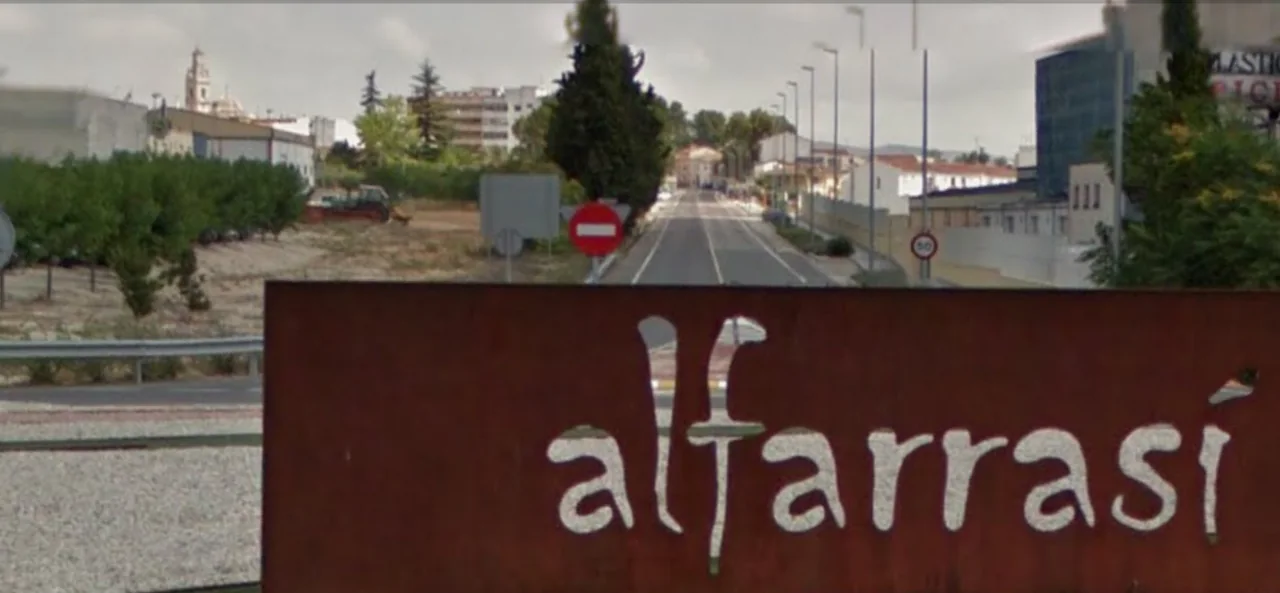
Alfarrasí stands on a route through the Vall d’Albaida beside the river of the same name. A visit has specific places: Sant Jeroni church, Cristo de la Agonía hermitage and its Calvary, and La Venta. Longer routes also cross the municipality, but they must not be confused with a short walk around the village. The featured image shows the entrance sign, citrus trees, road and distant bell tower; it does not depict traditional old-centre architecture.
What to see in Alfarrasí
Sant Jeroni church
València Turisme and the Vall d’Albaida district tourism authority date the church to the eighteenth century. Its single nave is covered by a barrel vault with lunettes and reinforced by buttresses. The interior is noted for its high altar, paintings by Joaquín Oliet and images of four Doctors of the Church: Gregory the Great, Augustine, Ambrose and Jerome.
Outside, the four-stage square bell tower combines brick and masonry above a stone base. This is the tower visible in the distance in the photograph. The façade can be viewed freely from the street, but interior entry depends on worship and actual opening. It must not be advertised as permanently accessible.
Cristo de la Agonía hermitage
The hermitage was built in 1739. It is a restrained hexagonal structure with a dome and four chapels. A cypress-lined Calvary leads to it; the stations or small structures date from 1961, and the setting was rehabilitated in 2001. The climb gives a wider view over the municipality and Vall d’Albaida, but it is not an all-conditions viewpoint: consider gradient, summer heat and religious activity.
Check the approach before climbing, carry water and avoid the hottest part of a summer day. The Calvary stations and hermitage are heritage rather than recreational furniture. Do not climb or lean on them, and leave no waste.
La Venta and river memory
Vall d’Albaida tourism places La Venta about one kilometre from the urban centre and connects it with the period when women went to the River Albaida to wash clothes. The restored setting brings the history of work and water into the route. It should not be promoted as a swimming area or a source of drinking water. Flow, ground and access can change after rain, so observe closures and warnings.
Routes crossing Alfarrasí
Four River Villages route
District information links Alfarrasí, Benissuera, Sempere and Guadasséquies on the Four River Villages route. It is shared across municipal boundaries, not an attraction located wholly inside Alfarrasí. Check the current track, distance, crossings and path condition before attempting it.
Way of El Cid
The municipality lies on the Xàtiva–Ontinyent walking stage of the Defending the South route. The official stage is about 34 kilometres, so a waymark does not make it a short circular stroll. Following it requires planning, mapping, water and a return solution. Visitors focusing on Alfarrasí can use only the village section without implying they completed the full stage.
Village and hermitage itinerary
- Entrance and centre. Locate the bell tower visible in the photograph and continue towards Sant Jeroni.
- Church. Observe the tower and doorway and, only when open, the interior paintings.
- Calvary and hermitage. Climb when heat and mobility allow, respecting religious use.
- La Venta. Add it as a separate River Albaida extension after checking the path.
Church and hermitage make a realistic half-day visit. La Venta or a long-distance route needs extra time and should never be appended automatically.
Festivals, food and safety
The most distinctive documented celebration is l’Angelet de la Corda on Easter Sunday, when a child dressed as an angel removes the Virgin’s mantle before High Mass. Patronal and Moors and Christians festivities take place in August for Sant Roc, the Holy Cross and Cristo de la Agonía. Local food includes oven-baked rice, rice with beans and turnips and paella; the district source also highlights virgin olive oil. Programmes and services change annually. Near roads, river and farm paths, check weather, stay alert and respect private property.
Related guides and local data
Official sources and verification
The editing date records changes to the text, not a new check of opening hours, telephone numbers or accessibility. Specific verification dates, where recorded, appear beside the relevant information.