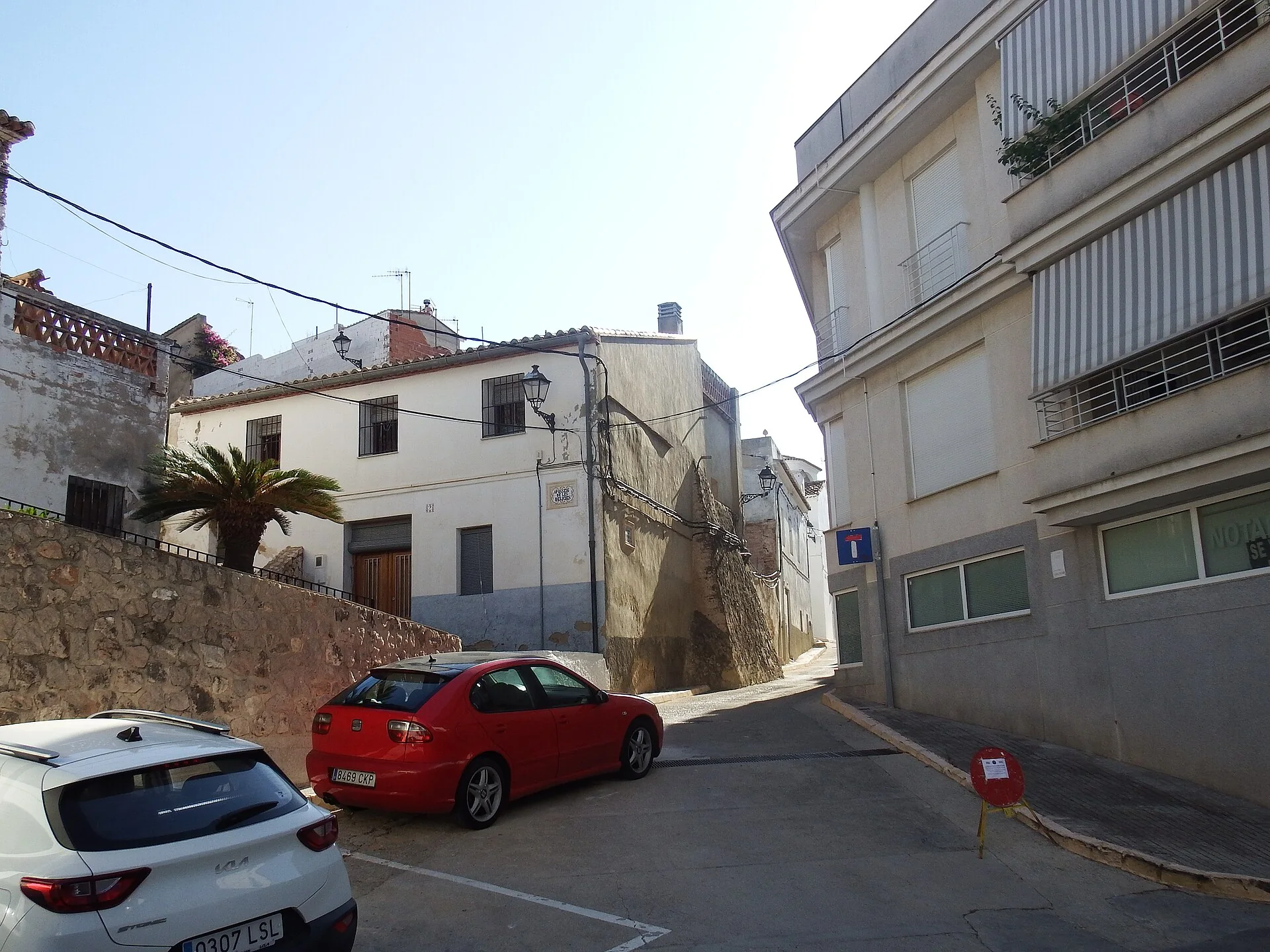
Fuente Encarroz—La Font d’en Carròs in Valencian—occupies a Safor hillside between its historic settlement and paths climbing towards Rebollet Castle. The visit has specific anchors: Rafalí and Portal Roig, Sant Antoní Màrtir church, devotional ceramic panels, Els Xorros fountain and two approved trails with different current statuses. The photograph shows Carrer de les Delícies and homes in the village, not a general panorama or the coast.
Rafalí, Portal Roig and the walls
The first settlement occupied the upper area called Rafalí. València Turisme describes a fourteenth-century enclosure in the Mudéjar building tradition with approximately 800 metres of wall line protecting the church site and nearby streets. Portal Roig and Rafalí retain wall, tower and flank remains and are recognised as an Asset of Cultural Interest.
The remains are deteriorated and the provincial profile says they are normally viewed from outside; the interior opens only on specific occasions. The wall park helps visitors understand the enclosure but does not permit crossing barriers, climbing masonry or searching for the former gate through private property.
Sant Antoní Màrtir church
The church occupies the site of a former mosque. After the Christian conquest it passed to the Carròs family and was converted into a church in 1329, making it one of the district’s historic places of worship. Its Gothic nave has six bays, side chapels between buttresses and pointed brick arches.
The Our Lady of Remei chapel contains two fourteenth-century sarcophagi associated with the Carròs family. They should not be confused with modern burials or used to invent an accessible crypt. Viewing the interior and tombs, and any guided activity, depends on parish or tourism opening.
Els Xorros, ceramic panels and the former town hall
Els Xorros fountain gives popular meaning to the place name. The earlier fountain was removed during the 1949–1950 square works and replaced by the present octagonal marble structure, now a focus for gatherings and festivities. This sequence matters: the visible fountain is not a medieval survival.
More than forty devotional ceramic panels appear on façades. The tradition dates from approximately 1750 and allows old devotions to be read from the street. The former town hall, now the tourism office and an exhibition space, retains newly exposed remains of the town’s early covered porch and the upper grain store. Confirm opening before seeking interior access.
Sant Antoni hermitage and the former Moorish quarter
The hermitage stands in a medieval street pattern associated with the former Moorish quarter, across the ravine that divided communities. Its earlier mosque was demolished during the 1521 Germanies revolt and the Christian building was erected between 1530 and 1580. January’s Porrat de Sant Antoni links it with a market, bonfire, blessing of animals and bread and cultural events; the programme changes each year.
SL-CV 60: Rebollet Castle trail
FEMECV’s current record defines a loop with shared out-and-back sections: 3.70 km, a theoretical 1 hour 5 minutes and 165 metres of ascent and descent. It starts in Calvary park, passes the Rafalí walls and approaches Rebollet Castle before Tossal Gros and Barranc Fondo col. Its latest quality control, in October 2025, is recorded as positive.
The castle is Islamic in origin and was conquered by Jaume I in 1240. “Positive control” does not make ruins and mountain path risk-free: download current mapping, never climb masonry, respect closures and check heat, fire danger and rain.
PR-CV 347: a separate, conditioned trail
The Assagadors and Covatelles summit route is a 6.50 km loop with a theoretical 2 hours 15 minutes and 335 metres of ascent and descent. It links Fontanelles, La Mola, Estepar, Covatelles, drove roads and La Plana and also enters Oliva. FEMECV lists conditioned quality control because of deficiencies in waymarks or continuity. Do not merge it with the shorter SL-CV 60 or rely on painted marks alone.
Realistic plans
- Urban route: Els Xorros, ceramic panels, tourism office, Sant Antoní Màrtir, Rafalí and the hermitage.
- Castle: add only SL-CV 60 with mapping, water and suitable conditions.
- Mountain: reserve PR-CV 347 for a prepared outing and take extra care with navigation.
Local cooking reflects Mediterranean produce and celebrations such as the porrat. Oliva, Rafelcofer and Beniflà are nearby additions, but their beaches, churches and mills do not belong to Fuente Encarroz.
Related guides and local data
Official sources and verification
The editing date records changes to the text, not a new check of opening hours, telephone numbers or accessibility. Specific verification dates, where recorded, appear beside the relevant information.