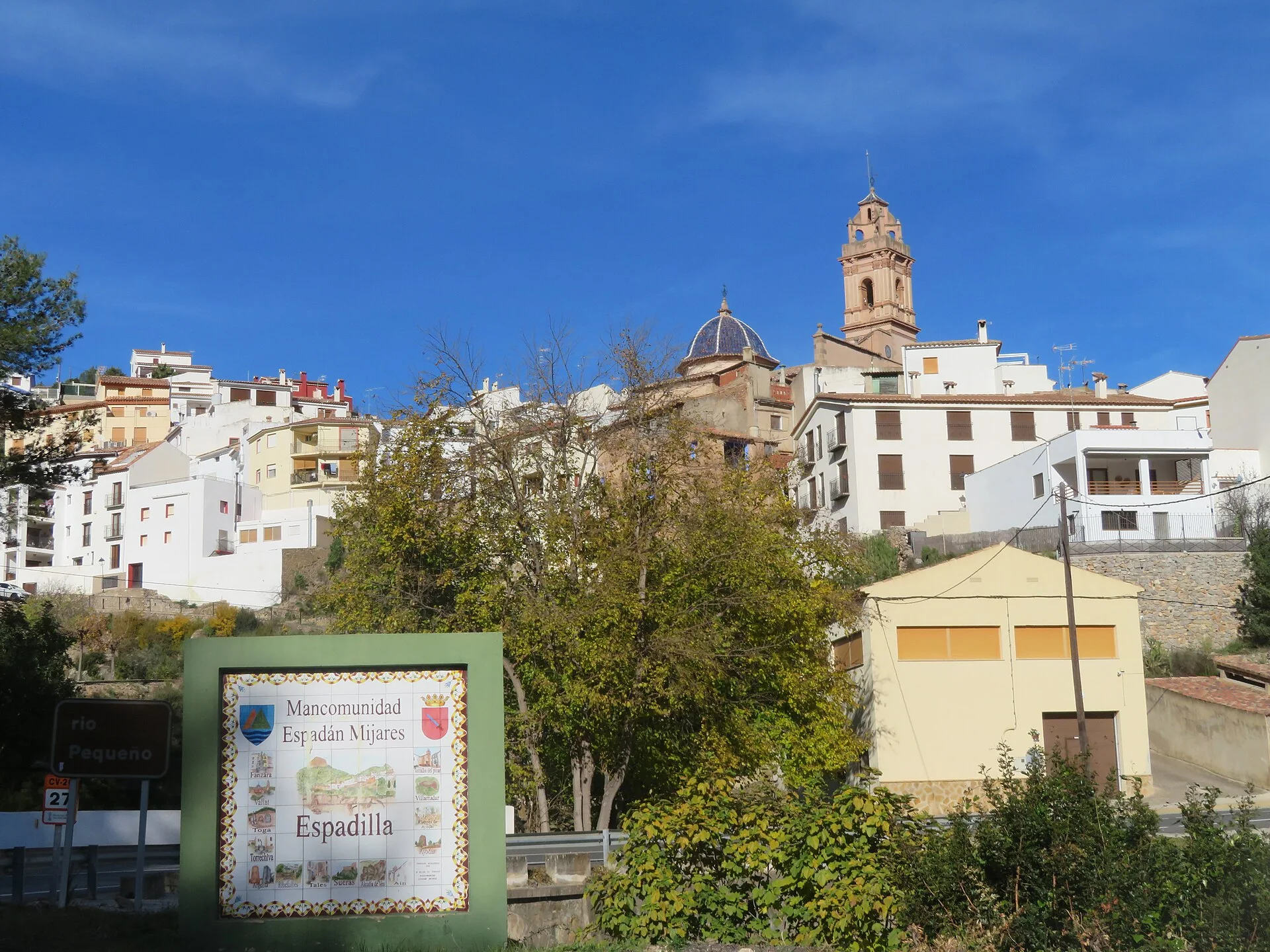
Espadilla combines a historic centre of Islamic origin, civic and religious heritage and a landscape dominated by Peña Saganta. The castle occupies a strategic position on the approach to the mountain, while the botanical garden and Mijares offer less demanding outdoor options. They are not equivalent stops: the centre suits a gentle walk, whereas the castle and summit require a mountain trail, ascent, time and preparation.
A settlement shaped like an alquería
Comunitat Valenciana Tourism attributes an Islamic origin to Espadilla’s traditional historic core. Its street pattern retains the compact logic of an alquería, and religious ceramic panels survive on several façades. The eighteenth-century parish church of San Juan Bautista stands above the settlement. The main photograph shows the town, church and a ceramic panel representing the Espadán-Mijares association; it is not a view of Peña Saganta.
Casa Abadía provides an unusual civic reference. Castellón Tourism dates it to the seventeenth century, says that it retains earlier Gothic forms and identifies it as the present municipal offices. The profile specifies office hours for visits, a condition to confirm before travelling. The urban route can continue to San Roque hermitage and the Calvary without assuming that every interior will be open.
Espadilla Castle
The castle is of Islamic origin. The provincial profile connects its later history with the Barony of Arenós, the ducal house of Gandia and the Duchy of Villahermosa. Part of the main tower and several stretches of wall survive, so it should be described as a ruin rather than an intact fortress. Castellón Tourism places it approximately 1.5 kilometres from the municipality in the direction of Ayódar, reached by a marked PR trail.
The short distance does not remove the difficulty. Access crosses mountain terrain, and the regional portal calls the activity moderate. Wear footwear with reliable grip, carry water and leave enough daylight for the return. Do not climb walls, move stones or leave the route. If the path is closed or damaged, view the site from its surroundings instead of improvising an approach.
Peña Saganta as a separate ascent
Peña Saganta reaches 723 metres according to the Provincial Council and dominates Espadilla’s backdrop. The climb offers wide views but is not an automatic continuation of the urban walk. Check the current trail, forecast, fire danger and ground conditions. Avoid the hottest hours in summer, and postpone the outing during rain, fog, strong wind or a wildfire alert.
The castle appears on the approach to the mountain, but reaching the ruins is not the same as reaching Saganta’s summit. Treating them as separate objectives lets visitors match the day to their experience and avoids describing the whole ascent as a short castle walk.
Botanical garden, springs and the Mijares
The botanical garden is a close-to-town option with areas of trees and shrubs, a recreation space and a pond. Verify its current condition and opening locally. The Melic, Sastre and Piqueta springs appear in the provincial inventory as excursion destinations. Their presence does not establish that the water is safe to drink without an up-to-date public-health notice.
The Provincial Council locates the Mijares natural pool in Partida de la Badina, about 500 metres from town, reached via the San Roque road. Its tourism profile calls it the most frequently used bathing area near the centre, but this does not replace daily notices. Check flow, water quality, access and prohibitions before bathing. Both the Mijares and the smaller Río Pequeño can react quickly to storms occurring away from the visit itself.
An itinerary matched to effort
- Explore the historic street pattern, San Juan Bautista church, Casa Abadía and the ceramic panels.
- Add San Roque hermitage, the Calvary and botanical garden if they are accessible.
- Then choose either the Mijares area or the approach to the castle; there is no need to combine both.
- Reserve Peña Saganta for an independent hike with suitable equipment, an official route and favourable conditions.
Local sources document bread rolls distributed for San Antonio and a December “day of the cakes”. These are specific traditions, not a menu available throughout the year. Confirm current businesses and opening hours before planning a meal or buying local produce.
Official sources and nearby guides
- Comunitat Valenciana Tourism: Espadilla
- Castellón Provincial Council: Casa Abadía
- Castellón Provincial Council: Espadilla Castle
- Castellón Provincial Council: Peña Saganta
- Castellón Provincial Council: Mijares River
Independent onward options include Fanzara, Cortes de Arenoso and Fuente la Reina, or the complete municipality guide finder.
The editing date records changes to the text, not a new check of opening hours, telephone numbers or accessibility. Specific verification dates, where recorded, appear beside the relevant information.