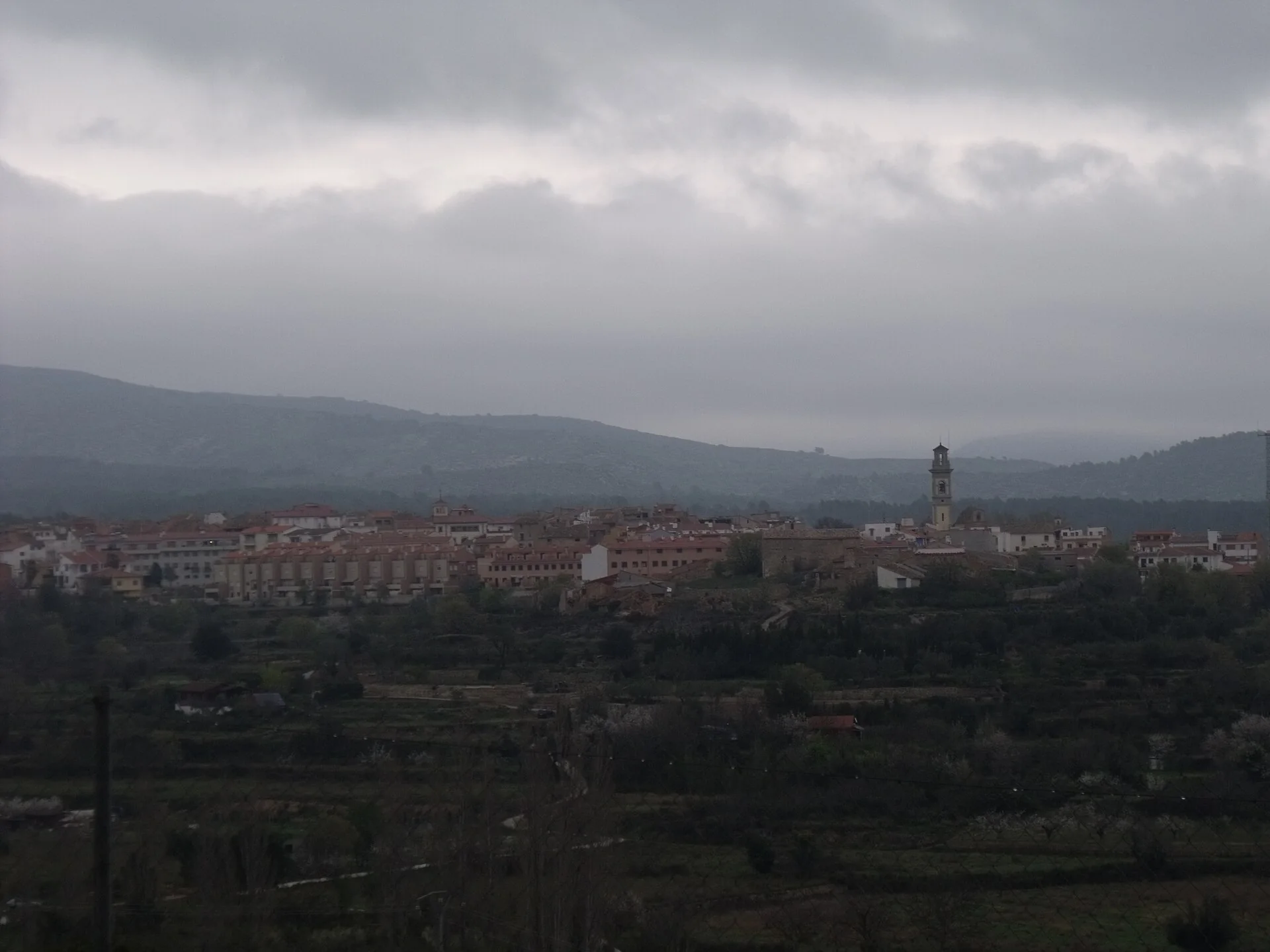
The photograph is a distant panorama of Caudiel beneath an overcast sky. San Juan Bautista’s bell tower rises on the right among roofs and cultivated plots; the convent cannot be identified precisely and Torre del Molino is outside the frame. The previous image label was therefore incorrect.
The bell tower marks the historic centre
San Juan Bautista parish church and the sanctuary of Virgen del Niño Perdido form one of the centre’s Baroque complexes. Only the tower profile can be recognised at this distance, not the devotional chamber, carved statue or interior decoration. The foreground plots also record the relationship between village and slope.
Torre del Molino stands outside the town
The tower, also called Torre de Aníbal because of a local tradition, is a cylindrical three-storey watchtower whose lowest floor served as a cistern. It is reached on an outlying walk and must not be confused with the photographed bell tower. Its connection with Hannibal is legend rather than a demonstrated historical identification.
The convent remains enclosed
The Discalced Carmelite convent opened in 1685 and is surrounded by a wall separating its cloisters, orchards and gardens. It is an enclosed community: provincial information states that the convent is not visitable and church access requires permission. Its Baroque interior cannot be inferred from this panorama.
This documentary edit corrects the photograph and separates parish church, outlying tower and convent. It does not verify worship, chamber, statue, plots, path, cistern, stability, permission, enclosure, hours, roads, signs or accessibility on site.
Related guides and local data
Sources consulted
- Turisme Comunitat Valenciana — Caudiel
- Turisme Comunitat Valenciana — Torre del Molino
- Turismo de Castellón — convento de las Carmelitas Descalzas
Documentary sources consulted on 1 September 2026. This is not an on-site inspection or a full check of opening hours, telephone numbers or accessibility. Any visiting conditions mentioned come from the linked sources.
The editing date records changes to the text, not a new check of opening hours, telephone numbers or accessibility. Specific verification dates, where recorded, appear beside the relevant information.