Gaibiel lies in Alto Palancia at the entrance to the Sierra de Espadán. Its heritage supports a specific visit rather than a generic village itinerary. The castle combines Iberian remains, an Almohad fortification, later additions and Civil War trenches. San Pedro has a documented artistic chronology, while the wash house, Calvary, hermitage and museum explain the settlement from street level. This guide separates public exteriors from sites whose opening or access must be checked.
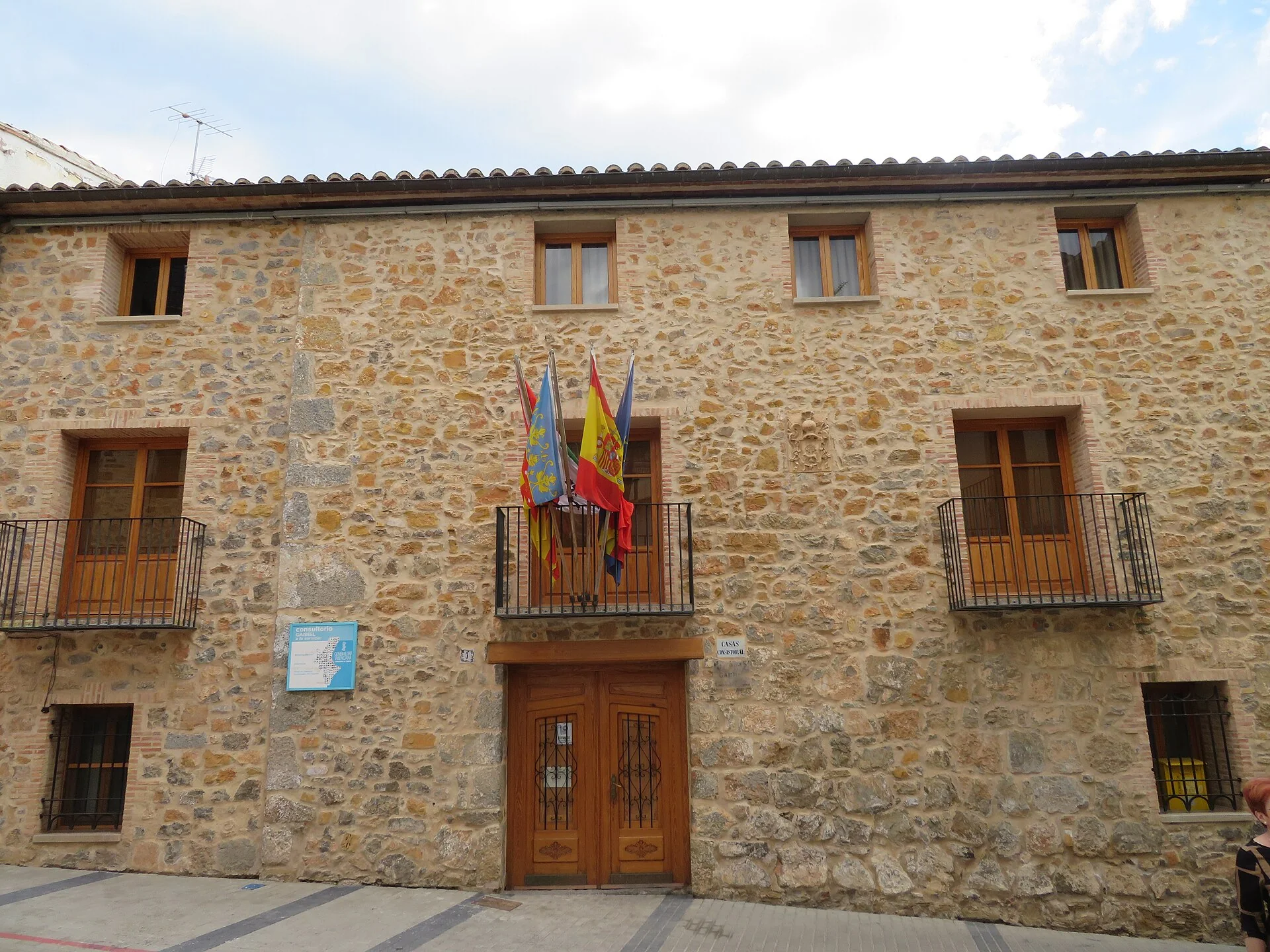
The photograph shows the former Casa de la Villa
The main image is not a view of the castle. Wikimedia identifies the masonry building as Gaibiel’s former Casa de la Villa and links it to the Valencian register of locally protected heritage. Balconies, a coat of arms, flags and municipal-service plaques can be seen on the façade. The castle stands on a rocky rise opposite the town.
Observe the building from public space without obstructing doors or services. Heritage protection does not make every room a visitor attraction. Any exhibition or interior activity needs current municipal confirmation.
A castle with several historical layers
Castellón Tourism dates the first structure to the Almohad period and records extensions in the fourteenth, sixteenth and nineteenth centuries. Walls from a small Iberian settlement and elements of Civil War trenches also survive. Calling the whole site a single medieval ruin would therefore hide much of its significance.
The castle occupies a rocky promontory with about 350 square metres of built area. Archaeological work identified a kitchen with a surviving Moorish oven, a large chapel, an internal ice store, two cisterns and a courtyard. Nearby are the remains of a circular watchtower; the provincial record describes masonry walls approximately 1.10 metres thick.
Use only the permitted approach and follow signs. Do not climb historic fabric, enter closed voids or remove fragments. Cisterns, slopes and trenches remain hazards even close to the village. Rain, high heat or insufficient daylight for the return are good reasons to postpone the outdoor section.
San Pedro Apóstol: dated architecture
Work on San Pedro Apóstol parish church began in 1792 during the episcopate of Lorenzo Gómez de Haedo. The academic-Baroque building has a basilican plan with three aisles, four bays and a transept. Tuscan pilasters frame the lintelled entrance and an upper niche; its brick bell tower has four stages.
Murals painted between 1795 and 1797 survive inside, together with a seventeenth-century silver chalice. These are documented features, but worship determines access. Visitors should not assume that the chalice is permanently displayed, and services require silence and respect for photography restrictions.
San Blas, Trinidad wash house and Calvary
The regional tourism portal describes San Blas hermitage as a small sixteenth-century Gothic building. It also names the wash house on Calle Trinidad, Arc de la Penya and the Rocha-Pilares aqueduct connecting the water landscape of Gaibiel and Jérica. Springs, pools, weirs and farmsteads record long human use of water.
A heritage fountain is not evidence that water is currently safe to drink. The Calvary follows a zigzag ascent on the hillside and provides a strong view of the relationship between village and relief. It is not the same route as the castle and should not be presented as universally accessible. Check gradient, surface, heat and wildfire restrictions.
The museum brings excavation finds into context
Gaibiel Ethnological Museum stands beside the town hall in Plaza Mayor. The Provincial Council says material recovered during archaeological work at the castle became the basis of its municipal collection. The building also provides space for temporary displays, screenings and seminars.
The museum is the place to study objects that must remain untouched at the site. Its official profile does not publish a regular timetable, so opening and booking need confirmation before travel. Being beside the town hall does not mean continuous access.
A realistic order
- Begin at the former Casa de la Villa and Plaza Mayor.
- View San Pedro and enter only when worship and opening permit.
- Confirm the museum before allocating time to an interior visit.
- Choose the Trinidad wash house, Arc de la Penya or San Blas for the urban section rather than forcing every point into one walk.
- Treat the castle as a separate outing with suitable footwear and enough daylight.
The provincial profile places Gaibiel at 517 metres above sea level and names 713-metre La Carrasca as its highest point. Those figures describe terrain; they are not a marked walking route. Actual duration depends on access and opening, so a fixed half-day or full-day promise would be misleading.
Official sources and nearby guides
- Comunitat Valenciana Tourism: Gaibiel
- Castellón Tourism: municipal profile
- Provincial Council: castle ruins
- Provincial Council: San Pedro Apóstol
- Provincial Council: Gaibiel museum
For a separate onward visit, see Jérica, Vall de Almonacid or Geldo, or return to the municipality finder.
The editing date records changes to the text, not a new check of opening hours, telephone numbers or accessibility. Specific verification dates, where recorded, appear beside the relevant information.