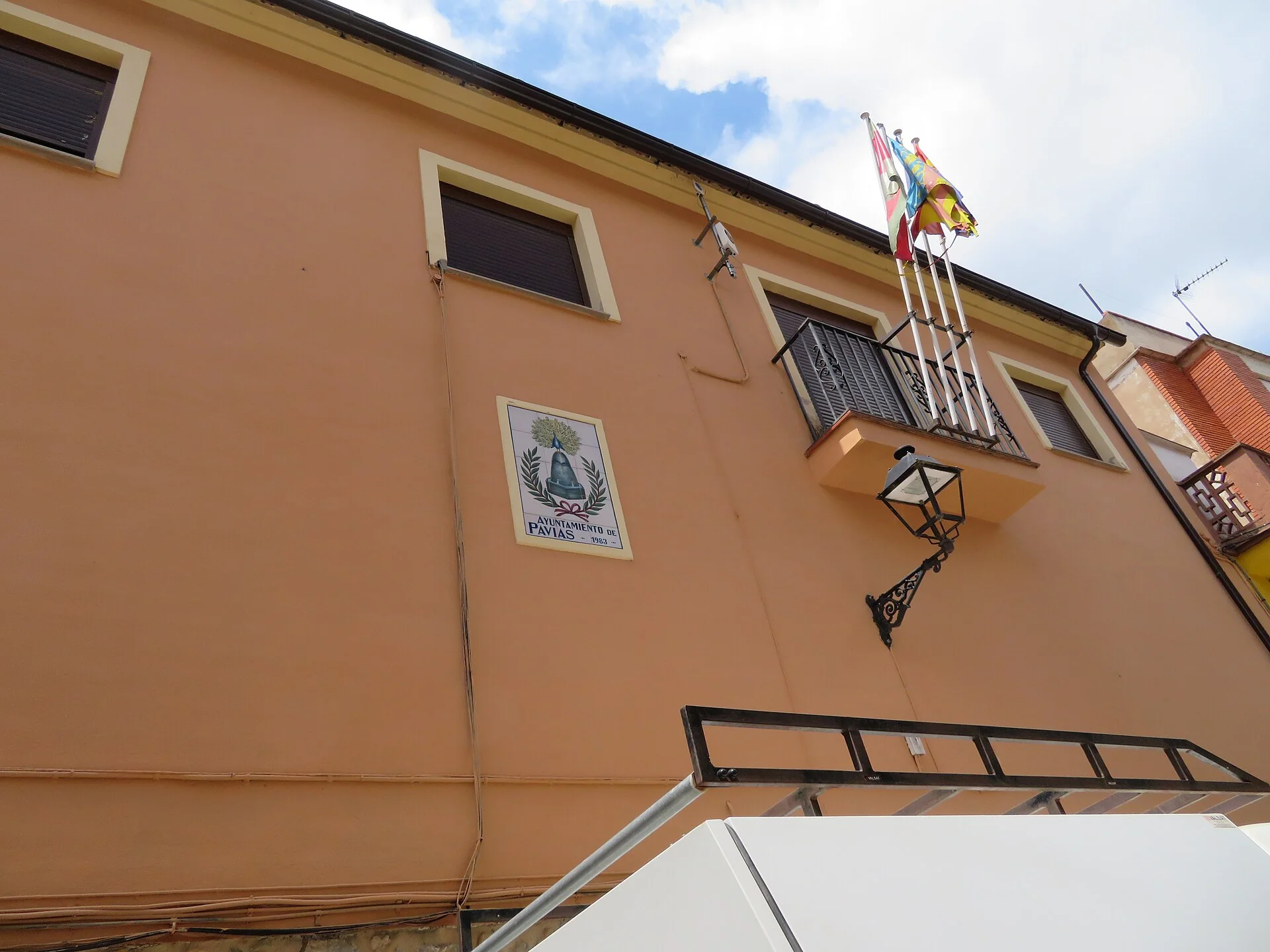
The photograph shows Pavías town hall’s façade. Its balcony, flags, a ceramic crest dated 1983 and part of the entrance can be seen. Neither the Ethnological Museum nor the church can be identified here.
The museum requires a separate stop
The council map lists the Ethnological Museum among the village’s places of interest. Its role is to preserve objects and memories of local life, but the photographed façade belongs to the town hall. Opening and displayed contents should be checked before visiting.
Santa Catalina combines several building phases
The earliest documentary reference to the church dates from the 16th century. Extensions concluded in 1736 and again in the 19th century, explaining its Baroque and Neoclassical mixture. Murals hidden beneath paint layers were uncovered during cleaning in 1995.
Oven, mill and washhouses complete the everyday story
The provincial inventory also includes a Moorish oven, former mill, washhouses and San Isidro hermitage. These relate to work, water and community life, offering more value than a generic description of the centre and remaining separate from the visible council building.
This documentary edit corrects the photograph and separates town hall, museum, church and everyday heritage. It does not verify offices, museum, collections, worship, murals, oven, mill, washhouses, hours, parking or accessibility on site.
Related guides and local data
Sources consulted
- Ayuntamiento de Pavías — plano y lugares de interés
- Turismo de Castellón — iglesia de Santa Catalina
- Turismo de Castellón — patrimonio de Pavías
Documentary sources consulted on 1 September 2026. This is not an on-site inspection or a full check of opening hours, telephone numbers or accessibility. Any visiting conditions mentioned come from the linked sources.
The editing date records changes to the text, not a new check of opening hours, telephone numbers or accessibility. Specific verification dates, where recorded, appear beside the relevant information.