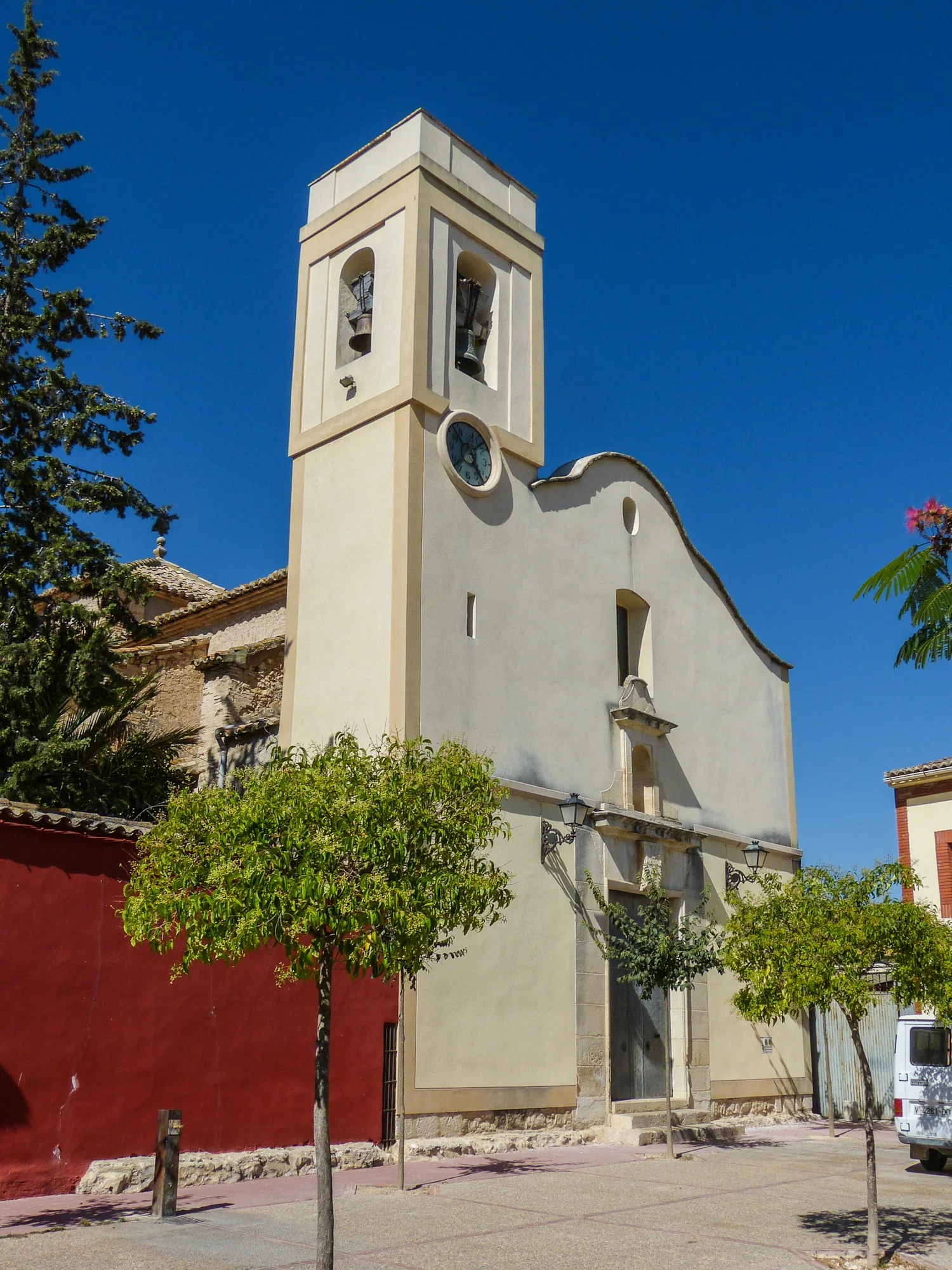
Sempere is a very small Vall d’Albaida municipality beside the Albaida landscape and Bellús reservoir. Its scale does not justify a template of unnamed mountains and springs. Sant Pere church, the trapezoidal square, eighteenth-century houses, the Nunyes Palace remnant and Four River Villages route provide specific value. The photograph shows the church and its clocked bell tower.
Sant Pere parish church
The eighteenth-century building is Neoclassical. Its five-bay nave has a barrel vault resting on pilasters that act as buttresses. Paintings in the cap over the crossing refer to Saint Peter’s Basilica in Rome and use trompe-l’œil, creating apparent depth through perspective.
The façade has a lintelled door and a two-stage bell tower visible in the photograph. The tourism source says the parish has a close relationship with the Vatican but does not define its legal or documentary scope. This guide preserves the institutional statement as context without inventing privileges. Interior access depends on worship and actual opening.
Plaça de Sant Pere and eighteenth-century houses
The trapezoidal Plaça de Sant Pere organises a settlement with eighteenth-century civil houses. Interest lies in the ensemble rather than treating every home as a monument. Walk streets and view façades from public space, respecting doors, residents and quiet.
El Casal cellar and courtyard
València Turisme mentions an eighteenth-century rural accommodation’s cellar and courtyard and the legend of three unmarried sisters. Sources use variants including “El Casal” and “El Caserón”, so confirm the current business name and any visit. A local legend is not a verified biography, and private accommodation is not an open museum.
Former Nunyes Palace doorway
The provincial river-villages route highlights the former palace doorway. The wording matters: this is a remnant or façade, not an intact palace with accessible rooms. The Nunyes family was linked to the lordship of Sant Pere. Further interpretation needs a source and any entry needs permission.
Four River Villages route
The route links Alfarrasí, Benissuera, Sempere and Guadasséquies through a level landscape of irrigation channel, vines, olives and market gardens. It incorporates Sempere’s church and palace remnant into a shared reading of the River Albaida. “Level” does not certify a traffic-free, paved or step-free route: check crossings, surface and continuity.
Never enter canals, riverbeds or crops. Avoid flood-prone ground and mud after rain; carry water and shorten the route in heat. Treat Bellús reservoir as a separately planned extension using permitted viewpoints, without assigning features in other municipalities to Sempere.
Net making and local life
The provincial profile documents the traditional making of nets and mesh among older women. This is living intangible heritage, not a scheduled tourist performance. Never photograph or request a demonstration without consent. It provides local value beyond a list of architecture.
Reading a very small municipality accurately
Sempere’s value is the relationship between a compact civic space, one well-defined church, a surviving palace doorway and the wider river landscape. It should not be enlarged on paper with anonymous fountains, mountain trails or monuments borrowed from Bellús and neighbouring villages. Check opening times before travelling and assume neither the church nor rural accommodation is open unless confirmed. The square and façades can be read from public space without disrupting residents or presenting private doorways as visitor facilities. On the inter-municipal route, use the named sequence Alfarrasí–Benissuera–Sempere–Guadasséquies to keep locations clear, and record where one municipal boundary gives way to the next. That precision is more useful than an inflated attraction list.
Realistic plans
- One hour: church, Plaça de Sant Pere, civil houses and palace doorway from public space.
- Two or three hours: add a clearly mapped section of the river route.
- Half day: combine with Benissuera or Guadasséquies while keeping each municipality’s monuments separate.
Festivities and food
Paella and rice in broth with turnips are documented local dishes. Sant Blai festivities traditionally occur around 3 February with a bonfire, parades, mass, procession and blessed bread rolls. Confirm the annual programme and respect the residential character of the village.
Related guides and local data
Official sources and verification
The editing date records changes to the text, not a new check of opening hours, telephone numbers or accessibility. Specific verification dates, where recorded, appear beside the relevant information.