La Yesa stands in Los Serranos at 1,008 metres above sea level. Its heritage supports a distinctive visit: a church completed in 1622 and rebuilt after a fire, hermitages in different states of survival, a wash house still connected with local use, carved-stone streets and an Iberian settlement reached across mountain terrain. Snow, heat and remaining daylight matter more than a generic half-day timetable.
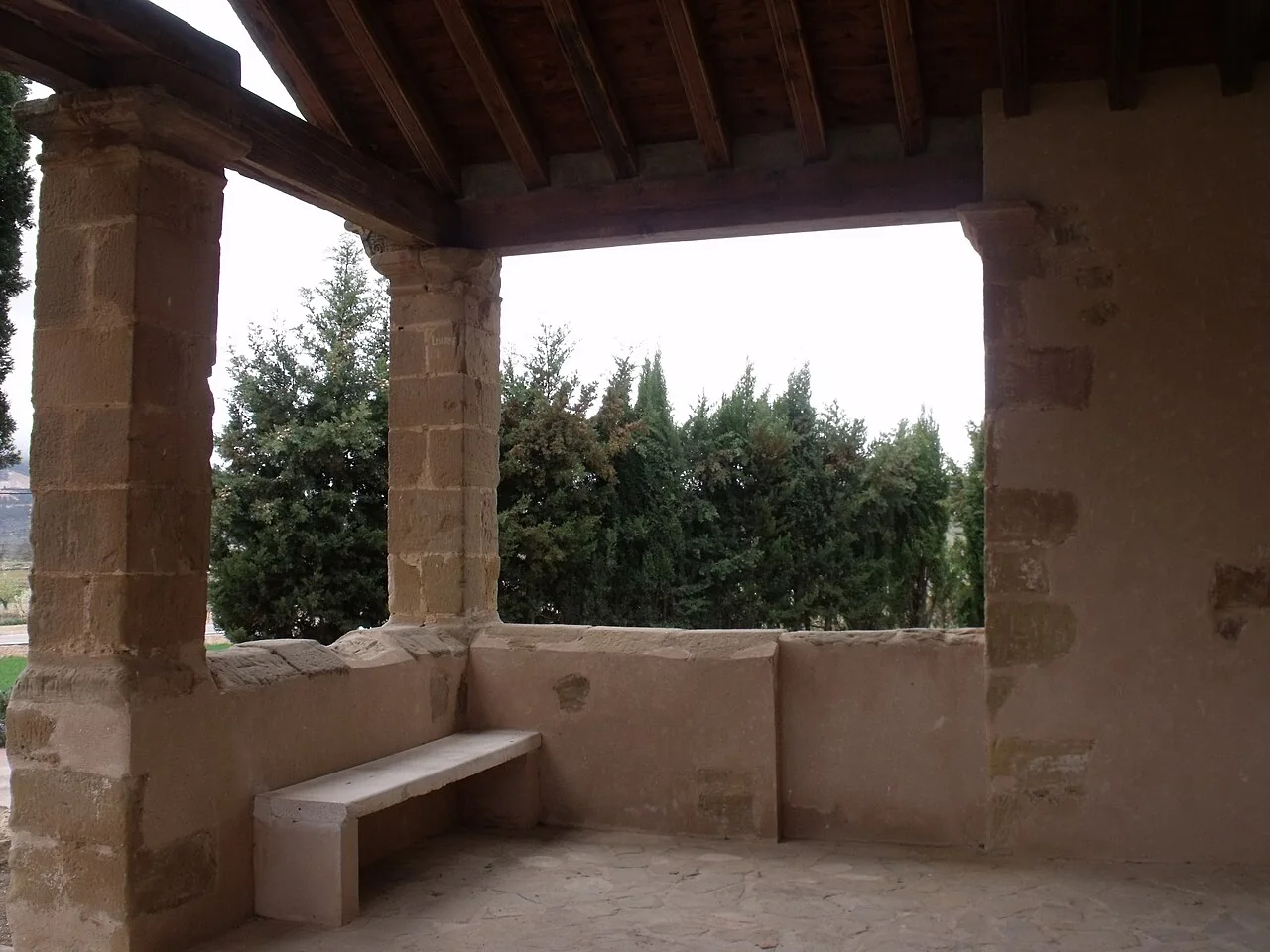
The image shows San Roque’s porch
The main photograph is not a panorama. Wikimedia describes it as an entrance and categorises it with San Roque hermitage and Valencian church porches. Stone pillars, a timber roof, a bench and the sheltered area before the door are visible.
The porch can be observed without assuming that the interior is open. Hermitages are places of worship and heritage rather than continuously staffed attractions. Respect services, closed doors and the surrounding ground.
Nuestra Señora de los Ángeles: 1622, fire and rebuilding
València Turisme dates the parish church to the seventeenth century and says it was completed in 1622 following a Renaissance model. Fire damaged it in 1840 during the Carlist Wars, and reconstruction lasted until 1852. It should not therefore be presented as an untouched building from one phase.
The bell tower is set into the left of the façade and uses masonry with dressed-stone corners. A moulding separates its two stages. The lower stage contains a slit opening and clock; a round-headed opening for the bells occupies the upper stage. A balustraded terrace with stone balls forms the top. Casa Abad adjoins the church.
The exterior belongs in the urban walk, while interior access depends on worship and current opening. Official profiles do not identify which works are permanently displayed, so no particular interior view should be promised.
Why official sources count the hermitages differently
The regional portal proposes a walk to San Juan Bautista, San Roque and the ruins of San Sebastián. The provincial profile lists four dedications: those three plus the ruined Nuestra Señora de Belén at Casa de las Hoyas. One page summarises a visitor walk while the other provides a broader inventory.
A ruin is not an open visitor building. Never enter unstable structures, move stones or cross barriers. Corral de las Hoyas, an abandoned hamlet encountered on the way to El Castellar, should be viewed from the permitted route without entering unsafe or private buildings.
Fountain, wash house and traditional work
The fountain and public wash house stand among cultivated plots. The Provincial Council says local residents still use the wash house, so basins must be left clear. Heritage status does not make fountain water safe to drink without a current public-health notice.
Official sources also name mills, pools, corrals, former tile works and oil mills. The tile works was converted into a hostel according to the provincial profile. They help explain labour and daily life, but not every site has public access and fields should not be crossed to link them.
El Castellar and its wheel ruts
El Castellar is an Iberian settlement. The regional portal identifies an old road with cart-wheel ruts, defensive walls, a tower and an interpretation panel; the approach passes Corral de las Hoyas. Do not walk along archaeological walls, picnic against them or remove fragments.
The route needs mountain preparation. At 1,008 metres, snow and ice are possible in winter, while summer sections may lack shade. Obtain a current route, check wildfire alerts, carry water, suitable footwear and battery power, and leave time to return in daylight. A panel at the site does not make every approach easy.
Monumental trees and separate routes
Named trees include Carrasca Tumbada, Carrasca del Pozuelo, Pino Sombrero, the ancient junipers and Almeza. Stay on paths, never climb them and avoid compacting soil around roots.
The regional portal names the Ceja and Sancho, Trades and Alto Negro routes. Their distance, difficulty and phone coverage cannot be assumed to match. Choose one, use the latest official line and turn back when weather or surface conditions are unsuitable.
Documented food and a realistic sequence
The provincial profile lists village stew with rice, beans and turnips; preserved sausages kept in oil; bread, pasties, bacon or sardine flatbreads, coquitos, aniseed rolls, sugar cakes with walnuts and raisins, and local honey. Availability depends on bakers, producers, season and booking.
- Begin at Nuestra Señora de los Ángeles and the streets with carved arches, emblems and shields.
- Continue to the fountain and wash house without interrupting local use.
- Choose San Roque and San Juan for the nearby walk and keep clear of ruins.
- Reserve El Castellar or one outdoor route for a separately prepared outing.
Official sources and nearby guides
For a separate onward visit, see Alpuente, Titaguas or Aras de los Olmos, or return to the municipality finder. Calculate real road distances.
The editing date records changes to the text, not a new check of opening hours, telephone numbers or accessibility. Specific verification dates, where recorded, appear beside the relevant information.