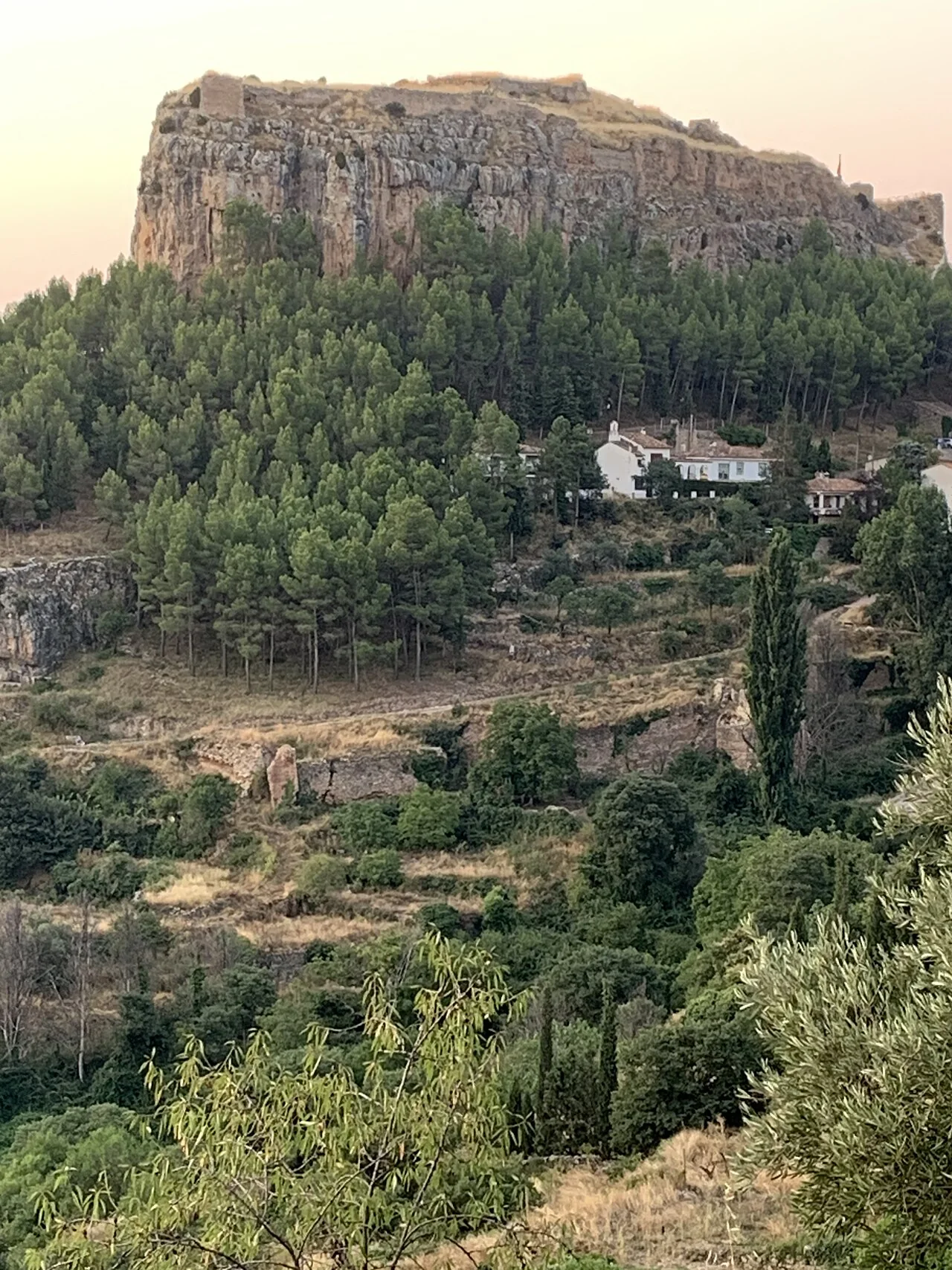
The photograph shows a rocky plateau crowned by the remains of Alpuente Castle and walls, with houses and trees below. It is a panorama of the defensive site, not a detail of the town hall or museum. The rock explains both the silhouette and the difference in level between fortress and town.
The castle dominates a former frontier town
Alpuente was an independent taifa and later a royal town on the frontier between Aragon and Castile. A route through the historic ensemble connects walls, the medieval street pattern and Torre de Alhama, the former town gate with rooms, arrow slits and dungeons. Seeing the fortress from afar does not establish the condition of each access or structure.
The museums occupy different historic buildings
The Ethnology Museum occupies the fourteenth-century public oven and explains trades, bread making, agriculture and communal organisation. Santa Bárbara Palaeontology Museum, MUPAL, uses another building to display fossils from local excavations and the scientific work used to interpret them. Current visiting arrangements and opening need checking for both.
The footprints lie outside the town centre
Palaeontological sites are distributed across the municipality. Walkways and panels at Corcolilla interpret Upper Jurassic footprints, while Cañada París preserves another kind of trackway. Museum and site complement one another, but are not in the same place and do not permit visitors to leave prepared routes.
This documentary review identifies the panorama and separates fortress, town, museums and sites. It does not verify opening, guided visits, gradients, surfaces, railings, works, accessibility, walkway condition or current protection of fossils and ruins on site.
Related guides and local data
Sources consulted
- Turisme Comunitat Valenciana — Alpuente
- Turisme Comunitat Valenciana — Ruta de la Taifa de Alpuente
- Turisme Comunitat Valenciana — MUPAL
- Turisme Comunitat Valenciana — yacimiento de Corcolilla
Documentary sources consulted on 31 August 2026. This is not an on-site inspection or a full check of opening hours, telephone numbers or accessibility. Any visiting conditions mentioned come from the linked sources.
The editing date records changes to the text, not a new check of opening hours, telephone numbers or accessibility. Specific verification dates, where recorded, appear beside the relevant information.