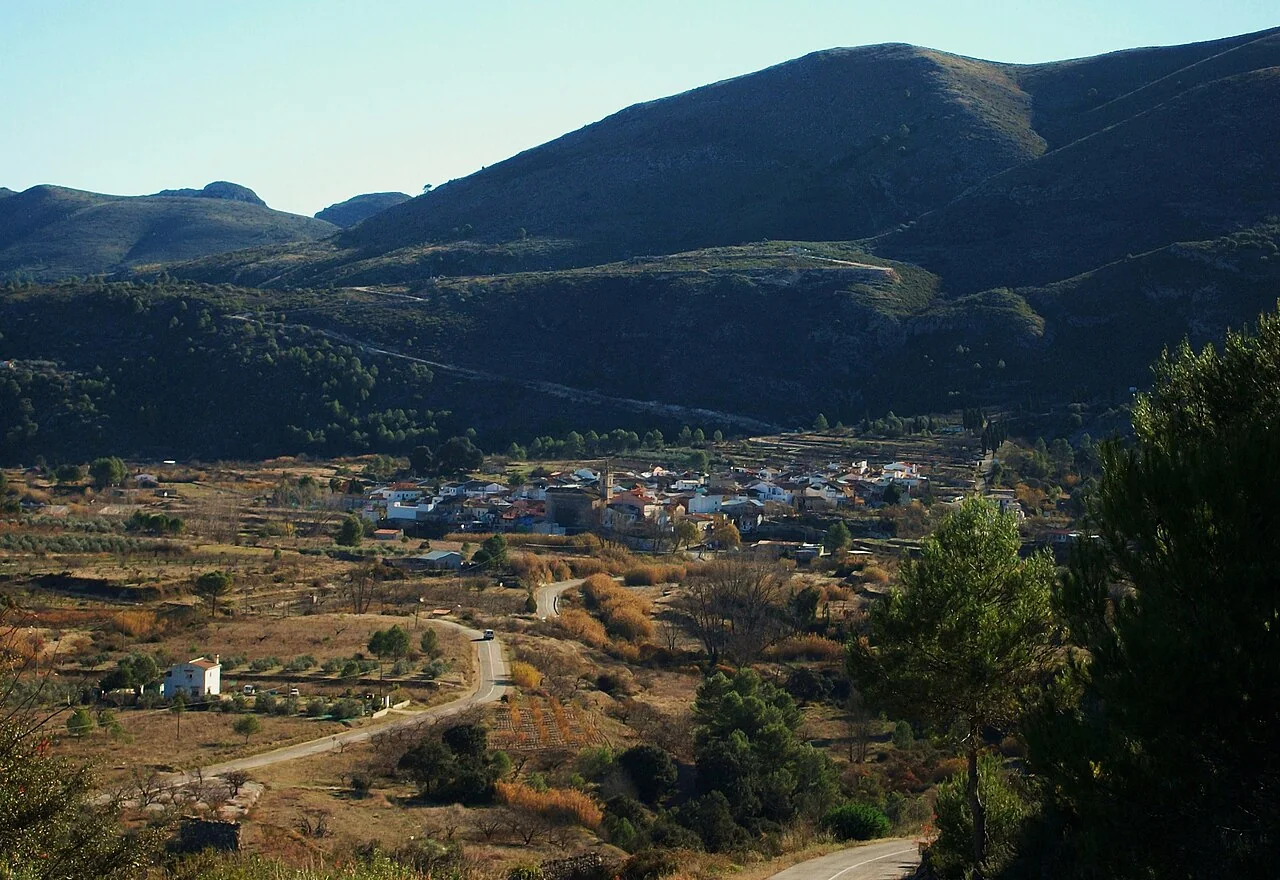
Vall de Ebo occupies an inland Marina Alta valley surrounded by limestone ridges, ravines and caves. Its best-known attraction, Cova del Rull, is an adapted guided visit; it must not be confused with the natural shafts or the technical Barranc de l’Infern route. The village centre, San Miguel Church and the spring-and-washhouse system add history and everyday heritage to the day.
What to see in Vall de Ebo
Cova del Rull
José Vicente Mengual, known as Tío Rull, discovered the cave in 1919. It first opened to visitors in the 1960s and reopened as an adapted, municipally owned attraction in 1995. The route reveals stalactites, stalagmites, columns and other formations created as water acted slowly on the limestone.
Tourist Info Pego i les Valls describes a 220-metre guided circuit with 19 metres of height difference and an approximate duration of 45 minutes. Although promoted as suitable for all ages, it is an underground space with steps, humidity and its own temperature. Seasonal opening and an annual closure apply, so confirm the time slot, last admission, payment method and any mobility requirements before travelling.
San Miguel Church and the historic centre
The Vall d’Ebo parish was created in 1535, separating from Vall de Gallinera, and its church was established on the site of the former mosque. The municipal planning catalogue dates a first foundation of the building to 1576 and attributes the façade and bell tower to the second half of the nineteenth century. It remains a place of worship, not a museum with permanent opening.
Font de la Serra, washhouse and El Remolí
A small bridge from the village leads towards Font de la Serra. Three spouts take water from the trough to an eighteenth-century washhouse; a path behind it reaches the ruins of a watermill from the same period, known as El Remolí. This compact sequence shows how the spring supported supply, washing, irrigation and settlement without requiring a long hike.
Rock art and the valley’s memory
The municipal area preserves prehistoric engravings and paintings included since 1998 in UNESCO’s Rock Art of the Mediterranean Basin on the Iberian Peninsula. Cova Fosca and other shelters are sensitive archaeological heritage: this guide does not publish coordinates or encourage unsupervised searches. Learn about them through municipal interpretation, expert guidance or officially organised visits.
Font d’en Gili and Barranc de l’Infern
A dirt track outside the village leads to Font d’en Gili, a municipal spring and picnic area. The Town Council presents it as a natural gateway to Barranc de l’Infern and describes an approximately two-hour approach walk into scenery of vertical walls and shaded corners.
That walk is not the full ravine crossing. The complete traverse includes technical passages and canyoning sectors that require skills, equipment, current information and, where appropriate, a professional guide. Els Avencs are not family viewpoints either: they are deep natural shafts, and approaching their edges presents a severe risk, particularly with children. Reconsider every outing after rain, during extreme heat or under a wildfire alert.
A one-day itinerary
- Book Cova del Rull in advance and organise the rest of the day around the confirmed tour.
- Walk through the centre, view San Miguel and continue to Font de la Serra, the washhouse and El Remolí.
- Use Font d’en Gili as a rest stop or the beginning of an easy walk only when the track and weather are suitable.
- Keep canyoning, caving and long mountain routes as separate technical activities.
Local food and nearby places
The Town Council associates local cooking with almonds, olives and oil, wheat olleta, grilled meat, puchero, rice with beans and cardoons, and rice with lentils. Perelló, a local pear variety, has its own seasonal fair. The route can continue to Vall de Gallinera, Vall de Laguar or El Verger, allowing for actual mountain-road travel time.
Frequently asked questions
Is Cova del Rull a self-guided visit?
No. It is a guided attraction with seasonal opening. Confirm the tour and conditions before driving into the valley.
Is the walk from Font d’en Gili the full Barranc de l’Infern?
No. A simpler approach walk is available, but the ravine traverse is a technical activity that should never be improvised.
Where can visitors see water heritage without a difficult hike?
Font de la Serra, its trough, the eighteenth-century washhouse and El Remolí ruins form a compact group close to the village.
Official sources and planning
- Vall d’Ebo Town Council — Cova del Rull
- Tourist Info Pego i les Valls — practical Cova del Rull information
- Vall d’Ebo Town Council — history and rock art
- Vall d’Ebo Town Council — Font de la Serra
- Vall d’Ebo Town Council — Font d’en Gili
- Vall d’Ebo Town Council — Barranc de l’Infern
- Comunitat Valenciana Tourism — Vall de Ebo
- Municipality guide finder
The editing date records changes to the text, not a new check of opening hours, telephone numbers or accessibility. Specific verification dates, where recorded, appear beside the relevant information.