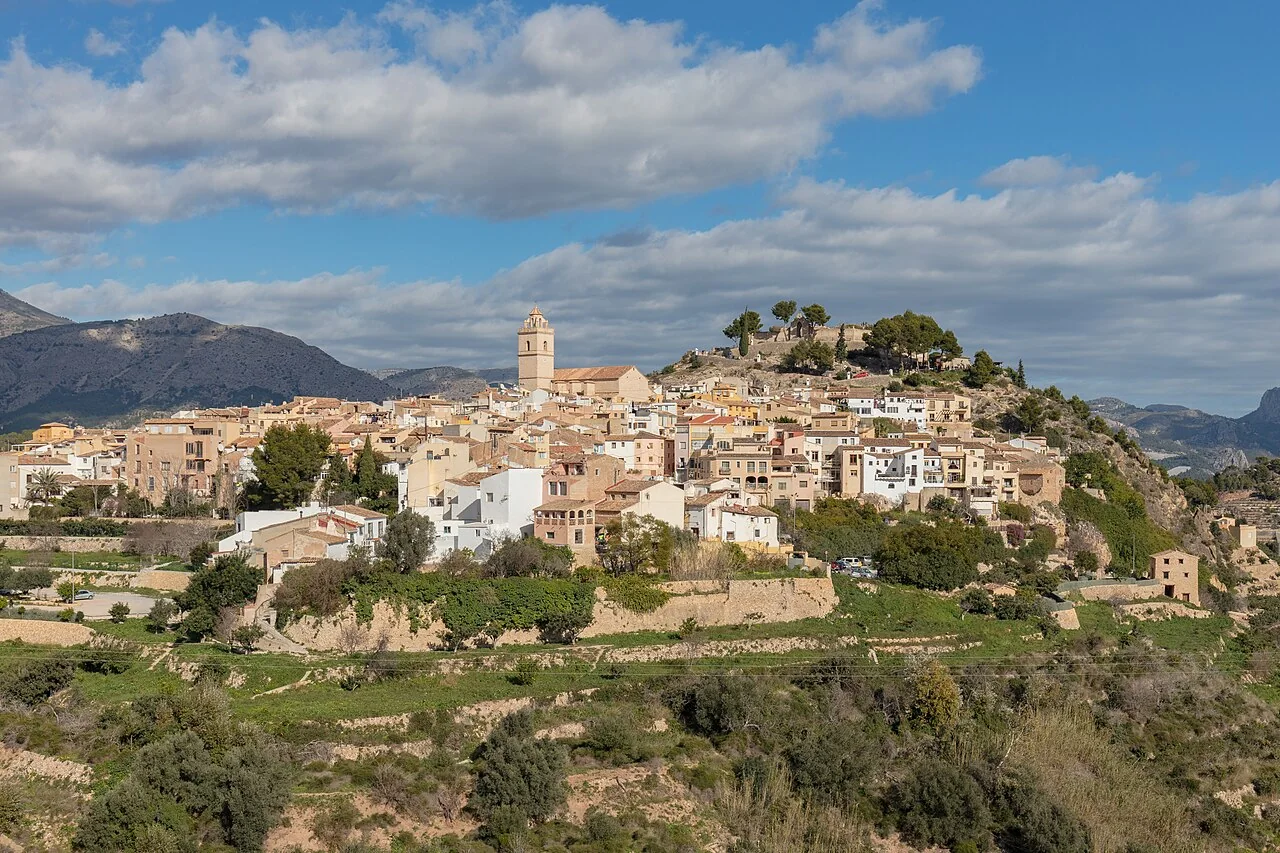
Polop wraps around a fortified hill and is best explored from bottom to top. Plaça dels Xorros introduces its water heritage, steep streets lead to the castle and old cemetery, and the Gabriel Miró House Museum adds a literary perspective. Ponoig belongs to a different scale and should not be folded into this urban walk.
Plaça dels Xorros and the 221 spouts
The present fountain took shape in a 1947 remodelling with 221 water outlets. Its supply comes from the Terrer and Garrofer springs, while ceramic panels make the square more than a photograph stop. It is a useful place to understand water’s role in the town before beginning the climb.
Gabriel Miró House Museum
Beside the square, the museum occupies an architecturally significant villa and holds a collection connected with writer Gabriel Miró and his relationship with Polop. It also serves as the tourist office. Municipal information requires advance booking for visits; hours and contacts can change, so check the official listing before travelling.
Climb to the castle and old cemetery
The castle is an Islamic fortress built in the early twelfth century. Surviving features include stretches of a double defensive wall, a cistern, a square masonry tower and rectangular rooms. Material was reused in nearby construction, and the enclosure later became the old cemetery, creating the appearance Gabriel Miró called an “orchard of crosses”.
The approach rises from the town. Expect gradients and uneven ground, respect the site’s funerary character and do not imagine a complete furnished castle. Its value lies in the surviving structures, defensive position and view across Marina Baixa. Check for works or access restrictions before climbing.
How to read the double enclosure
The surviving walls do not all belong to one moment. The outer and inner circuits reflect successive defensive needs, while the cistern explains how the hilltop could store water. Rectangular rooms and the masonry tower are archaeological remains rather than reconstructed attractions. Keeping those distinctions in mind prevents the old cemetery, later paths and medieval fabric from being described as one unchanged castle.
A coherent town route
- Begin at Plaça dels Xorros and read the fountain’s ceramic panels.
- Enter the Gabriel Miró museum only after confirming access or booking.
- Climb through the traditional centre without using informal shortcuts.
- Explore the enclosure respectfully and return through the old streets.
Ponoig: a separate outing
Ponoig reaches 1,181 metres and has walking trails, rock walls and a via ferrata. The ferrata is a technical activity for people with suitable experience and equipment, not a spontaneous extension of the castle walk. Trails on Ponoig and in Gulabdar ravine also require a defined route, water, suitable weather and an honest fitness assessment.
Food and nearby options
Foods associated with Polop include pilotes de dacsa and olleta de blat; verify current menus. Relleu focuses on a reservoir and ravines, Sella on water heritage and Aitana, and Tàrbena on Majorcan heritage.
Official sources and verification
The editing date records changes to the text, not a new check of opening hours, telephone numbers or accessibility. Specific verification dates, where recorded, appear beside the relevant information.