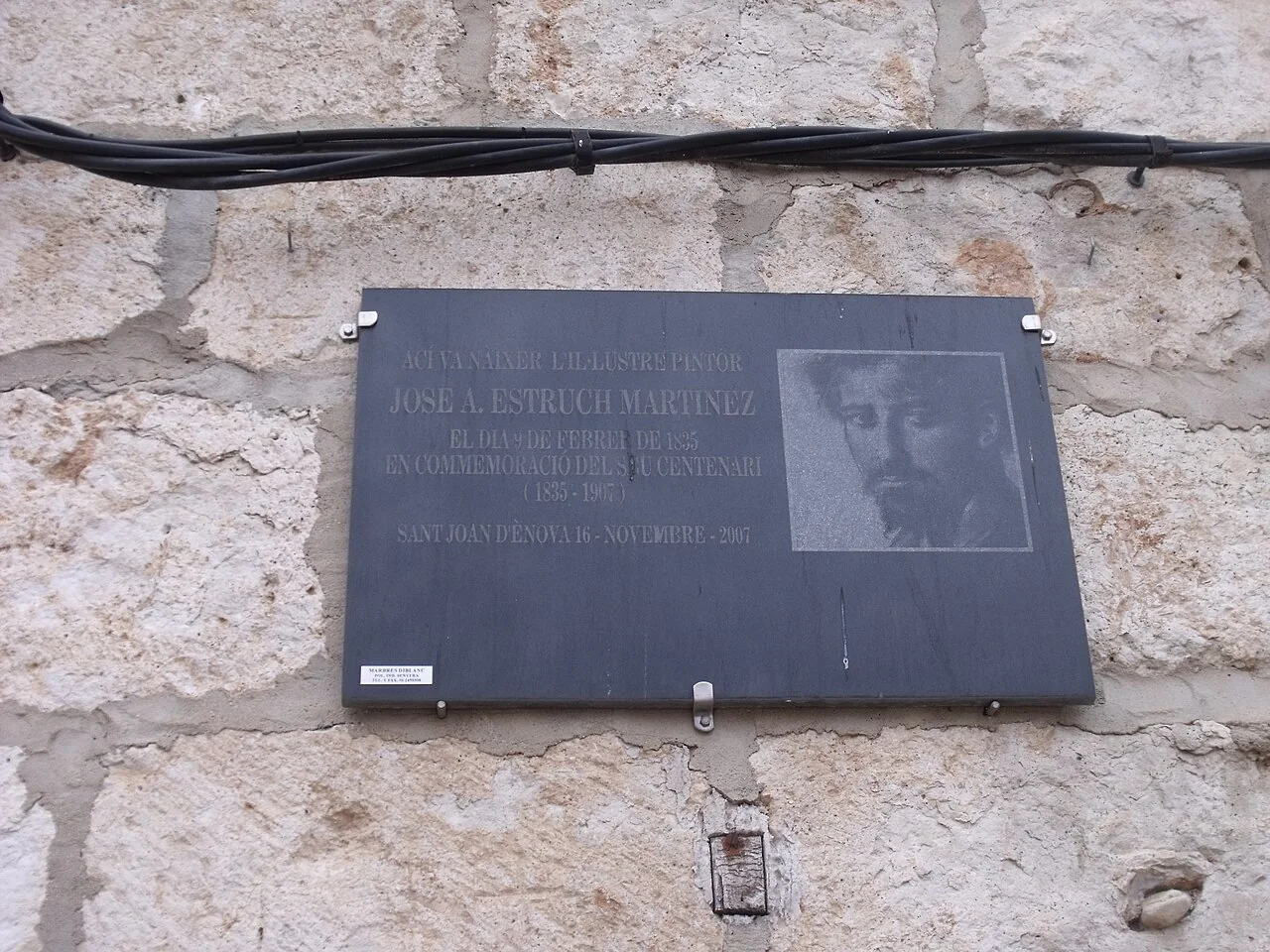
Sant Joanet —historically also called San Juan de Énova or Sant Joan de l’Énova— is a small Ribera Alta municipality. Its interest does not depend on an invented collection of attractions. Three references give the visit real substance: the protected tower associated with the former palace of the Marquis of Bèlgida, Sant Joan Baptista church and the memory of painter José A. Estruch. The photograph shows the plaque commemorating the artist’s birthplace; it is not a view of the historic centre.
What to see in Sant Joanet
The fortified tower
València Turisme lists a fortified tower among the principal local heritage elements. The inventory published by the Valencian government in the 2023 official gazette records the Sant Joanet “Torreón” as a monument, while a 2024 resolution awarded funding for its master conservation plan. These records establish its importance but also require restraint: protected status does not automatically mean that an interior is open to visitors. View it from public space, never enter a closed enclosure and do not lean on old walls.
Remains of the Marquis of Bèlgida’s palace
The provincial tourism profile also identifies remains of the former palace of the Marquis of Bèlgida. Tower and palace should be read as related parts of a seigneurial past, not advertised as a complete castle or a museum with regular hours. A street walk can reveal surviving volumes and materials, but any interior access must be confirmed directly with the council.
Sant Joan Baptista parish church
Sant Joan Baptista is the village’s religious landmark. Its façade and bell tower belong naturally on the urban walk; entry depends on worship and occasional opening. Do not promise a particular art collection without a public inventory or interrupt a service. The dedication also connects the building with the patronal celebrations on 24 June.
The plaque and painter José A. Estruch
The featured image depicts a plaque mounted on a façade. Its inscription honours painter José A. Estruch Martínez and marks the 1835–1907 centenary. Research held by the Polytechnic University of Valencia documents that José Antonio Estruch was born in Sant Joan de l’Énova on 9 February 1835, studied under Francisco Martínez and at the San Carlos Academy, and worked especially in portraiture and religious painting. The plaque is viewed from the street: it neither turns the home into a museum nor grants permission to enter.
A River Albaida landscape, not the Júcar
The previous template incorrectly described water heritage “connected with the Júcar”. The provincial source places Sant Joanet on sediment deposited by the River Albaida, with farmland on its right bank. It describes completely flat relief and an exceptionally high proportion of cultivated land, especially orange groves. The landscape should therefore be understood through irrigation channels, plots and farm access roads linked to the Albaida, without assigning the municipality a Júcar riverbank or undocumented signposted routes.
Farm lanes remain working spaces. Respect signs, leave machinery room to pass, stay outside private plots and take particular care at junctions without a pavement. Mud or flooding may affect low points after heavy rain. Irrigation channels are not swimming places and their water must not be assumed drinkable.
A one-hour village walk
- Start by the church. Observe the façade and connect it with the Sant Joan Baptista feast.
- Find the tower and palace remains. Read them from the street as related historic fabric without promising interior entry.
- Look for the Estruch plaque. Read its inscription and connect the artist with his birthplace.
- Finish at the agricultural edge. View the Albaida plain from a public lane without entering crops.
The compact village does not need to be padded into an artificial full-day itinerary. Combine it with a nearby municipality only after checking real distance, transport and opening conditions.
Festivals, food and practical conduct
València Turisme places the patronal festivities on 24 June for Cristo de la Agonía and Sant Joan Baptista, with further celebrations in the second half of August. The same source documents chickpea oven-baked rice, rabbit paella, lean-meat balls and pumpkin-and-sweet-potato arnadí. Dates, programmes and places serving food change, so check before travelling. Park without blocking homes or farm access and keep the visit proportionate to a small residential municipality.
Related guides and local data
Institutional sources and verification
The editing date records changes to the text, not a new check of opening hours, telephone numbers or accessibility. Specific verification dates, where recorded, appear beside the relevant information.