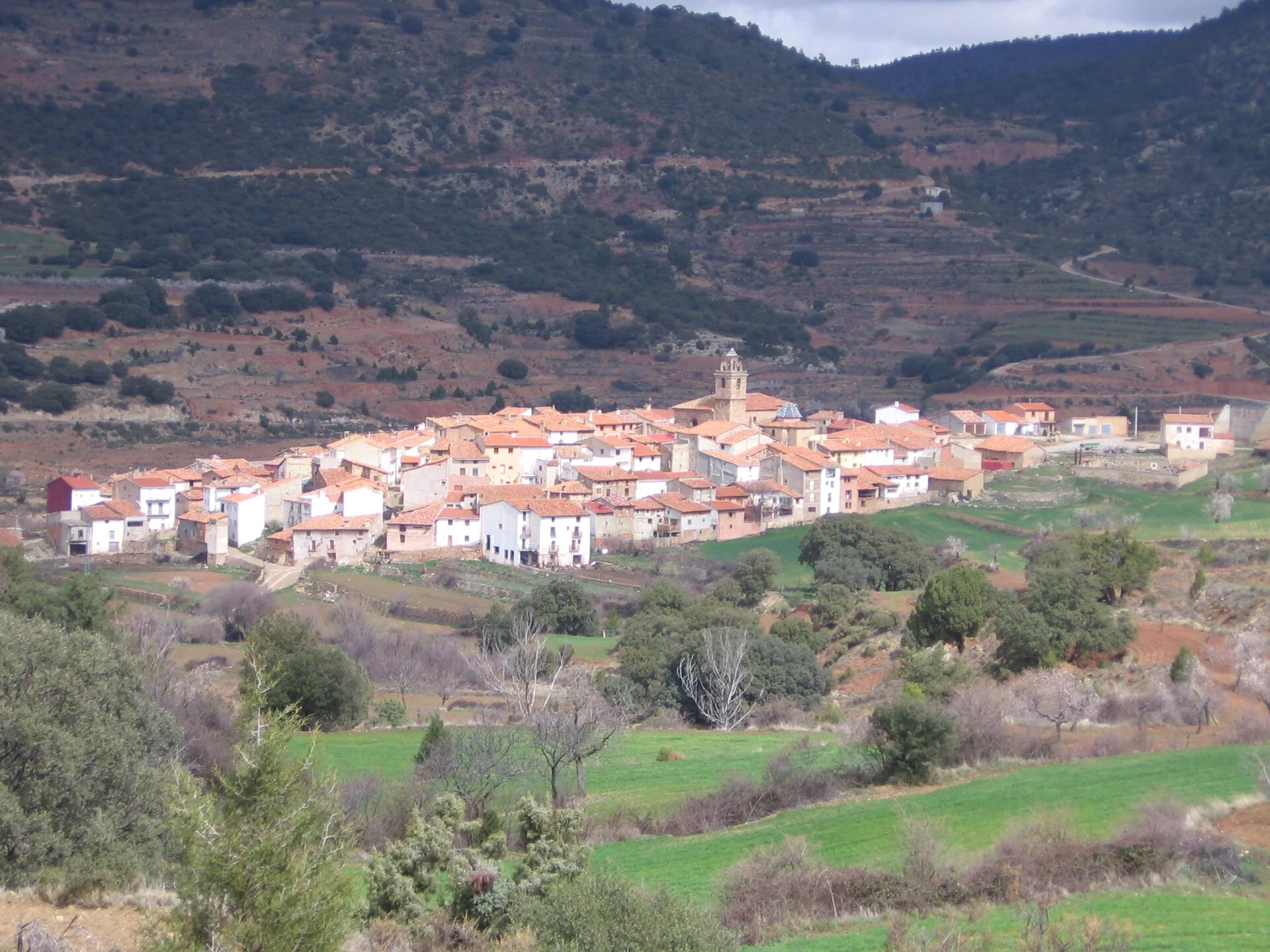
Puebla de San Miguel is a high-mountain settlement in Rincón de Ademuz, surrounded by the natural park bearing its name. The photograph does not show a juniper or Alto de las Barracas; it is a view of the village from the access road, with the church at its centre and terraced fields around it. A responsible visit separates urban heritage from protected-area routes because their distances, elevation and rules differ substantially.
What to see in Puebla de San Miguel
San Miguel parish church
València Turisme’s own pages give different dates. Its destination profile places construction in the late seventeenth century, while another provincial article traces it to the sixteenth. They also differ over how much of the former high altarpiece remains after the Civil War. This guide does not turn that discrepancy into false precision: the church is the village landmark, and current local interpretation should be consulted when the interior is open.
The façade and bell tower can be viewed from public space. Entry depends on worship; never advertise a complete altarpiece without confirmation or disrupt a ceremony.
Purísima hermitage
The provincial profile dates this restored hermitage to 1700. It is distinct from San Roque and Santa Quiteria hermitages, the latter associated with a pilgrimage in the border setting of Arcos de las Salinas. A short visit should prioritise Purísima near the village rather than merging separate chapels or promising open interiors.
Historic archive and former town hall
The archive is kept in the former town hall and, according to València Turisme, contains documents from around 1400 onwards. It is a documentary resource rather than a freely accessible tourist room. Researchers need an appointment and consultation conditions; ordinary visitors can value the building without demanding access to records.
El Cubo ethnology museum and surgeon-barber’s house
El Cubo occupies a former wine vat building. The provincial source says the village once had nine and now retains two. The museum explains historic winemaking tools and is complemented by the surgeon-barber’s house and collections on dry farming, livestock and forestry. Confirm both venue and opening before travelling, particularly outside peak season.
Washhouses and tile works
The municipality retains two washhouses and a traditional tile works. The official park route places the Tejería about two kilometres from the village and explains the temporary tile-makers’ dwelling and kiln where moulded clay pieces were fired. This is heritage rather than scenery: respect structures, closures and conservation work.
Puebla de San Miguel Natural Park
Declared in 2007, the park occupies the western Javalambre foothills and covers over 6,000 hectares. The regional authority highlights Spanish and creeping juniper, Scots pine and the 1,838-metre Alto de las Barracas, the highest point in the Valencian Community. Its value goes beyond old trees: flora micro-reserves, high-mountain plants, raptors, protected butterflies and traditional land-use heritage all matter.
Junipers, witnesses to time
The official leaflet describes a 4.2-kilometre circuit taking about ninety minutes, graded low difficulty and gaining 92 metres. It leaves the village, passes Lavadero de Abajo and Pilón de la Hoya, reaches monumental Sabina La Fantástica and crosses Barranco de los Tajos and Los Pucheros juniper woodland. “Low” does not mean accessible to everyone or safe in snow, ice, storms or extreme heat.
Camino de la Sal and El Carrascal
Camino de la Sal is linear: 9 kilometres, about three hours and medium difficulty, from the forest house to Don Guillén recreation area. El Carrascal is a different and much larger route: 26 kilometres, roughly six hours twenty minutes on foot, medium-high difficulty and 573 metres of ascent. Do not mix their sections or present Alto de las Barracas as a quick roadside stop.
Choosing a realistic plan
- Two hours: church, streets, washhouses and a pre-arranged El Cubo visit.
- Half day: village plus the juniper circuit only in suitable conditions.
- Mountain day: one defined long route with a downloaded map, return deadline and route shared with another person.
Rules, weather and food
The park leaflet asks visitors to remain on paths, avoid motor vehicles, cycle only on forest tracks and respect cultural heritage. Fire depends on designated places and the current emergency level; camping at Don Guillén requires authorisation, so always check current rules. Winter snow and ice are possible, and mobile coverage cannot be assumed. Documented food includes a bean-and-potato stew with meat and blood sausage, plus gachas. Carry water and warm layers even between seasons, and never collect plants or damage monumental trees.
Related guides and local data
Official sources and planning
The editing date records changes to the text, not a new check of opening hours, telephone numbers or accessibility. Specific verification dates, where recorded, appear beside the relevant information.