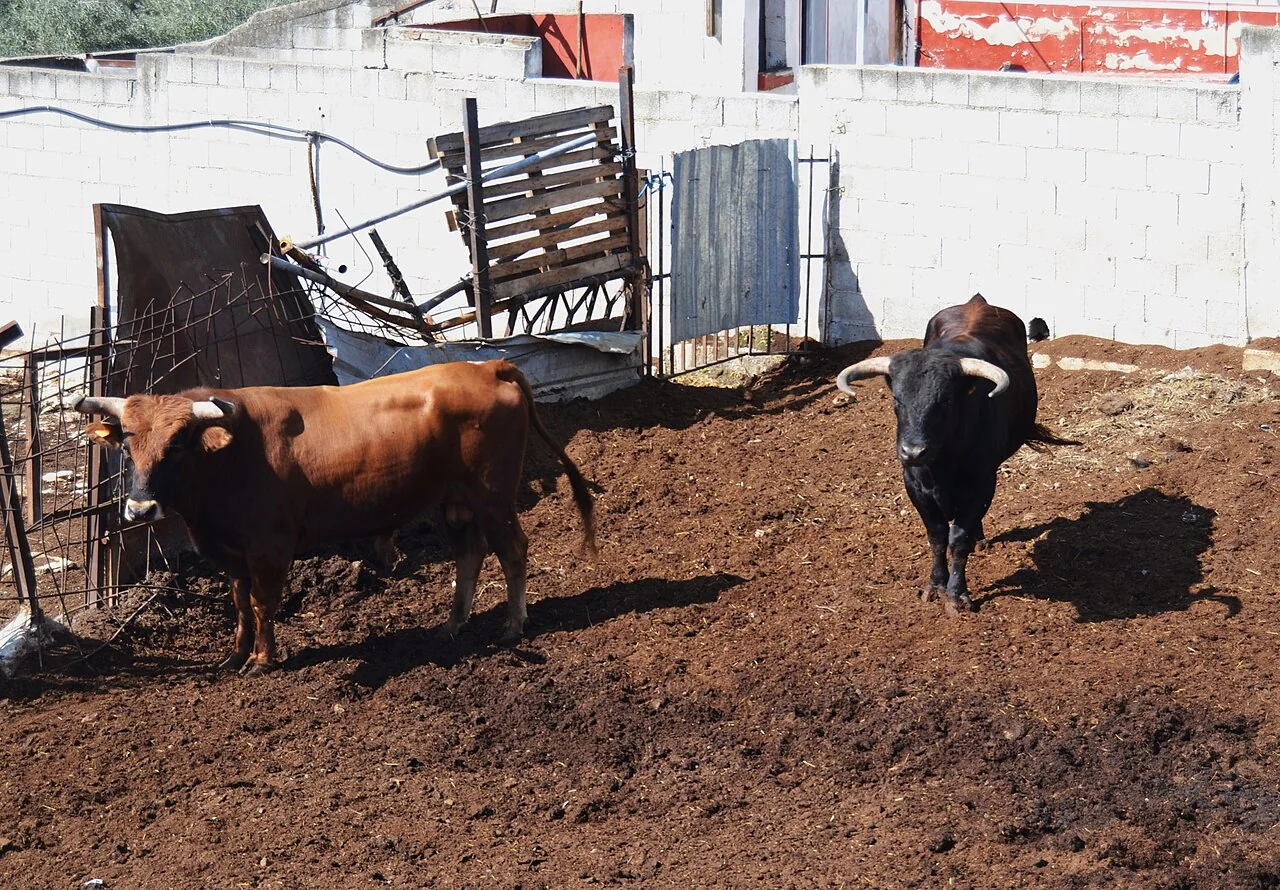
Quatretonda combines religious heritage and eighteenth-century houses in the settlement with a large municipality extending into the Buixcarró range. Sants Joans church, Sant Josep and Sant Martí hermitages, oil-making tradition and two trails of very different demands support a real visit. The inherited image does not show monuments: it depicts two bulls inside a livestock enclosure in Quatretonda.
Heritage in Quatretonda
Sants Joans church and bell tower
The Baroque-period church combines Gothic, Renaissance, Baroque and Rococo elements. It has one nave covered by a rib vault. The provincial profile highlights a seventeenth-century Mare de Déu altarpiece above the sacristy door and a set of frescoes showing several figures and dedications.
The bell tower has three stages and a crown. Dated 1694, it combines Gothic-derived pointed arches in the bell stage with Renaissance balls and pinnacles. Church and tower are related parts, not two independent monuments. Interior entry depends on worship.
Sant Josep hermitage and Calvary
This seventeenth-century Baroque hermitage stands on a small rise. Its rectangular plan has a three-bay nave, barrel vault and chapels between pilasters. The altarpiece-like entrance façade ends in a bell gable, balls and pinnacles and includes a sundial and stone inscriptions. Use the existing access and respect closures.
Sant Martí hermitage
Its origin and date are unknown. Tradition connects it with the former church of a small Morisco settlement, but this interpretation is not an established architectural date. The building was abandoned during the Civil War and reconstruction began in 1956 through local initiative. A November pilgrimage maintains the community connection; confirm dates and access.
Eighteenth-century houses and oil mill
Tourism information names the Calatayud, Felip Faus and Romuald houses and streets such as Crist de la Fe, Benigànim, Sant Doménec and Sant Josep. Many are private urban references: view façades without entering doorways. The historic oil mill represents continuity of oil production; the institutional profile records cold pressing and long family management. A working business is not a freely visitable attraction, so arrange any entry.
Two trails that must not be confused
SL-CV 39 Senda de l’Escaló
FEMECV’s current record describes a 5.70-kilometre loop taking about one hour fifty-five minutes, with 235 metres of ascent and descent. It starts on the Quatretonda–Pla de Corrals track at the Pinet-track junction and passes Senda de l’Escaló, Cucó de la Petaca and Camí dels Colls Blancs. The record shows positive quality control, last dated December 2022.
PR-CV 172 Senda del Molló
This is a different mountain day: a loop with shared out-and-back sections, 19.30 kilometres, about six hours and 560 metres of ascent and descent. Starting at Avinguda del País Valencià, it visits Coll de l’Anglés, Molló, Pla d’Engolidors, Bastida refuge, Cova de la Falaguera and other points. FEMECV assigns effort MIDE 3 and positive quality control, last published for November 2022.
The PR crosses protected areas in Serra de Quatretonda and Montdúver–Marxuquera. Check current rules and authorisations. Neither a 2022 control nor a GPS track replaces checks for weather, fire risk, closures and trail condition.
Choosing the visit
- Urban walk: Sants Joans, bell tower, identified houses and Sant Josep hermitage.
- Natural half day: SL-CV 39 only with mapping, water and suitable conditions.
- Mountain day: PR-CV 172 only with preparation, an early start and capacity for 19.30 kilometres.
Never enter shafts, caves or closed refuges, and do not leave the route to search for Nevera de la Talaia or other features without a defined path. The short trail is not automatically step-free simply because it is described as approachable. Check surfaces, road access and gradients for the group, and treat the urban heritage circuit and mountain routes as separate accessibility decisions.
Food, festivities and image
Documented food includes oven-baked rice, rice with beans and turnips, “bride’s kisses” sweets and olive oil. Festivities and bull-related events have variable calendars. Wikimedia titles the 2015 photograph “Dos bous per Quatretonda”; the literal description does not establish the date, exact place or context of a particular celebration.
Related guides and local data
Official sources and planning
The editing date records changes to the text, not a new check of opening hours, telephone numbers or accessibility. Specific verification dates, where recorded, appear beside the relevant information.