Benigànim supports a visit built around named buildings and distinct stories. Its centre brings together a street pattern of Islamic origin, Gothic and Renaissance architecture, former monastic life and the memory of Blessed Josefa de Santa Inés. Valencia’s provincial tourism service suggests themed routes devoted to Blessed Inés, the churches and the former royal town. Those themes show why Benigànim is not merely an interchangeable “old centre”. The route below connects documented places while avoiding permanent claims about opening times or treating active places of worship as unrestricted attractions.
What to see in Benigànim
Church of the Santíssim Crist de la Sang
The Church of the Blood is one of the most distinctive stops. The provincial destination page dates it to the 14th century and explains that the building originated as a mosque before becoming a church. Gothic arches, ceramics, paintings and a bell tower are among the features highlighted inside. Its setting helps visitors read the historic quarter and the transition between different cultural periods. Admission must be checked because it remains a religious building rather than a museum with continuous public opening.
Sant Miquel Arcàngel parish church
Sant Miquel belongs to a different architectural phase. Tourism material from the Provincial Council describes the parish church as an example of Mannerist Renaissance architecture, contrasting with the Gothic simplicity of the Church of the Blood. Seeing both on one walk gives the route real substance through differences in scale, style and urban role. The nearby Plaça Major, town hall and central streets are also worth observing, without assigning an undocumented date or story to every attractive façade.
La Puríssima and Blessed Inés
València Turisme dates the Church of La Puríssima and Blessed Inés to the 16th century and points to its side chapels and façade relief of the Immaculate Conception and the Blessed. Beside it stands the Discalced Augustinian convent, founded in 1611. Josefa Teresa Albiñana, remembered as Blessed Inés, lived there and her remains are venerated in the complex. This is a place of enclosure and devotion: historical importance does not permit entry into private convent areas or guarantee visits outside announced occasions.
The park, house and orange tree of Blessed Inés
Several places continue the story beyond the monastery. The provincial tourism portal identifies her house, also known as Casa dels Tudela, the park named after her and an orange tree listed as a monumental tree of the Valencian Community. Local tradition says that she planted it upside down, with its crown in the ground and roots in the air, around 1630. That account should be understood as devotional tradition rather than a verified botanical explanation. The public park makes it possible to encounter the story without intruding on religious spaces.
Sant Francesc monastery, the Calvary and the ice house
The Franciscan group broadens the visit beyond Blessed Inés. The monastery and Church of Sant Francesc were founded in 1575; the provincial listing highlights the entrance, interior decoration and cloister. Nearby, the Calvary contains 16th- and 17th-century structures forming the Stations of the Cross and the Chapel of Veronica. The former convent ice house is a circular masonry structure once used for storing snow. The Provincial Council dates it to the final third of the 18th century and associates the date 1785 with its dome. Current condition and access should be confirmed before making a special trip.
Suggested route
- Start at the Church of the Blood. Use it to understand the early historic quarter, without assuming the nave will be open.
- Continue to Sant Miquel and Plaça Major. Comparing Gothic and Renaissance buildings gives the walk a clear purpose.
- Follow the story of Blessed Inés. Connect La Puríssima, the convent exterior, her house and the park with its orange tree.
- Reserve the final section for Sant Francesc and the Calvary. Add the ice house only after confirming its location and access.
The central section is best explored on foot. Reaching the Franciscan group and other outlying points may involve additional time, slopes or a separate journey. Visitors with limited mobility should ask the council about the actual accessibility of churches, streets and routes. The existence of an official visitor route does not by itself prove that every stage is step-free.
Festivals and food
21 January is devoted to Blessed Inés. Provincial information mentions a novena, bonfire, Mass and procession, although the current programme must be checked each year. Patron saint festivities in late August honour the Divina Aurora, Christ of the Blood and Saint Michael and include Moors and Christians events. Local food references include paella, baked rice and brothy rice, together with fogassa, sweet-potato pastissets, anise-flavoured rolls and arrop i talladetes. These descriptions document local food culture; they do not mean every dish is served every day, so visitors should check real opening and booking arrangements.
What the photograph actually shows
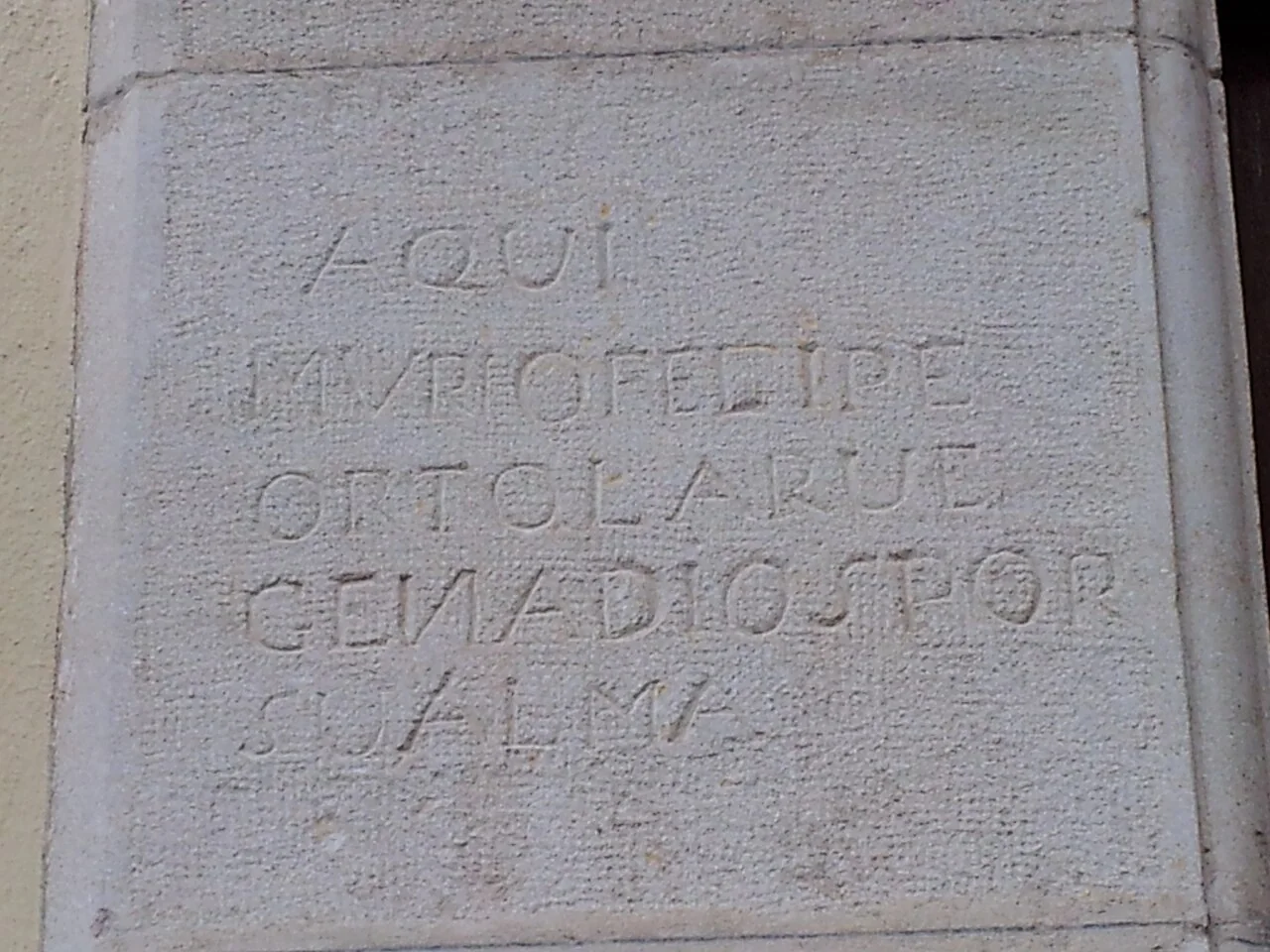
The main image is a close view of a historic inscription carved into stone on a Benigànim façade. It does not show the entire old quarter and cannot identify a building on its own. The Wikimedia Commons record provides the photographer, licence and general location, but its description does not document the person named in the weathered text with enough precision. This guide therefore does not assign the plaque to a specific individual. Describing what is genuinely visible is more reliable than completing a difficult inscription by guesswork.
Planning advice
- Check the council and València Turisme websites for openings, building work, festivals and guided visits.
- Respect worship and enclosure: several key places remain active religious spaces.
- Do not assume the ice house or convent interiors are accessible without confirmation.
- In summer, plan exposed sections for the morning or late afternoon.
- During festivals, check road closures and changes to the usual walking route.
Useful questions
What is the clearest way to understand Benigànim?
Compare the Gothic Church of the Blood, Renaissance Sant Miquel and the places associated with Blessed Inés. They are different, documented references rather than generic labels.
Can every interior be visited?
Not necessarily. Worship, enclosure, conservation and local events affect admission. The route still works from public streets when a building is closed.
Which section requires the most planning?
Sant Francesc, the Calvary and the former ice house. Confirm distance, access and current route conditions before setting out.
Related guides
Official sources and image credit
The editing date records changes to the text, not a new check of opening hours, telephone numbers or accessibility. Specific verification dates, where recorded, appear beside the relevant information.