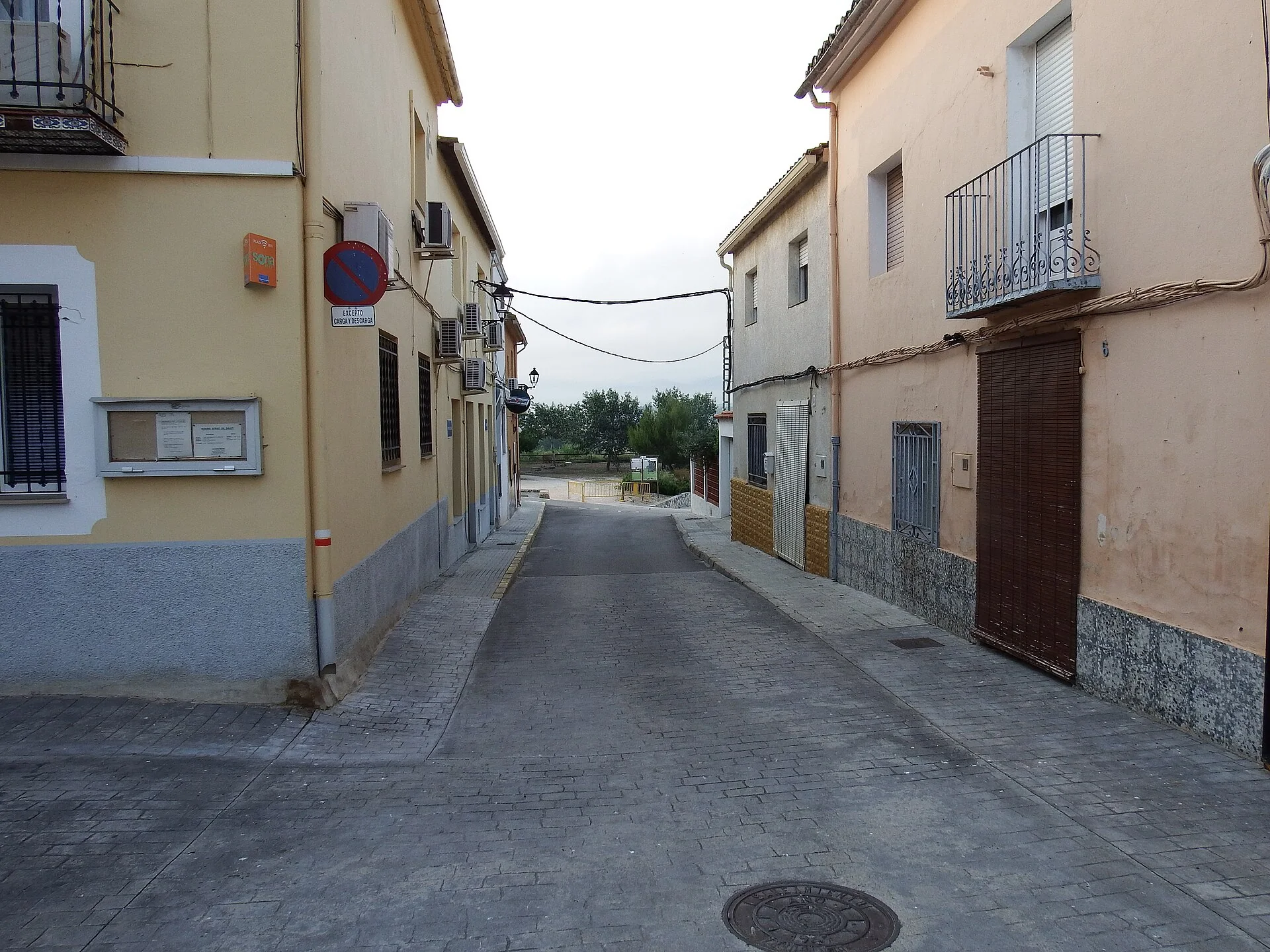
Benissuera is a small Vall d’Albaida municipality on the left bank of the River Albaida. A visit does not need unnamed “nearby mountains” or invented buildings: it rests on two specific landmarks, Bellvís Palace and Sant Josep church, and on the farming landscape shared with the other River Villages. The photograph shows a residential street descending towards farmland, not the palace or a supposed monumental old town.
What to see in Benissuera
Bellvís Palace or Palace of the Viscounts of San Germán
The principal heritage building combines a sixteenth-century Gothic house arranged around a square central courtyard with an earlier tower considered probably Islamic in origin. València Turisme says it was linked to the lordship of Bèlgida and the Bellvís family until the mid-nineteenth century, then to the Viscounts of San Germán and the Colomer family. It was declared a protected monument, a Bien de Interés Cultural, in 2003.
The palace is private property, so protected status does not mean free entry. An ordinary visit must remain within what can be seen from public space, without crossing gates, courtyards or land and without promising an open interior. Its tower and overall form help explain the relationship between a lordly residence, territorial control and growth of the small settlement.
Sant Josep parish church
The present church dates from the second half of the eighteenth century. It has one nave of three bays, a barrel vault and chapels between the buttresses. The provincial source describes simple rural architecture rather than elaborate academic design. It also says the community depended on Sant Pere parish until becoming an independent parish in 1535; that is an administrative milestone, not the construction date of the present building.
The exterior fits easily into a short village walk. Interior entry depends on worship and actual opening. Never interrupt a service or advertise permanent hours without confirmation.
The Four River Villages route
The institutional route links Alfarrasí, Benissuera, Sempere and Guadasséquies on an easy, level course through the settlements, irrigation channel and farmland planted with vines, olives and other crops. Benissuera’s Bellvís Palace can be added. This gives a specific reading of the Albaida and irrigation landscape without inventing mountains inside a municipality of about two square kilometres.
“Easy and level” does not mean fully traffic-free or accessible in every condition. Check the current line, road crossings, works, mud and heat; remain on public ways, respect crops and close any authorised gate. View the river and channel without entering riverbeds, canals or fields. Avoid flood-prone land after heavy rain.
A realistic half-day plan
- Village walk: follow the streets, identify Sant Josep church and view Bellvís Palace only from permitted public space.
- Landscape reading: reach the edge of farmland on public ways and understand the connection between the village, table grapes and River Albaida.
- Walking extension: choose one clearly mapped section of the Four River Villages route, or plan the full course with a map and enough time.
The compact settlement rewards a slow visit but does not justify trespass to “complete” an itinerary. Sempere and Guadasséquies combine naturally; Alfarrasí adds its documented church and hermitage, with travel time calculated separately.
This is a modest heritage visit rather than an all-day attraction with staffed facilities. Bring water, confirm transport and opening conditions, and do not assume public toilets, guided entry or food service will be available at the required time. Visitors with reduced mobility should assess street gradients and the chosen rural section independently: describing the inter-village course as level does not certify every surface, kerb or crossing as step-free.
Farming, festivities and food
València Turisme identifies table grapes as the principal crop. Documented local cooking includes oven-baked rice and puchero; the characteristic sweet is homemade snow nougat. These are records of food culture, not a guarantee that every dish is sold in the municipality each day.
Sant Antoni is traditionally celebrated in January with a bonfire and blessing of animals, while patronal festivities are concentrated in September. Dates and events can change annually. Check the current programme, avoid obstructing residential streets and respect the quiet of a very small village.
Related guides and local data
Official sources and verification
The editing date records changes to the text, not a new check of opening hours, telephone numbers or accessibility. Specific verification dates, where recorded, appear beside the relevant information.