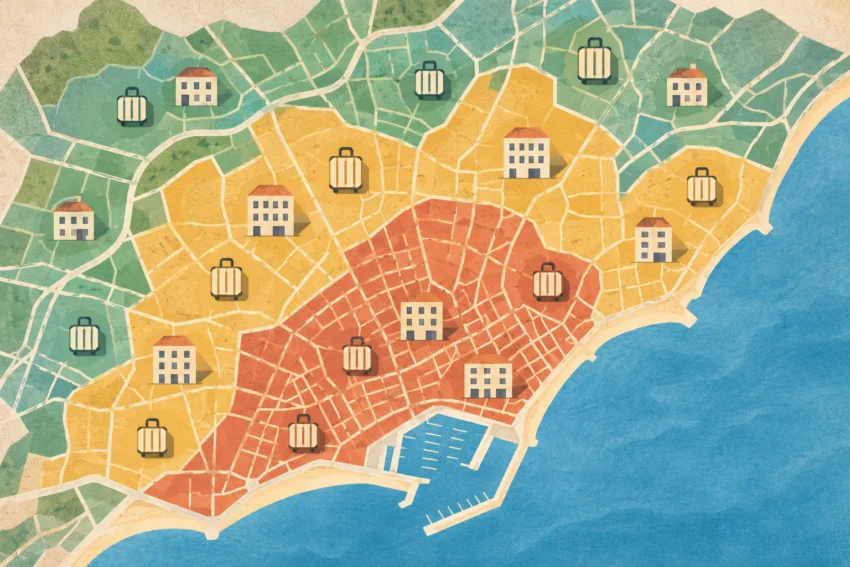
Alicante has replaced census districts with neighbourhood-scale areas as the basis for deciding where tourist accommodation may grow. The revised proposal divides the city into 26 units and creates three regimes: controlled growth, maintenance and reduction. In the areas under the greatest pressure, no ordinary new schemes would be allowed even when existing bed spaces disappear.
The change covers hotels, hostels, apartment blocks and tourist-use homes, but it is not yet an approved rule. The city council has reopened public consultation because it considers the revisions made after the first consultation to be substantial. The official notice provides 20 working days, while the municipal noticeboard gives 18 December as the end of the display period.
Two indicators and three levels of restriction
The main indicator, known as IPAT, compares registered tourist bed spaces with the resident population. The file sets an initial reference value of 7.19 beds per 100 residents, with an upper threshold of 14.38, exactly twice that level.
Below 7.19, an area is classed for controlled growth: new accommodation may be added up to its capacity ceiling, subject to all other planning rules. Between 7.19 and 14.38, it enters maintenance, where new beds require at least an equivalent number to have been removed first within the same area. Above 14.38, it moves into reduction: closures do not create capacity for ordinary new openings.
The municipal documents place the Traditional Centre, Old Town, Mercado, Ensanche-Diputación, the first line of Playa de San Juan, and the APA-9 and Lomas del Garbinet area in the last group. The analysis accompanying the plan calculates that five units contain 62.3% of the city’s tourist bed spaces but only 13.9% of its resident population.
The maintenance tier includes Urbanova, Carolinas, Campoamor, San Antón and La Albufereta, according to the mapping published with the file. Most of the municipality is currently below the average and would therefore fall under controlled growth. The classifications would not be permanent: the council intends to update the indicators annually using official accommodation and population data.
Tourist-use homes face a second cap
For individual tourist-use homes, an IPAT result that allows growth will not be enough. A second indicator, ISVAT, measures tourist-use homes per 100 dwellings. Its initial limit is 1.56%. Once that level is reached in a neighbourhood, no new tourist-use home would be allowed even if the area remains in the controlled-growth tier.
In single-family residential areas outside the 26 units, the proposal sets a maximum of one tourist-use home per block. The revision also generally prevents whole residential buildings from being converted into commercial tourist accommodation. Exceptions are reserved for full rehabilitation of listed buildings and, in controlled-growth areas, complete buildings formally declared to be in legal ruin.
The ground floor of buildings used entirely for tourist accommodation would have to host activities open to the public, apart from space essential to the establishment. Ground-floor accommodation units would also be barred on designated civic and shopping streets. A special route remains for projects classified as tourist excellence, but it requires specific justification and a reasoned decision.
What changes now — and what does not
Public consultation does not grant or withdraw licences by itself. It allows residents and interested parties to inspect the revised version and submit objections to the substantial changes. Environmental assessment and the planning process must then continue before any approval. The municipal decree itself asks the environmental authority to decide whether the revisions remain free of significant effects or require the ordinary assessment procedure.
Legally established businesses may continue under their existing authorisations and the transitional rules. The document also addresses earlier applications and favourable reports, but their treatment depends on the exact dates and conditions in the transitional provision; not every pending application is automatically protected.
The regulatory text, explanatory report, maps and summary are available on the council’s Urban Planning website and at the Urban Planning Information Office at Plaza del Ayuntamiento 5. The next verifiable milestones are the close of objections, the environmental decision and the version eventually taken forward for approval. Until then, the new map is an advanced proposal, not Alicante’s final regime.
Full municipal file · Official DOGV notice · Independent reporting by Alicante Plaza