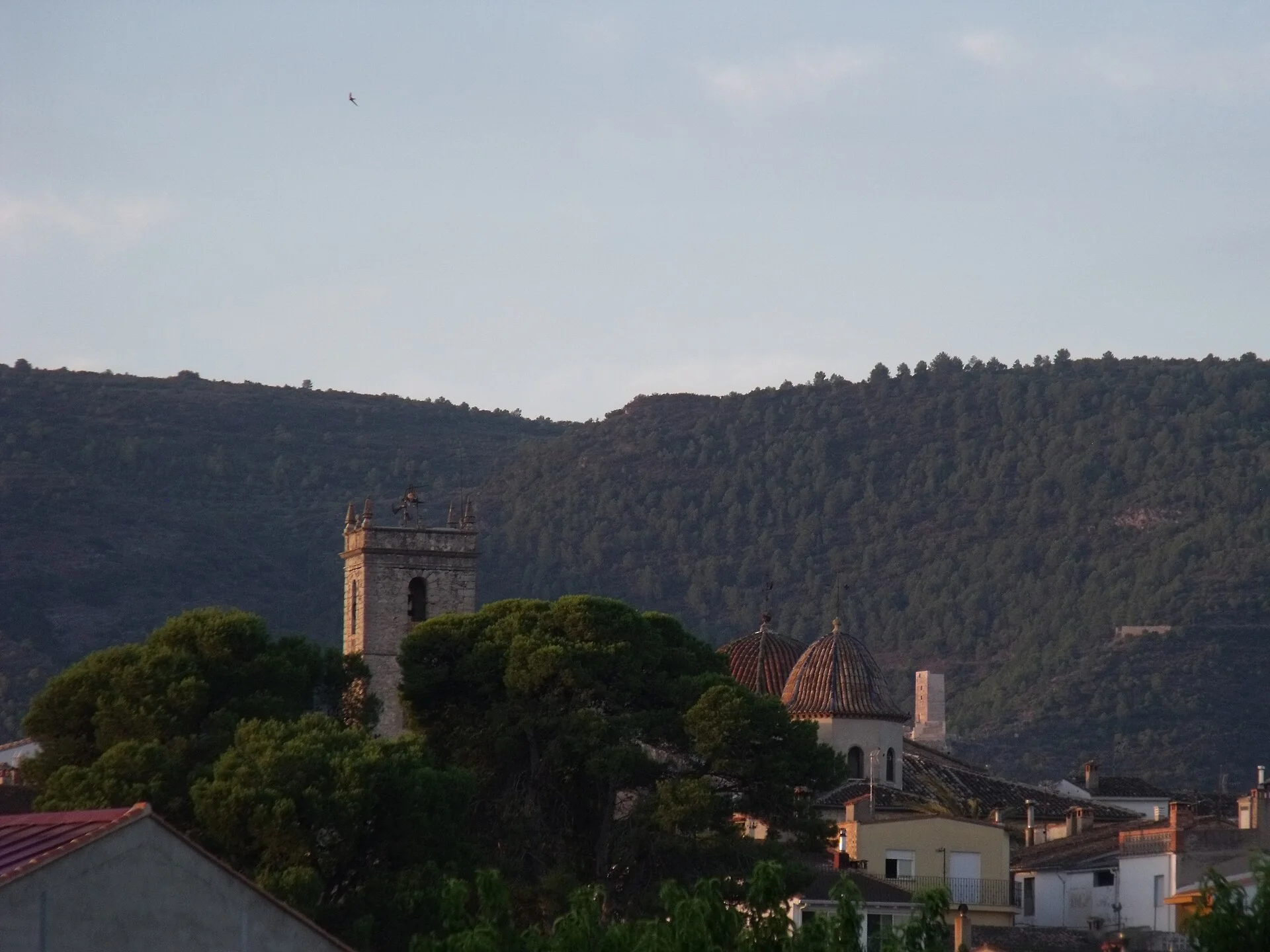
Bèlgida lies on the northern slope of Benicadell and brings together named urban heritage, fountains and paths. Sant Llorenç Màrtir church, the former Bellvís palace tower, archaeology museum, Sant Antoni and Calvary hermitages, and the Grapat, Baix and Freda fountains support a real visit without generic “traditional architecture”. The photograph shows Sant Llorenç’s bell tower and domes against the wooded hills.
What to see in central Bèlgida
Sant Llorenç Màrtir church
The district source traces the church’s origins to the fourteenth century, while València Turisme dates the current building to the late seventeenth. Its façade uses a Renaissance Tuscan order, and development included the sacristy, tabernacle, 1659 doorway and Ecce Homo chapel built from 1777 to 1779. The chapel retains Baroque decoration and eighteenth-century Valencian tiles.
The bell tower and domes visible in the image identify the church from outside. Interior access depends on worship and actual opening; describing its fabric does not guarantee a visit or justify disrupting a service.
Former Bellvís palace tower
The tower stands on Carrer Presó at the corner of Plaça de l’Església. The district source considers it probably late fourteenth century and describes a rectangular plan. The provincial profile adds the large pointed voussoir doorway, pointed window arches and entrance spaces with Gothic rib vaulting. It is a palace remnant rather than a complete castle. View it from public space and confirm any interior access.
Plaça de la Constitució
The square contains a fountain built in 1884 and the town hall. Vall d’Albaida Tourism says the administrative building keeps a panel commemorating the first centenary of the Battle of Raboser. An object inside a working council office is not necessarily a permanent exhibition, so ask before entering and respect municipal business.
Don Mariano Jornet Perales Archaeological Museum
The collection contains finds from the municipality assigned to the Eneolithic, Moorish and Iberian-Roman periods. Two institutional sources disagree about its present location: València Turisme places it in the culture centre, whereas the district website says it is in the palace tower. One also publishes weekday hours that may have changed. To avoid sending visitors to the wrong door, confirm both venue and opening with the council.
Hermitages and fountains
Sant Antoni Abat hermitage
About 300 metres from the village, it stands at the fork of the roads towards Montaverner and Benigànim. The single-nave building has a barrel vault and was completed in 1721. It is linked with the Sant Antoni celebration on 17 January. The exterior fits a short walk; interior opening must not be assumed.
Calvary hermitage
This small rectangular whitewashed building has a clay-tile gabled roof and was inaugurated in 1724. It is separate from Sant Antoni and should not become filler in a route: its value lies in scale and devotional context.
Font del Grapat and Font de Baix
Font del Grapat receives seepage from Carrícola’s Horta Nova and has a rest area. Font de Baix carries water through a dry-stone gallery to two bronze spouts. Both were restored and are linked by a recovered path. “Restored” does not mean drinking water: obey health notices and never enter galleries.
Font Freda and the Benicadell range
Font Freda rises in the mountains within Bèlgida municipality and was renovated in 1904. Reaching its recreation area is a separate excursion, not part of the urban stroll. Paths and ravines require mapping, suitable footwear, water, weather planning and a fire-risk check. The hills looking close behind the church in the photograph do not imply instant trail access.
Realistic visit plans
- Urban walk: Sant Llorenç, Plaça de la Constitució, palace tower and a museum enquiry; about two hours if it opens.
- Nearby extension: Sant Antoni, Font del Grapat and Font de Baix, without entering plots or blocking farm lanes.
- Mountain outing: treat Font Freda as a separately planned activity, never an improvised final stop.
Festivals and food
Sant Llorenç patronal festivities take place in August. Carnival retains traditions such as l’enfarinà, drum-and-pipe music and fancy dress; exact dates need an annual check. The provincial source documents stew, vegetables, rice with beans and turnips, almond cake and lye-cured olives. Respect the residential setting, agricultural property and mountain restrictions throughout the visit.
Related guides and local data
Official sources and verification
The editing date records changes to the text, not a new check of opening hours, telephone numbers or accessibility. Specific verification dates, where recorded, appear beside the relevant information.