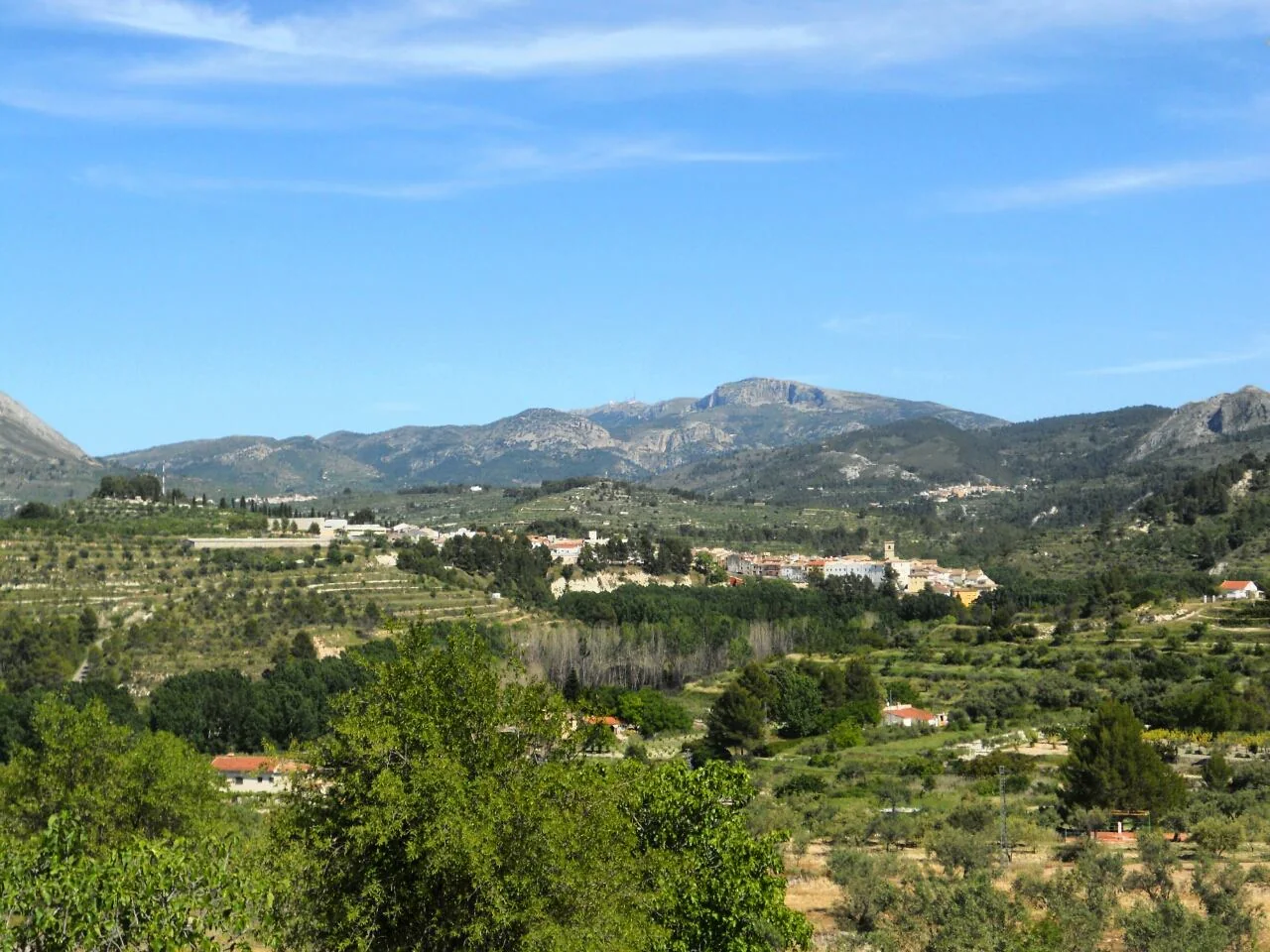
Benilloba stands beside the Frainós River in a terraced landscape among the mountains of El Comtat. Its most useful story is specific: water powered flour mills, crossed irrigation channels and aqueducts and, by the end of the nineteenth century, generated electricity. The village centre, parish church and route to Molí del Salt explain this relationship without presenting unsupported buildings as visitor attractions.
What to see in Benilloba
Neoclassical parish church
The church overlooks the square and provides the clearest starting point. The Town Council describes a Neoclassical Latin-cross building with a three-bay nave, side chapels and a false dome over the crossing that is not expressed externally. The Communion Chapel dates from the nineteenth century, while the ashlar bell tower has four cubic stages. Frescoes and vault decoration survive inside, but this remains a place of worship: access depends on opening and religious services.
Streets, ceramic panels and Calvari
The urban walk is most rewarding at the scale of small details. The municipal inventory records ceramic devotional panels dedicated to Sant Miquel Arcàngel, Sant Jaume Apòstol and Sant Tomàs de Villanueva, set into façades and niches. The walk can then continue towards Calvari, where a path among cypress trees opens views of the village and mountains. The point is not to label every street a monument, but to connect the square, domestic architecture and farmland.
Route to Molí del Salt
The municipal walking route is about 6.5 kilometres and leaves Benilloba along Senda dels Molins. Before the waterfall it passes Font de la Teuleria, remains of the aqueduct with the same name, Molí de les Penyes del Salt —built in 1852— and an old bridge. This sequence shows that the destination is not an isolated cascade, but part of a water and industrial corridor.
Molí del Salt or Fàbrica de la Llum
The river crosses a limestone gorge and drops nearly twenty metres near the mill. Molí del Salt was built between 1760 and 1770, belonged to the Counts of Revillagigedo and passed through several owners. In 1899 it was bought for the Benilloba Electric Company, which explains the name Fàbrica de la Llum, or electricity works.
The building is an advanced ruin and its roofs have collapsed. View it from the established path without entering, climbing or leaning on the walls. The descent includes masonry steps that may be slippery; “free access” does not mean step-free access or an absence of hazards. Flow varies with rainfall, and visitors should not assume there will be abundant water or a safe bathing place.
La Canal aqueduct at Barranc de Cuixot
Near the boundary with Penàguila is a second feature, distinct from the Teuleria aqueduct. La Canal was built in 1794 so that Séquia d’Ombria could cross the ravine and irrigate Benilloba’s fields. Its two arches are unequal, one small and the other larger with a curved design. Treat it as a separate excursion and confirm current access rather than placing it automatically within the village walk.
A practical itinerary
- Start in the square, view the church and look for the ceramic panels without disturbing residents or services.
- Continue to Calvari if the heat and the group’s mobility make the climb suitable.
- Allow at least two hours for the mill route, plus time for stops; use grippy footwear and carry water and sun protection.
- Visit Barranc de Cuixot in a separate part of the day only after checking access and weather.
Local food and nearby villages
The municipal recipe collection identifies olleta, borreta, pericana and arroz con costra, together with oil from local olive groves. Benilloba’s bakery-made magdalenas also feature in local tourism promotion. Availability depends on the establishment and day, so ask before relying on a particular dish. A wider route can use the guides to Benillup, Benimarfull and Benimassot.
Frequently asked questions
Can visitors enter Molí del Salt?
It should not be treated as an interior visit. The surrounding site is reached by an outdoor path, but the mill is an advanced ruin. A safe visit means observing without entering the structure.
How long is the route from Benilloba?
The Town Council publishes an approximately 6.5-kilometre route along Senda dels Molins. Actual time depends on the surface, stops and final descent.
Are there two aqueducts?
Yes. Sources distinguish the remains near Font de la Teuleria on the Salt route from La Canal at Barranc de Cuixot, built in 1794 for Séquia d’Ombria.
Official sources and planning
The editing date records changes to the text, not a new check of opening hours, telephone numbers or accessibility. Specific verification dates, where recorded, appear beside the relevant information.