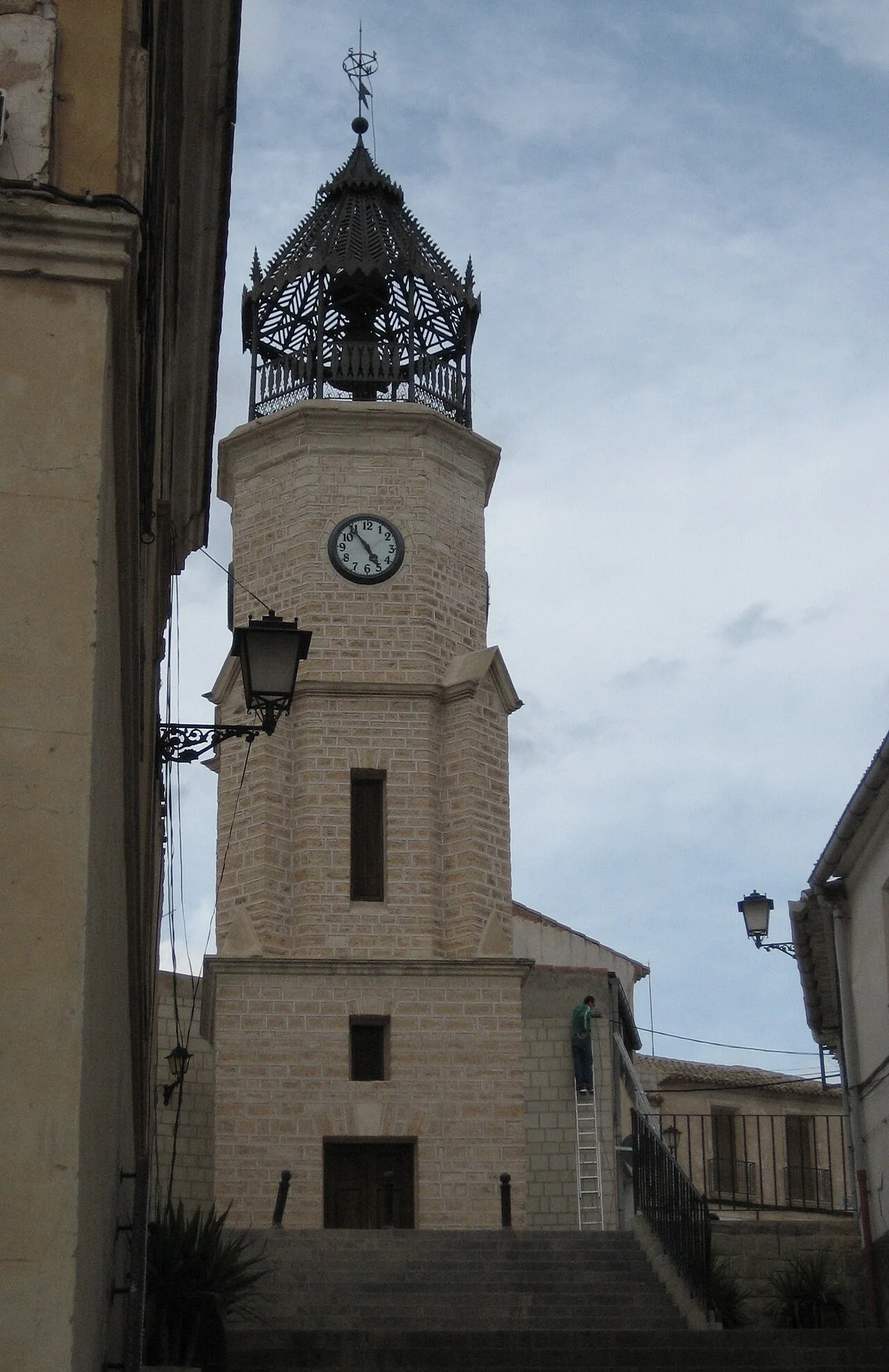
Pinoso has a mountain whose salt ends up in Torrevieja and a public clock that still needs winding. Both reward a closer look at the town: an industrial story beneath the ground and another that continues to mark the hours above the rooftops.
Hearing the clock and understanding its workings
The Clock Tower began with a project commissioned in 1887. Its mechanism uses three weights with different tasks: striking the hours, sounding the quarters and keeping the clock running. You can recognise the tower from the street, but an interior visit puts those separate functions into context.
The council offers guided visits and states that the original machinery is wound by hand each day. Its visitor information directs you to an application submitted at Casa de Don Pedro, beside the tower. Check the available arrangements: this is not an interior open for unrestricted entry at any time.
Salt is not confined to the coast
Cabezo de la Sal is a diapir, a landform created by salt-bearing materials rising upwards. Its brine travels by pipeline to the saltworks at Torrevieja. The municipal environmental activity requires planning and coordination when crossing the mining area, and collecting rocks and minerals is prohibited.
Our recommendation is therefore to separate the town visit from the geological outing. A photograph of the hill does not tell you the condition of its paths, cavities or installations. If you want to explore it, contact the council’s Environment Department; a cave appearing in a leaflet is not permission to enter.
Reading the landscape in the flag
The local colours summarise other activities: dark red represents wine, and white stands for salt and the cream-coloured stone quarried on Monte Coto. This offers a simple connection between vineyards, quarries and what you have seen in the town. A visit to a working site or winery needs to be arranged with its operator, not assumed to be part of the walk.
Related guides and local data
Sources consulted
- Ajuntament del Pinós · Visitas a la Torre del Reloj
- Turisme Comunitat Valenciana · Historia y mecanismo del reloj
- Ajuntament del Pinós · Cabezo de la Sal y condiciones de las actividades
- Ajuntament del Pinós · Vino, sal y piedra en los símbolos locales
Documentary sources consulted on 28 August 2026. This is not an on-site inspection or a full check of opening hours, telephone numbers or accessibility. Any visiting conditions mentioned come from the linked sources.
The editing date records changes to the text, not a new check of opening hours, telephone numbers or accessibility. Specific verification dates, where recorded, appear beside the relevant information.