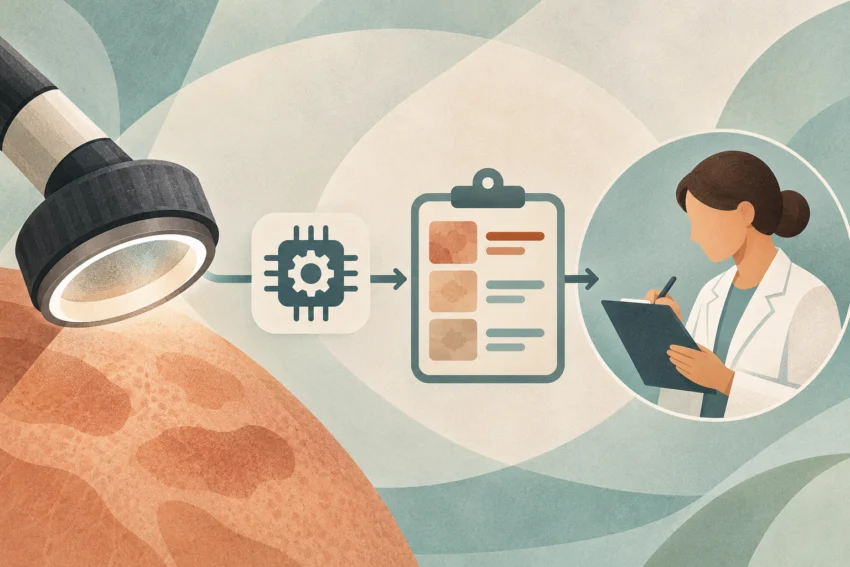
A photograph taken at a local health centre could receive an automated assessment of a skin lesion’s malignancy risk in under five minutes. Valencia’s Health Department has put an artificial-intelligence licence out to tender, intending to add it to the region’s teledermatology network and help determine which cases should reach a specialist first.
If the procurement is completed, the system will cover all 244 health centres and 567 auxiliary clinics in the Valencian Community, as well as dermatology teams in its 24 health departments. The tender budget is €1.452 million including tax. Its estimated value rises to €2.04 million once a possible extension is included.
Patients will not use the tool themselves. A primary-care professional will capture an image with a mobile device or dermatoscope and send it through the corporate application. The software will return a risk assessment to be considered alongside the clinician’s judgement when deciding whether to refer the patient to dermatology and how urgently.
A triage aid rather than a diagnosis
The tender requires CE marking as a class IIb or higher medical device. Minimum technical thresholds include 90% sensitivity for skin tumours, 70% specificity and a quality-control function that rejects unsuitable images. Diagnostic performance will account for 55 of the 100 award points, compared with 20 for price.
Those thresholds describe the overall performance the supplier must demonstrate; they do not turn an individual output into a diagnosis. Decisions will remain with healthcare professionals and suspected cancer will still require confirmation through biopsy analysis. The stated purpose is to improve referral priority and avoid unnecessary waits, not to replace a dermatologist.
The licence will be corporate, with no cap on authorised users, examinations or patients. The initial contract will run for 25 months: one month of preparation followed by 24 months of clinical use, including maintenance, updates and monitoring. The documents allow an extension of up to one year for a further €726,000 including tax.
Opening the tender does not mean the software is already operating in clinics. Bids remain open until 9 December, after which the contract must be awarded, formalised and implemented. Until then, the teledermatology network continues to follow its existing pathway without this automated analysis.
The award will provide the first public test, revealing the selected product and the clinical evidence behind it. Once deployed, usage data — rejected images, prioritised referrals and confirmed outcomes — will show whether the filter improves care in practice without generating additional false alarms.