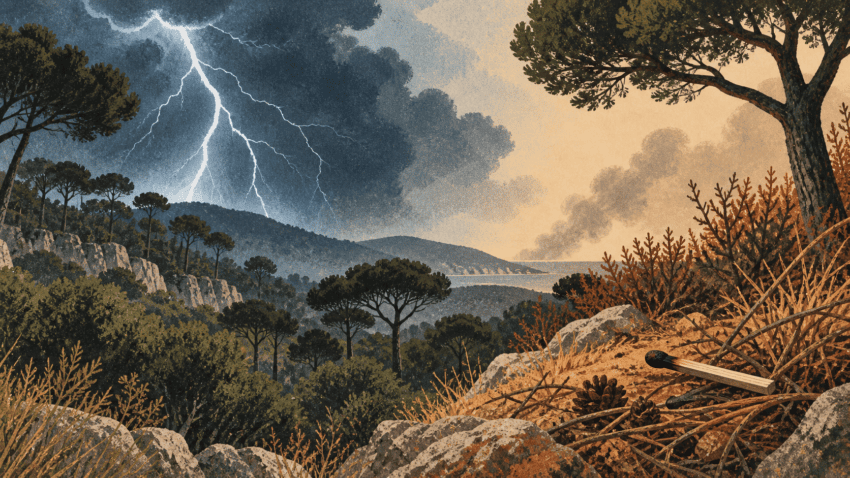
Human activity was behind 42 of the 103 wildfires recorded in the Valencian Community during July and August. The provisional regional government statistics classify 31 fires as deliberate and attribute another 11 to negligence. Together, they account for just over 40% of the incidents in the two central months of summer.
A second figure gives a better measure of the season’s severity: 9,789.4698 hectares were affected, including 6,051.4777 hectares of wooded land. The count may change because some investigations remain open and the administration itself labels the data provisional.
More lightning strikes, but greater damage from human-caused fires
Lightning was the most frequent cause, starting 41 fires. That does not mean natural causes accounted for most of the land burned. Radio Valencia’s analysis of the official register places the most destructive incidents among the deliberate fires, including the Vall d’Uixó blaze, which exceeded 9,000 hectares.
The comparison makes it necessary to distinguish the number of ignitions from their consequences. Many lightning fires were put out quickly, while a small number of human-caused fires concentrated much of the damage. The storm-related fire in Segorbe and the Calderona range affected around 600 hectares; the Soneja fire, at roughly 160 hectares, remained under investigation when the figures were released.
The El Saler fire shows why some classifications take time. Following the late-August blaze, Spain’s nature-protection police unit Seprona initially ruled out natural causes and indicated that the fire may have been deliberate. That preliminary finding, announced by the central government delegation and reported by Europa Press, does not amount to an identified perpetrator or a court ruling.
A provisional balance still open to revision
Provisional causes are revised as investigations progress. The 31 deliberate fires, 11 negligence cases and 41 lightning fires therefore describe the current register, not a final close to the season. Nor did every fire that began in summer remain within the municipality where it started, so the total area should not be read as a local allocation.
The next useful reference point will be the regional statistics update with resolved causes and consolidated area figures. If the classification of major incidents such as Soneja or El Saler changes, the share attributed to human activity may move too. Even now, however, the figures show that preventing negligence and investigating deliberate fires remains as important as preparing for dry thunderstorms.