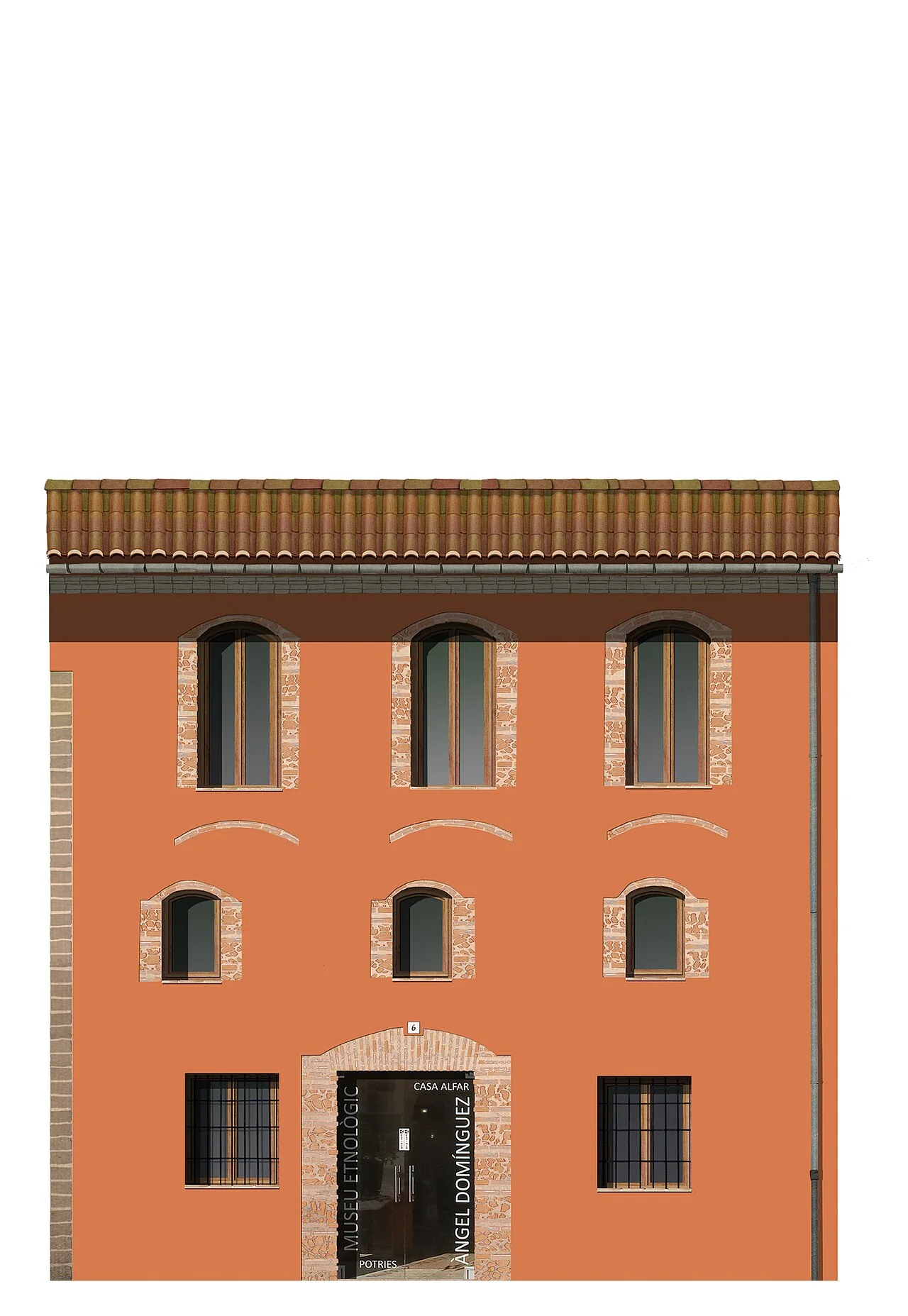
Potries is best understood through two activities that shaped the town: pottery and the distribution of irrigation water. The Àngel Domínguez Cassoleria Museum preserves a traditional home and workshop, while Casa Fosca and Casa Clara explain how water has been divided across La Safor’s cultivated plain for centuries. Sants Joans Church, the former manor house now used as the town hall and the Calvary provide further named, locally meaningful stops.
Àngel Domínguez Cassoleria Museum
The museum occupies a late-18th-century house on Carrer del Cup. Its domestic section retains the kitchen-dining room, bedroom and original furnishings. The workshop preserves the kiln, settling pools, foot-powered potter’s wheel and glaze mill used in ceramic production. Home, courtyard, workshop and kiln therefore explain both the manufacturing process and the life of a pottery family.
Five potteries were documented in Potries at the beginning of the 20th century. The work of the last active potter, Àngel Domínguez, ended in the mid-1980s, after which the council acquired the property to protect this memory. Opening times, admission, guided activities and accessibility should be checked on the museum’s official website before travelling.
The Water Route: a working system
The historic network begins at Assut d’en Carròs on the Serpis or Alcoi River and carries water through the Séquia Reial d’Alcoi. Near Potries it reaches Casa Fosca, a dividing structure beneath a strong masonry vault. A document from 1511 already records the divider and its gates. It is not a visitor interior: the locked building protects fair distribution and access belongs to the irrigation official responsible for the system.
Casa Fosca, Casa Clara and the canals
At Casa Fosca, water separates into the Rebollet Canal and the shared Gandia and Oliva canal. Farther on, Casa Clara divides it again between the main Gandia and Oliva branches. The route also interprets canal sections, smaller dividers, mills and two restored washhouses, one on Carrer Corts Valencianes and one behind the church. These are functioning structures: never operate gates, enter locked compounds or walk on unstable canal edges.
In 2025 the council renewed and extended interpretive signs on the Water Route, including information at Casa Fosca. Rural path conditions can still change. Consult the current itinerary, carry water and sun protection, and keep away from canals and ravines during heavy rain.
A walk through the town
Town hall and the Borja connection
The town hall occupies a former manor house built before 1611 and associated with Pere de Borja i Centelles, governor of Gandia. Its historic five-lock door also introduces the shared control of irrigation water. View it as part of the town walk without assuming that working administrative rooms are open to visitors.
Sants Joans Parish Church
The parish became independent in 1574. The church keeps a 16th-century relic of Saint Blaise associated with the Porrat de Sant Blai, along with a copy of the Christ of the Agony from the chapel. Interior entry depends on worship and local programming; the square, narrow streets and washhouse behind the church keep the walk useful when it is closed.
Calvary and Christ of the Agony chapel
A paved, stepped path lined with cypresses climbs a small hill south-east of the town. Its gradient is steep. Work on the chapel began in 1854, and a façade inscription gives 1865 as a possible completion date. The upper terrace overlooks the cultivated plain, but this extension is not suitable for every level of mobility or for periods of extreme heat.
A realistic itinerary
- Begin at the Cassoleria Museum: confirm admission or booking and use the collection to understand local pottery.
- Walk through the centre: connect the town hall, Sants Joans, traditional streets and nearby washhouse.
- Choose one extension: follow a marked section of the Water Route or climb the Calvary according to time, heat and mobility; neither is compulsory.
A compact cultural visit fits into half a day. The full hydraulic route, a guided activity or a meal justifies longer. Treat Casa Fosca, Casa Clara and washhouses as working heritage, and respect crops and private property.
Porrat de Sant Blai and local food
The Porrat de Sant Blai takes place around 3 February and is recognised as a Provincial Tourist Interest Festival and a locally protected intangible tradition. Its programme changes every year. Official visitor sources associate Potries with rice dishes, bonítol, pumpkin fritters and the fair’s olleta; seasonal availability should be confirmed with each venue.
Access and safety
- Check or reserve the museum and guided activities through official channels.
- Never enter locked water dividers or interfere with canals; they remain part of an active irrigation system.
- The Calvary has steps and a steep gradient; choose the town route when mobility is limited.
- For rural paths, take water, sun protection and suitable footwear, and check weather and wildfire risk.
Nearby places
Continue the La Safor context in Rafelcofer, Piles or Ròtova, checking current access and realistic travel times.
Related guide and official sources
The editing date records changes to the text, not a new check of opening hours, telephone numbers or accessibility. Specific verification dates, where recorded, appear beside the relevant information.