Fuenterrobles stands on the eastern plateau of La Plana de Utiel-Requena. Its heritage explains the town’s name, rural life and the changing agricultural landscape: Fuente del Concejo, the 1931 wash house, a museum collection, Santiago church and named outdoor itineraries form a more specific visit than a generic list of vineyards. Sierra de Bicuerca rises to the east and the Magro crosses the southern part of the municipality; the Cabriel valley should not be described as running through the town.
Fuente del Concejo and the town’s name
Fuente del Concejo is also known as Fuente de la Glorieta or simply “the fountain”. València Turisme explains that it originated as a natural source with several springs. In Roman times it supplied a nearby rural villa; it later provided water for residents, livestock and irrigation. The fountain and the oak trees that grew around it together gave Fuenterrobles its name.
The municipal wash house was built in 1931 close to the fountain and has been restored. Together they explain water as an everyday service rather than decoration. Respect the site and do not assume that the water is safe to drink without a current public-health notice.
Rural Life: a community collection
Colección Museográfica Vida Rural contains close to one thousand objects connected with earlier generations’ lives. It began when a resident gathered items donated by local people; the council later acquired and expanded it. The provincial profile calls it one of the district’s most important ethnographic collections because of both its size and subject range.
This community provenance gives the collection value beyond an assortment of decorative antiques. Tools, household utensils and other pieces introduce farming, trades and family organisation. Check opening, booking and accessibility before travelling. The designation “museum collection” does not imply the permanent hours of a large urban museum.
Santiago Apóstol and the urban walk
The parish church is dedicated to Santiago Apóstol and was built in 1757. It is a modest Neoclassical building with one nave, a small transept and a Latin-cross plan. València Turisme identifies it as the smallest Neoclassical church in the district. Interior access depends on worship, but the exterior fits naturally into a walk linking Fuente del Concejo, the wash house and the collection.
Fuenterrobles belonged administratively to the province of Cuenca until 1851, a detail that helps explain its transitional position on the plateau. This history should not be mistaken for a present boundary: the municipality is now in Valencia province and La Plana de Utiel-Requena.
Water Route, optical telegraph and archaeology
The regional portal proposes the Water Route as a way to understand the settlement’s origins. It also identifies old mills, a nineteenth-century optical telegraph tower and the Iberian settlement of La Peladilla, with remains dated to the second century BCE. Each requires different treatment: the telegraph and settlement are historic sites, not places to climb structures or collect fragments.
Rural itineraries include monumental trees and locations such as the lime trees at the cooperative and Talayuela, Barraca Pozuelo, Dehesa and the Regajo poplars. The last itinerary also encounters sandy ground and Cueva del Cid. A list of names does not guarantee that every path is marked or open at the same time; obtain an up-to-date municipal route, carry water and check wildfire risk.
The cooperative and farming landscape
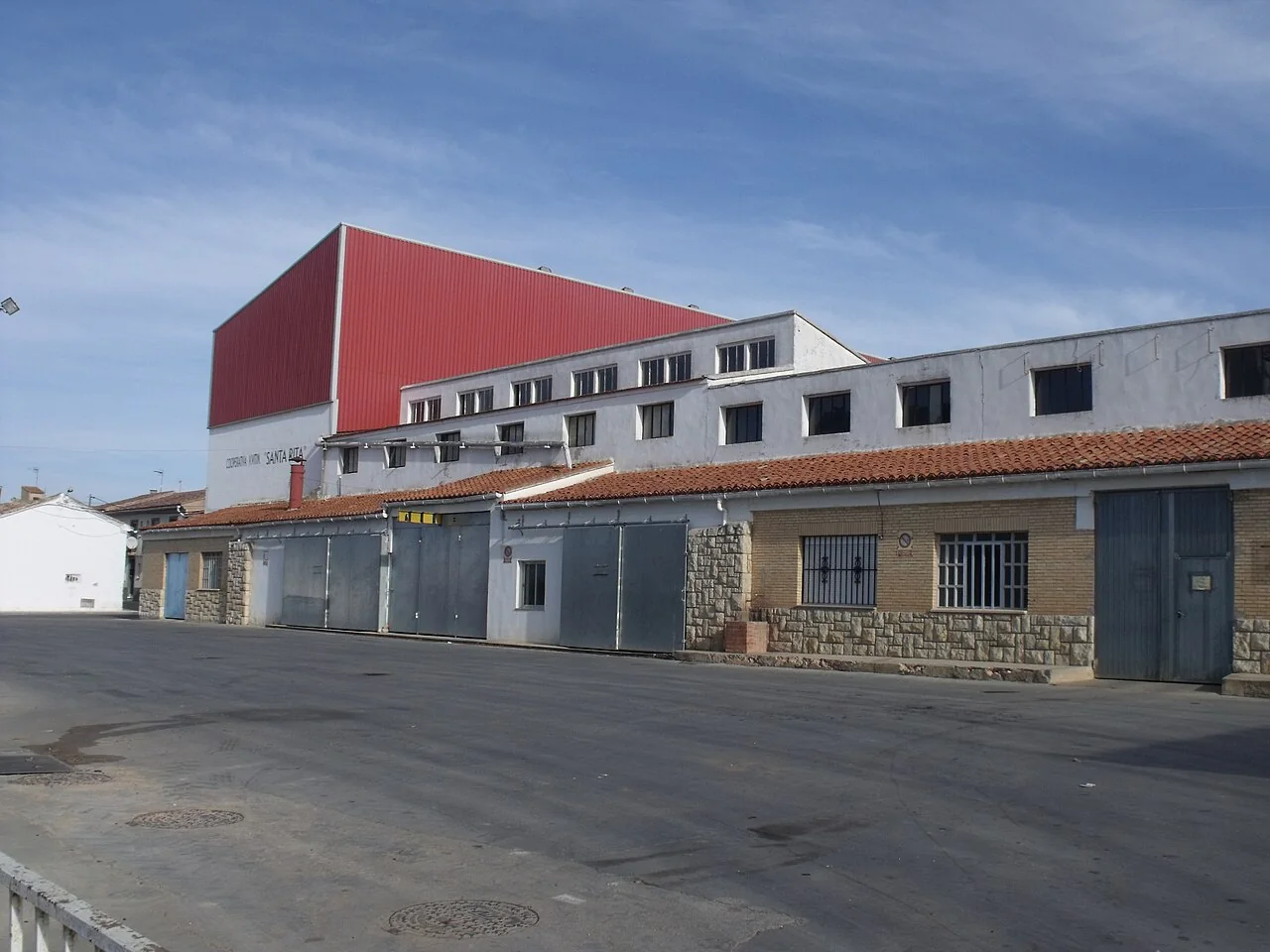
The main photograph does not show the historic centre. Wikimedia identifies it as Cooperativa Santa Rita, a name also visible on the building. The image illustrates Fuenterrobles’ wine-growing economy, but it does not establish that the industrial premises offer visits. Opening, sales and tours must be confirmed directly and cannot be inferred from a photograph.
Documented local food includes Torta de la Virgen de las Candelas made with marzipan and small pine shapes made from pine-nut nougat. Sources also mention ajoarriero or atascaburras and potatoes with cod. These are specific local references whose availability depends on the calendar and individual businesses.
A practical itinerary
- Begin at Fuente del Concejo and the wash house to understand the town’s origin.
- Continue to Santiago Apóstol church and the Rural Life collection if opening has been confirmed.
- Choose either the Water Route or one monumental-tree itinerary for the outdoor section rather than linking all of them.
- Reserve the optical telegraph or La Peladilla for a separate outing with a current route and archaeological care.
Official sources and nearby guides
For an independent onward visit, see Requena, Sinarcas or Chera, or return to the municipality finder. They require separate road-distance planning.
The editing date records changes to the text, not a new check of opening hours, telephone numbers or accessibility. Specific verification dates, where recorded, appear beside the relevant information.