Benirredrà covers only 0.39 square kilometres and its built-up area merges with Gandia, yet it retains a distinct sequence of heritage. The municipal protection catalogue approved in 2024 identifies specific buildings while correcting two tempting exaggerations: the historic core is small and heavily transformed, and there is no officially registered hiking trail within the municipality. The meaningful visit is therefore a compact urban walk between Plaça d’Espanya, Sant Llorenç, Casa Gran and Les Esclaves convent-school, with only a carefully assessed extension towards the ruins of Sant Josep.
What to see in Benirredrà
Sant Llorenç Màrtir parish church
Construction began in 1574, when Benirredrà separated from the parish of Real de Gandia. The municipal catalogue says work continued through the 17th century and that the two rear sections of the bell tower belong to the early 18th century. This development explains why the church should not be assigned to a single date. The building and its interior decoration are protected as a Bien de Relevancia Local, or heritage asset of local relevance. Municipal documentation records frescoes, sgraffito and old paintings, some of which have undergone restoration.
Sant Llorenç remains an active parish. The exterior and square are visible from public space, while entry depends on services and announced opening arrangements.
Les Esclaves convent and school
The large Les Esclaves complex dramatically changes the scale of the town. It was built in 1908–1909 to a design by the Basque architect Enrique Epalza y Basterra. The catalogue describes Historicist Eclecticism dominated by Gothic elements, allowing the building also to be characterised as Neo-Gothic. The institution began educational work in November 1909, and the complex served as a military hospital during the Civil War. It is now used as a school and religious residence.
Its towers, rose window and main composition can be appreciated from the street, but this is a working school and residence rather than an unrestricted monument. Do not enter courtyards or photograph pupils. The building is protected as a local heritage asset.
Casa Gran, palace of the Counts of Ròtova
Casa Gran on Carrer del Forn is an 18th-century manor house and one of the few surviving examples of local noble civil architecture. It belonged to the Baron of Ròtova and retains a heraldic shield on the façade. The catalogue also connects it with the soldier Vicente Alcalá de Olmo y Morales, who lived and died there. It is privately owned, so visitors should remain outside and not treat its history as an invitation to enter.
Plaça d’Espanya, the former town hall and Casa Abadia
The compact historic area centres on Plaça d’Espanya and streets including Forn, Lledoner and Nou. The former town hall, dated broadly to the 18th and 19th centuries, was restored in 2017 and has a sundial on one façade. Beside Sant Llorenç, Casa Abadia represents one of the few preserved examples of vernacular architecture. The council’s own study stresses how extensively the centre has changed. Focusing on documented buildings is more reliable than assigning historical value to every house.
Sant Josep chapel: a ruin, not an open interior
Sant Josep is the municipality’s only chapel and is protected as a local heritage asset, but its condition is poor. The catalogue reports that it has no roof and preserves little more than the base of a cross-shaped plan and a few masonry walls. It stands on a hill behind the cemetery and has no current use. It should never be advertised as an open chapel. An unconsolidated ruin carries risk, and any approach requires checking access, route ownership and safety with the council. Do not climb on walls or enter closed areas.
A compact urban route
- Begin in Plaça d’Espanya. Observe Sant Llorenç, the former town hall and the surviving architecture around the square.
- Continue along Carrer del Forn. View Casa Gran and its shield from outside.
- Walk towards Les Esclaves. Understand it as a school, residence and protected building while respecting its daily activity.
- Decide separately about Sant Josep. Add it only when access and conditions have been confirmed; the ruins are not a normal urban stop.
The core route is easily walked and does not require three to five hours. Benirredrà is small: careful observation of the exteriors can fill a short morning before continuing to Gandia or elsewhere in La Safor. Padding the itinerary with unnamed “mountains and traditional paths” would be misleading, since the municipal plan confirms there are no registered trails inside the boundary.
Landscape and municipal limits
The municipality contains a small cultivated area and the eastern side of Serra Falconera, but major infrastructure including the AP-7 and N-332 crosses this limited space. Planning documents mention informal routes towards the range and Molló de la Creu, not a marked local network. The Ruta dels Monestirs passes through the protected Serpis landscape in the wider area and should not be described as a municipal trail starting in Benirredrà. Walking beyond the centre requires official mapping and routes maintained by the responsible authorities.
Festivals and local identity
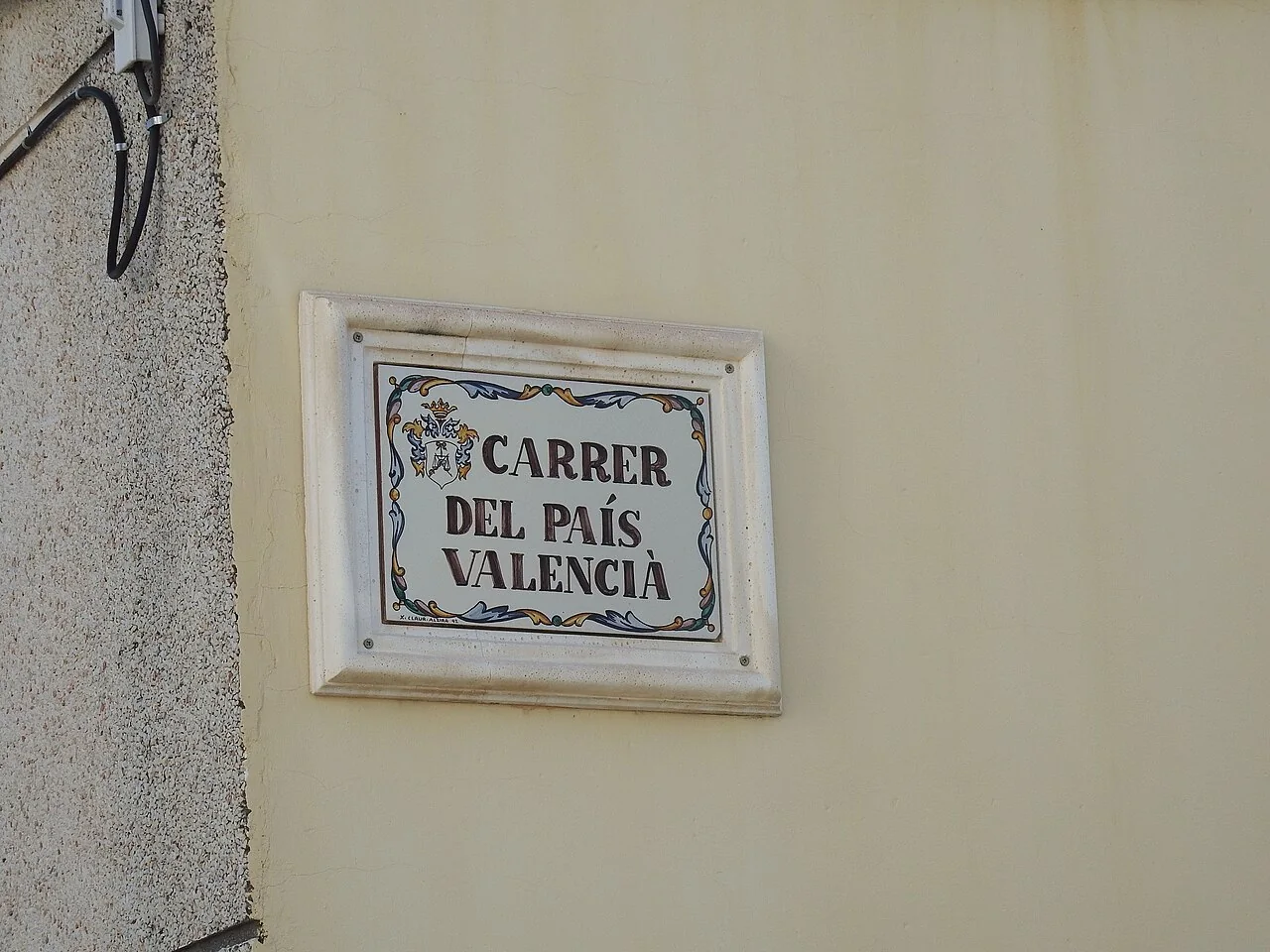
València Turisme places the main festivities on 10–13 August, honouring Sant Llorenç, Our Lady of Mount Carmel, Saint Louis and the Sacred Heart. Safor Turisme also highlights January’s Porrat de Sant Antoni, with cultural activities, stalls, traditional games and a bonfire. Dates and programmes need checking each year. The photograph shows a ceramic sign reading “Carrer del País Valencià”. It is a precise piece of street furniture, not a view of the entire heritage area or a monument.
Useful questions
Does Benirredrà have a large historic centre?
No. The municipal catalogue describes it as small and greatly transformed. Its visitor value lies in several clearly identified buildings.
Can visitors enter Les Esclaves?
Do not assume so. It is a functioning school and religious residence. The exterior is visible from public streets, while interior access would require explicit permission.
Is there a local hiking trail?
No registered trail exists within the municipality according to the planning document. Sant Josep is a poor-condition ruin requiring a specific safety check, not an automatic recommendation.
Related guides
- What to see in Castellonet de la Conquesta
- What to see in Beniflà
- What to see in Daimús
- Municipal guide finder
Official sources and image credit
The editing date records changes to the text, not a new check of opening hours, telephone numbers or accessibility. Specific verification dates, where recorded, appear beside the relevant information.