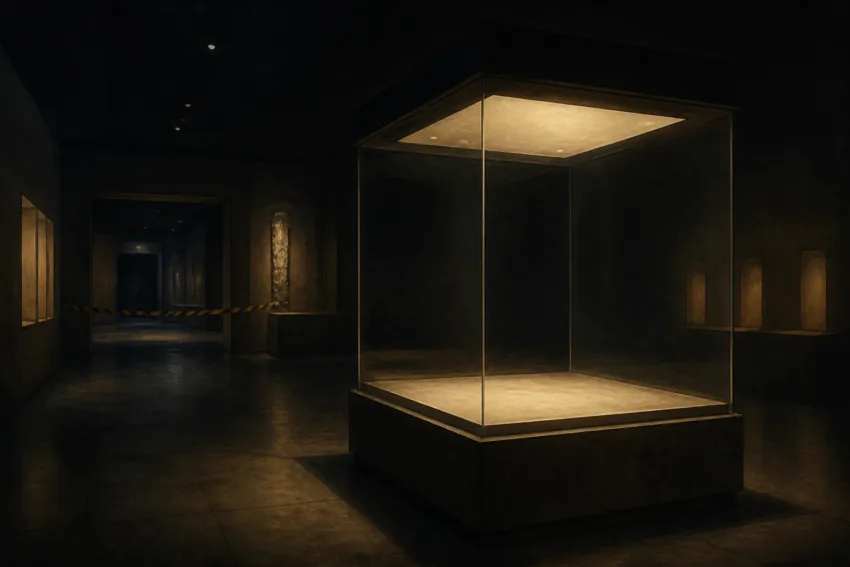
Villena Museum remains closed and the city council has not set a reopening date after most of the Treasure of Villena was stolen. Two days after the break-in, the clearest public consequence is the suspension of visits while the Guardia Civil examines recordings and completes an inventory of the missing objects.
The museum’s alarm reached the Guardia Civil command centre in Alicante at 5.23am on Thursday 27 August, government representative Manuel Pineda said at a press briefing reported by El Periódico de Villena. Judicial police have footage from cameras inside and outside the building. It shows several people and several vehicles, but the Guardia Civil commander did not give a firm number or endorse a single theory.
Mayor Fulgencio Cerdán confirmed that the intruders took most of the archaeological collection and three crowns associated with the Virgin of Virtues. A complete object-by-object account still depended on the police inventory. Figures circulating since the theft should therefore not be treated as a final loss assessment.
The break-in lasted only a few minutes. The MUVI alarm followed another alert at the municipal sports centre; the mayor said the two events might be linked but left that question to investigators. Authorities have not officially identified the intruders’ destination or confirmed reports that the theft was commissioned.
An empty case and a loss that cannot be measured only in gold
The heritage value goes far beyond the metal. The museum’s own collection record dates the group to around 1000 BC and describes bowls, bracelets, bottles and composite objects made from gold, silver, iron and amber. José María Soler and his colleagues discovered it in 1963. The museum places it alongside the grave goods from the royal tombs at Mycenae as a landmark of European Bronze Age metalwork.
The museum admitted journalists on Friday to explain its protective systems. According to the account of that visit, alarms detected the entry and cameras recorded the route through the building. The treasure room was a roughly 75-square-metre strongroom protected by physical barriers and several security rings. Its latest scheduled inspection took place on 3 August.
Detection and recordings do not by themselves settle questions about the response. The intruders left before officers reached the building. Investigators must establish how the barriers were overcome and whether there were operational failures; neither the museum’s technical account nor subsequent political accusations amount to forensic findings.
Reporting published on Saturday says the MUVI remains closed with no reopening date. The museum website still displays its normal timetable and should not be read as evidence that visits have resumed. The next verifiable development will be an official inventory, the recovery of objects or a municipal reopening date. Until then, both the criminal inquiry and the assessment of what happened inside the museum remain open.