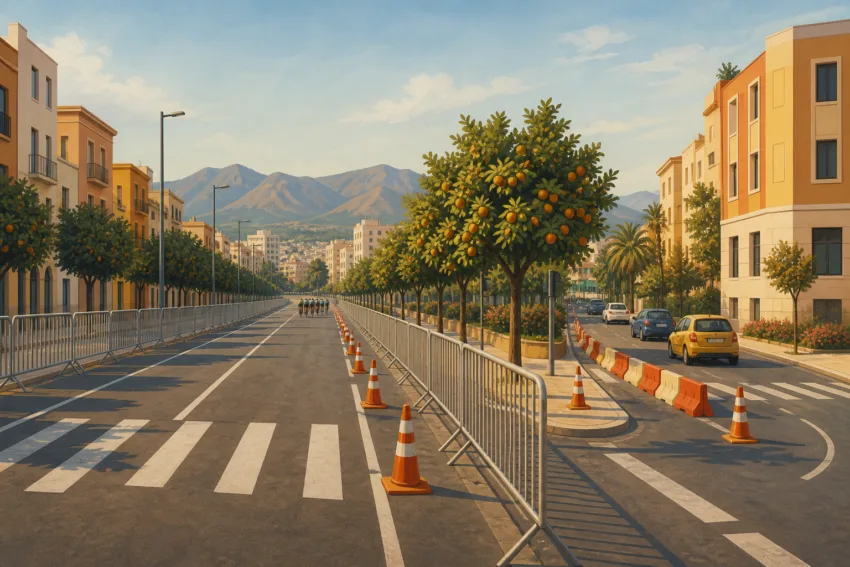
The Vuelta’s arrival in Castelló will begin affecting traffic before the peloton comes into view. The first closure starts at 8pm on Wednesday 26 August on Calle Río Sella, where television equipment will be installed. On Thursday, restrictions spread around the finish from early morning before reaching the eastern and northern ring roads during the afternoon.
The disruption is not confined to the city. The 177.5-kilometre sixth stage leaves Alcossebre and crosses a dozen municipalities before entering Castelló. The advertising caravan and security convoy require roads to be temporarily closed, so journeys between the coast, La Plana and inland areas may be affected for several hours.
Race organisers place the finish between 5.18pm and 5.43pm, depending on the riders’ speed. The city council is using a wider operational window, until around 6.30pm, to manage closures and reopen roads. Drivers should not treat the earliest finish estimate as a promise that the streets will immediately be clear.
The finish takes over Chatellerault from 7am
Avenida Chatellerault will close from 7am on Thursday between Guitarrista Fortea and Ronda Este while the finish area is built beside Palau de la Festa. Cardenal Costa will also close at Camino San José. Both locations remain affected until dismantling work is complete.
Installation of barriers for the final kilometre begins at 9am. This affects the southbound Ronda Este between Hermanos Bou and Camino Villamargo. At about 2pm, the northbound carriageway up to Hermanos Bou also closes. As the race approaches, restrictions extend along Ronda Este and Ronda Norte between Camino Villamargo and the CV-149.
For traffic entering the city centre from the Grau during that period, the council’s alternative route is through the Lledonera roundabout, approached from either Caminàs or Camino Villamargo. Reopening will be gradual: northbound traffic on Ronda Este should resume after the stage passes, while the finish area remains occupied during dismantling.
A north-to-south route through the province
The neutralised start in Alcossebre is scheduled for 1.11pm. The official route then runs through Alcalà de Xivert, Les Coves de Vinromà, Torre d’en Doménec, La Serratella, Albocàsser, Serra d’en Galceran, Benlloc, Vall d’Alba, Cabanes, Oropesa del Mar, Benicàssim and Castelló.
At the middle forecast speed of 41 kilometres per hour, the peloton is expected in Alcalà de Xivert at 1.19pm; Les Coves at 1.40pm; Torre d’en Doménec, 1.53pm; La Serratella, 2.16pm; Albocàsser, 2.27pm; Serra d’en Galceran, 2.53pm; Benlloc, 3.03pm; Vall d’Alba, 3.11pm; Cabanes, 3.21pm; Oropesa, 3.42pm; and Benicàssim, 3.50pm. These are passing estimates, not reopening times: the advertising caravan travels ahead of the riders, while local councils and the Guardia Civil adjust restrictions to the race’s actual progress.
The closing section crosses the Desert de les Palmes again and climbs El Bartolo before descending towards the city. That combination of mountain roads and urban approaches leaves few useful diversions once the convoy has sealed the route.
A second inland stage follows on Friday
The province-wide disruption does not end on Thursday. Stage seven leaves Vall d’Alba at 1.40pm on Friday 28 August and travels through Vilafamés, La Barona, Les Useres, Costur, Figueroles, Llucena, Castillo de Villamalefa, Zucaina, Montanejos and Puebla de Arenoso before continuing towards Valdelinares.
The organiser’s timetable indicates when the race is likely to pass, but each municipality controls its exact road closures. Anyone travelling for a medical appointment, work shift or onward connection should plan outside the affected window or check the relevant local notice before setting out. The Vuelta timetable is the reference if the sporting schedule changes; city streets will reopen according to the municipal operation and the removal of finish-line infrastructure.
Sources: the Vuelta’s official route timetable; mobility arrangements announced by Castelló City Council; and province-wide reporting by Radio Castellón–Cadena SER.