Sourced guide
Setting and character
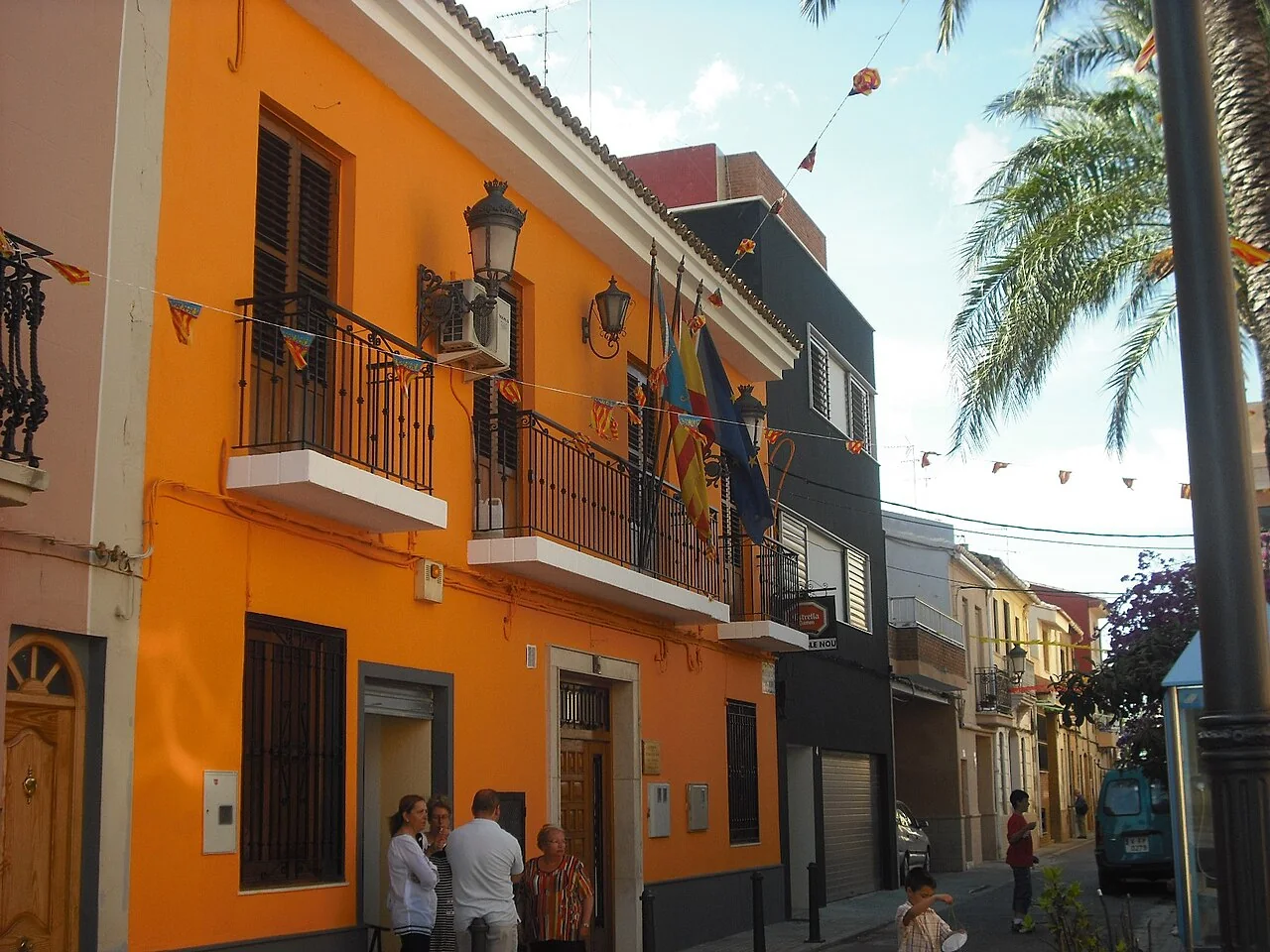
One fact determines the whole visit to Llocnou de la Corona: according to the provincial authority, its municipal territory is the smallest in Valencia province and is essentially limited to the built-up area. There is no mountain route or extensive countryside inside its boundary. The photograph shows the orange Town Hall façade and a decorated street during festivities, not a monumental historic square.
Documented heritage
The settlement is associated with a convent founded in 1676 by Franciscan religious from Valencia’s Corona de Jesús. After it was abandoned, houses and farm workers’ huts gathered around the site, giving rise to the name La Corona. This history explains a municipality of only a few streets and makes editorial padding especially misleading. Its distinctive value lies in seeing how an entire municipality fits into a very short walk.
Landscape and territory
Our Lady of the Rosary church was begun on 17 December 1899 over the former hermitage and opened in 1904; another institutional summary gives 1902 as completion. These are best understood as construction stages rather than concealed as conflicting dates. Described as Neo-Gothic, the building has a single nave, side chapels, a choir and a Neoclassical altarpiece. The main square opens beside it.
How to organise the visit
One or two hours is enough for the Town Hall, church, square and residential streets without borrowing attractions from outside the boundary. Church entry depends on worship. Corpus Christi and Sant Vicent Ferrer festivities help explain community life; flags and neighbours in the image document social use of the street, although the photograph does not identify a particular event or year.
Food, boundaries and context
The provincial listing names all i pebre and paella, but daily food service may be very limited. Alfafar, Sedaví or Catarroja can extend the trip, provided their ports, fields and landmarks are not reassigned to Llocnou. Its scale calls for careful parking, clear doorways and respect for residents. A brief visit can still be valuable when its limits and unusual municipal geography are explained honestly.
Responsible planning
When planning a visit to Llocnou de la Corona, check the linked council or tourism page, the weather forecast and any notices about fire risk, works or festivities. Churches are not museums with permanent opening hours, while farms, terraces and houses mentioned may be private. Carry water and suitable footwear, avoid blocking narrow streets and never enter riverbeds, ruins or closed structures. Timing depends on gradient, mobility and stops, so keep the town walk separate from a mountain route or an outlying drive.
How to use this information
For Llocnou de la Corona specifically, the linked sources support the names, dates and features used to explain the municipality, but they do not replace a real-time check. A heritage record may remain historically accurate even when access, signs or the building’s use changes. This guide therefore separates established facts from variable recommendations and does not promise admission, tours, toilets or food service. Where institutions provide different dates, they are treated as phases or the discrepancy is stated instead of being hidden.
When exploring Llocnou de la Corona, accessibility differs greatly between a square, hermitage, viewpoint and trail. Anyone needing step-free routes, adapted public transport or accessible toilets should confirm them with the council before travelling. Bus frequency, taxis and charging points can also vary in small villages. Save useful contact details, download a map before leaving the settlement and allow enough daylight to return. No scenic reference is permission to cross private property or continue in poor weather.
Frequently asked questions
How much time should I allow?
For Llocnou de la Corona: Allow roughly one to four hours for the settlement and plan the described routes or outlying sites separately.
Are interiors and natural sites always accessible?
For Llocnou de la Corona: No. Confirm opening times, permission, trail condition and restrictions through official sources before travelling.
How is this different from a generic template?
For Llocnou de la Corona: Every place, date, image and municipal boundary has been checked for this municipality, with the supporting sources linked below.
Related guides and local data
Official sources and verification
The editing date records changes to the text, not a new check of opening hours, telephone numbers or accessibility. Specific verification dates, where recorded, appear beside the relevant information.