A visit with context
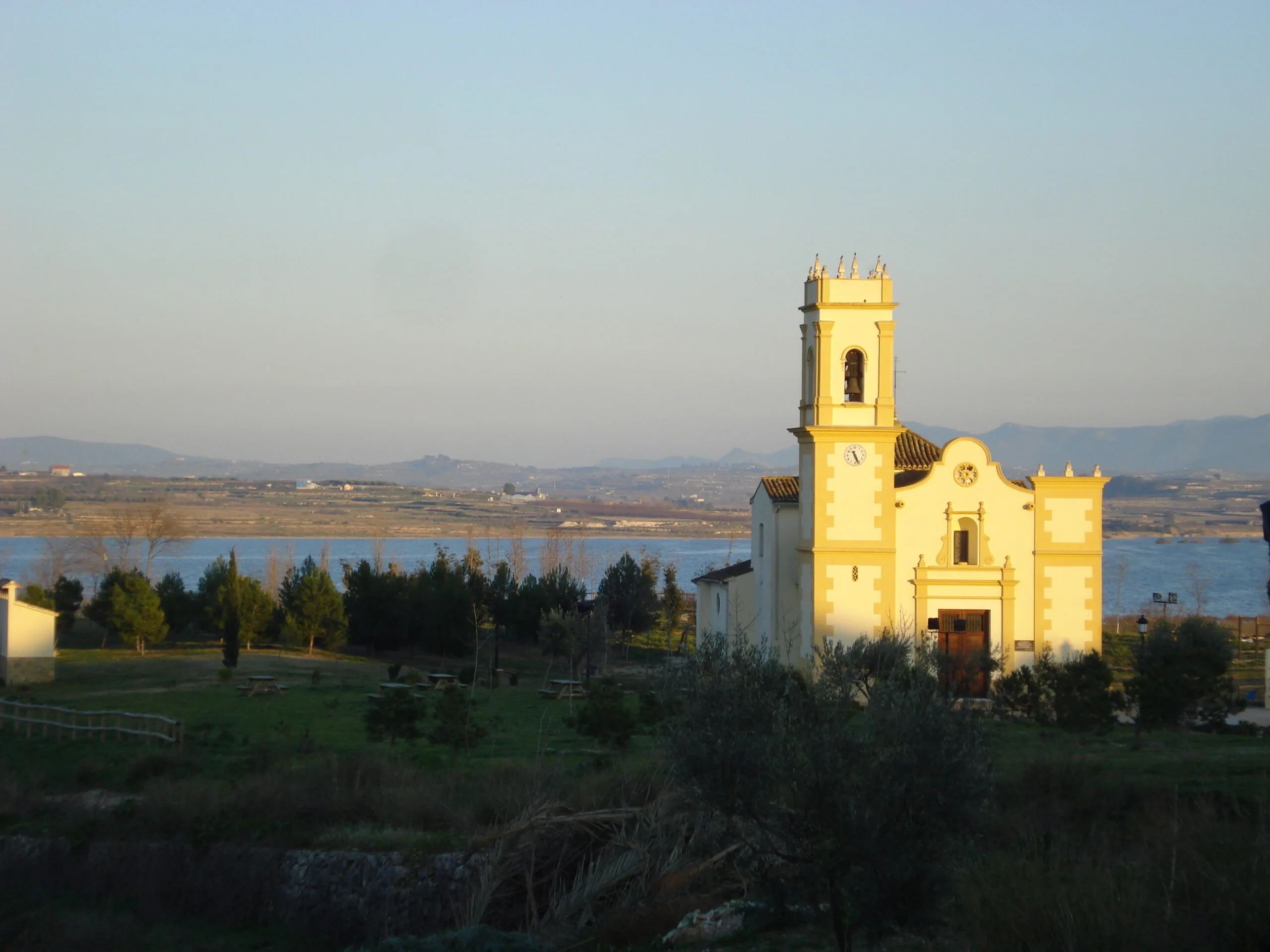
Guadasequies —Guadasséquies in Valencian— changed profoundly when Bellús reservoir was built. The old Our Lady of Hope church now standing before the water captures that transformation and is much more informative than the previous generic entrance to a recreation area. The replacement image accurately connects heritage and landscape without deleting the old media file or changing the guide’s public address.
Heritage and history
The historic church is an early-eighteenth-century Neoclassical building according to the provincial authority. Reservoir adaptation works threatened its survival in the 1990s, but it was restored in 2003 and houses a local museum. This recent preservation story is central to understanding the place. Interior and museum access must be confirmed with the council; being able to view the outside does not imply permission to enter a closed building.
The new Our Lady of Hope church was built in 1999 and opened in July 2000. Its Latin-cross plan and polygonal lantern with stained glass form a clear contrast with the older church. Including both buildings is not repetition: together they explain a transfer of religious functions and the municipality’s response to a landscape substantially altered by major hydraulic infrastructure.
Landscape and route
Cristo del Amparo hermitage stands on higher ground and dates from the early twentieth century. The institutional listing describes masonry and brick construction, a Latin-cross plan, barrel vault, dome and rose windows, together with a Baroque Christ painting from the mid-eighteenth century. A route can link both Hope churches and climb to the hermitage, taking account of heat and gradient and avoiding unsigned reservoir access points.
Planning the visit
Documented local food includes puchero and oven-baked rice casserole with beans and turnips. These are cultural references, not guaranteed menus, so check local kitchens and hours. View the reservoir only from safe public places; swimming, boating and access to infrastructure must not be promised. Bellús and other Vall d’Albaida villages can extend the day provided every shore, building and viewpoint is assigned to the correct municipality.
Responsible planning
This guide gives priority to municipal, provincial and regional-government sources. Its links let readers verify the original evidence and identify later changes. Use a current map for the journey and check transport on the day of travel: services to small municipalities can be infrequent, while an old timetable is not proof that a bus or facility still operates.
Distances should be adjusted for mobility, age and temperature. Sloping streets, uneven surfaces and buildings without continuous access can change a route substantially. Anyone requiring step-free access should ask the council or venue a specific question, because describing two places as close does not mean there are no steps. Respect for homes, crops, worship, local events and signs is part of a visit that benefits the community.
Related guides and data
Official sources and checks
The editing date records changes to the text, not a new check of opening hours, telephone numbers or accessibility. Specific verification dates, where recorded, appear beside the relevant information.