Albalat dels Sorells offers a compact introduction to Horta Nord: a Gothic palace now used as the town hall, a Baroque church with a large dome, ceramic devotional panels, brick chimneys from the former tile industry and routes into the market gardens. Its closeness to Valencia does not make it merely a commuter stop. The palace and pedestrian Plaça del Castell create a clear centre for the visit.
Palau dels Sorells and Plaça del Castell
Palau dels Sorells, also known as the castle-palace of the Counts of Albalat, is a fifteenth-century work of Valencian civil Gothic architecture and the present town hall. Turisme Comunitat Valenciana places it at the heart of the town; the provincial profile describes its defensive character, surviving tower, Gothic windows and quadrangular courtyard with an open staircase.
The pedestrian square allows visitors to study the exterior at any time. A town hall is not automatically a museum: interior access must follow administrative use, organised visits and council instructions. Begin with the building’s mass, gate, tower and relationship with the square rather than assuming entry.
Holy Kings church and the Cristo chapel
The parish church of the Holy Kings is an eighteenth-century Baroque building whose large dome stands out in the skyline. The façade and dome are part of the street walk; entry requires checking opening and respecting worship. Religious heritage also includes the chapel of Cristo de las Ánimas, associated with the ceremonial lowering of the image during the first weekend of September festivities.
The buildings have different roles: the parish church anchors the historic centre, while the chapel has its own devotional and festive life. A reliable guide should not claim that both interiors will be open on the same day. Their exteriors and surrounding streets already form a coherent route.
Ceramic panels and industrial chimneys
Religious ceramic panels survive on private façades. They are visible heritage but remain part of homes: view them from public space, do not enter doorways and avoid photographing private interiors. Their small scale provides a deliberate contrast with the palace.
Slender brick chimneys recall the local tile and brick industry. The regional tourism source identifies them as protected industrial heritage and evidence of a more recent economic phase. They are neither medieval towers nor decorative replicas. Observe them from accessible streets and never enter enclosed industrial plots.
The Mill Route and Xurra Greenway
The local Mill Route crosses cultivated land towards a traditional farmhouse, while the green route connects with the Xurra Greenway. This former railway alignment creates a cycling corridor of about 16 kilometres through several Horta Nord municipalities. There is no need to complete it: a short out-and-back section from Albalat can add landscape without taking over the day.
The market gardens are working land divided by irrigation channels. Follow the route, give way on narrow tracks, never step on crops and take care at road crossings. Rain can leave mud, and summer favours early or late hours. Cyclists should check works, diversions and suitability before setting out.
A sensible route
- Plaça del Castell: start with the Palau dels Sorells exterior and its present civic use.
- Holy Kings: walk to the church and read its dome in the town skyline.
- Central streets: look for ceramic panels and identify chimneys from public space.
- Market gardens: choose either the Mill Route or a short Xurra connection rather than rushing both.
Arrival and local food
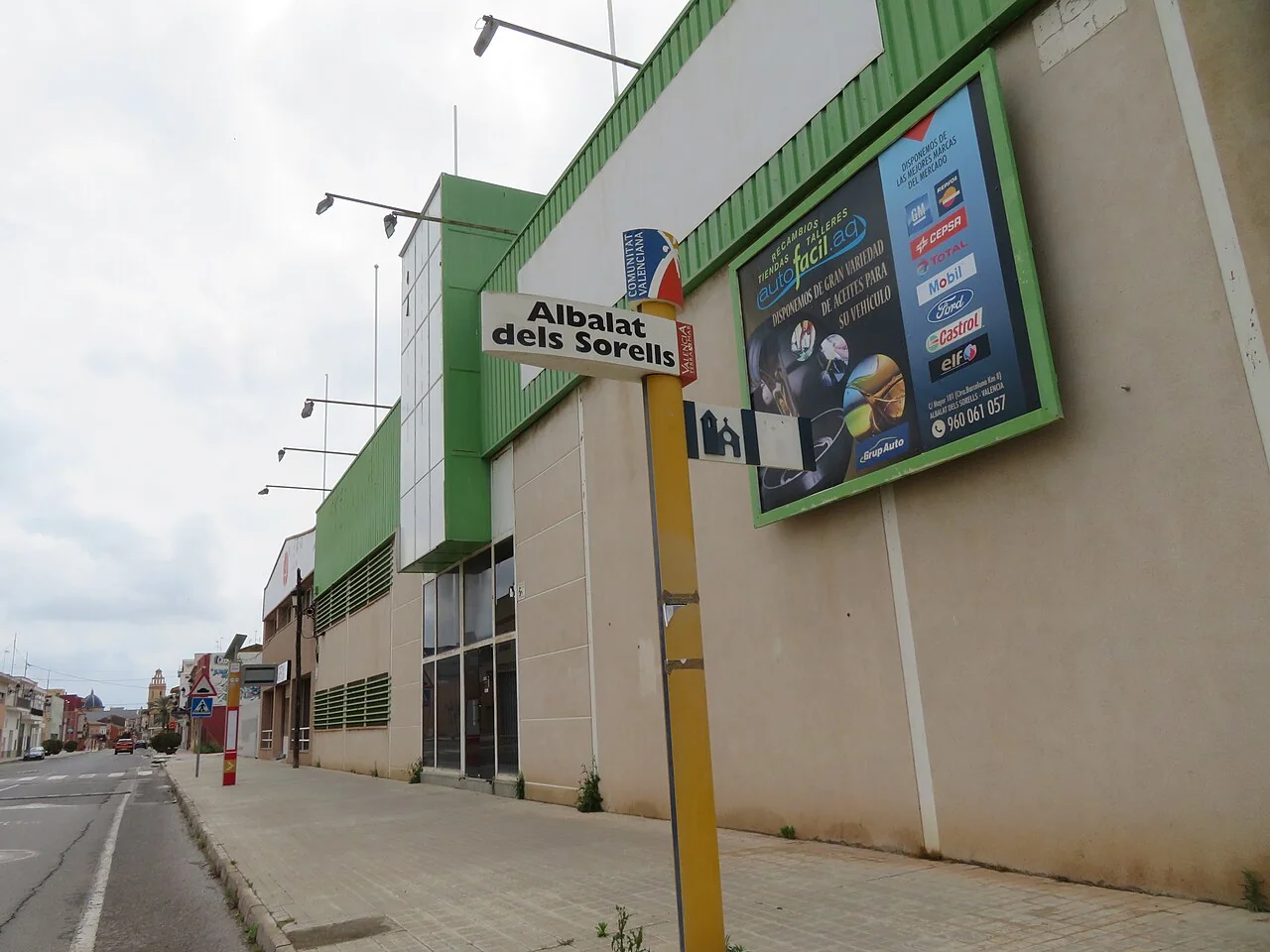
Albalat dels Sorells has a Metrovalencia station, the setting shown in the main photograph. Lines and timetables can change, so consult Metrovalencia on the day of travel. The provincial profile mentions paella and coca cristina. Ask local bakeries about the latter rather than assuming it is made every day.
Nearby visits
Continue with the market gardens and coast of Alboraia, the industrial heritage of Vinalesa, or Albuixech. Calculate each transfer separately and do not assign neighbouring landmarks to Albalat.
Sources and editorial scope
This guide was checked against Turisme Comunitat Valenciana, València Turisme and Spain’s National Statistics Institute. Use our municipality finder to extend the route. Current opening, notices and restrictions always take precedence.
The editing date records changes to the text, not a new check of opening hours, telephone numbers or accessibility. Specific verification dates, where recorded, appear beside the relevant information.