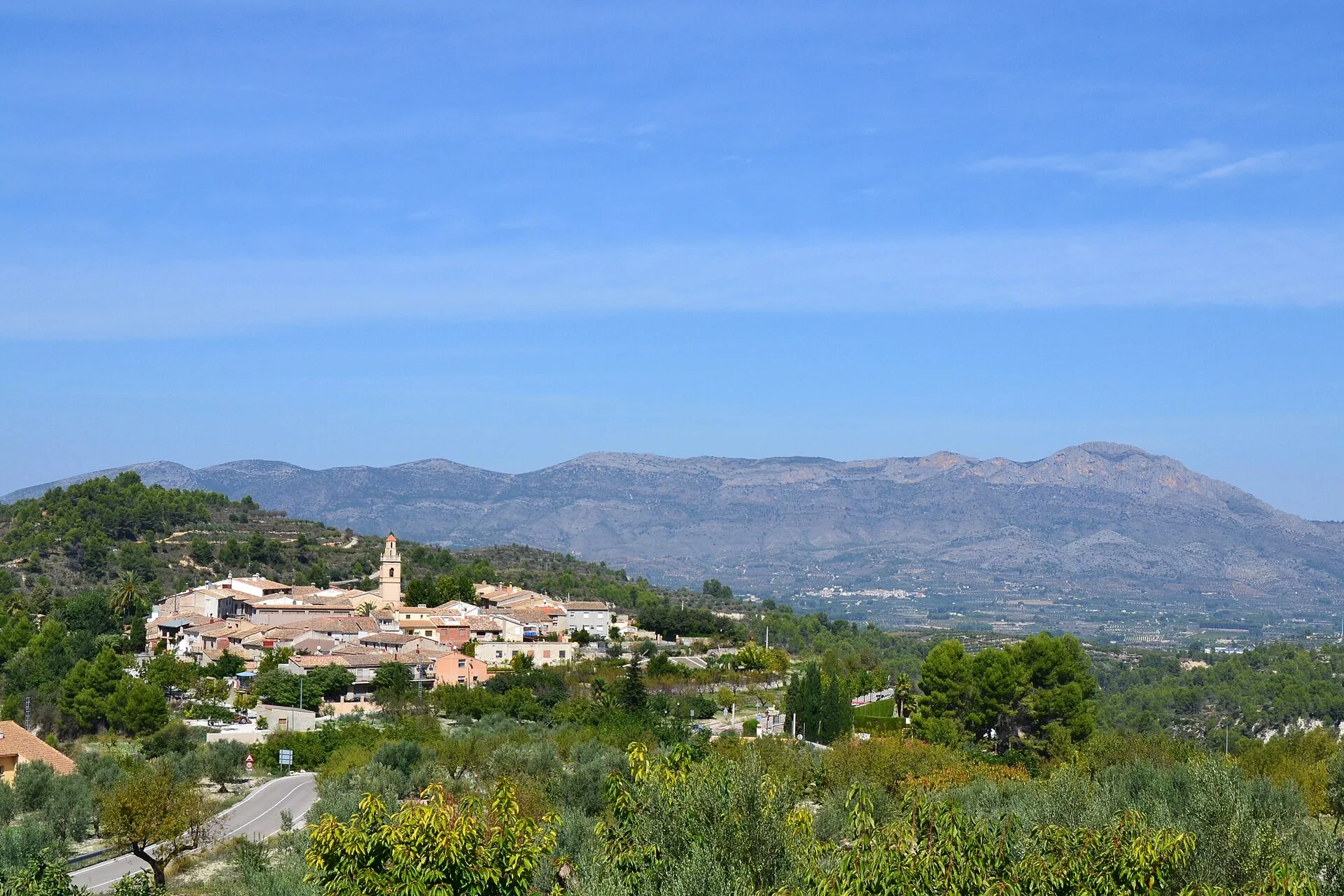
Benillup occupies a small rise in the Travadell valley and places three distinctive references within a compact centre: Our Lady of the Rosary Church, an old olive-oil mill converted into a cultural venue, and a viewpoint over the valley. Font Vella can be added outside the village. The most useful visit connects heritage, olive cultivation, landscape and living culture instead of repeating a generic checklist of streets and springs.
A walk through central Benillup
Our Lady of the Rosary Parish Church
The church is dedicated to Our Lady of the Rosary. The council documents it as a 16th-century building and a locally protected heritage asset. Municipal tourism material says that it incorporated an earlier defensive structure or watchtower from the former Islamic settlement. Its square bell tower, sundial and Saint Lawrence weather vane make the building identifiable from around the village.
The bells add specific local history. According to the same municipal material, the larger Sant Llorenç bell dates from 1942 and the smaller Santa Àgata bell from 1799. These details can be understood without promising interior entry. Check current parish or council information for worship, celebrations and any announced opening.
The old oil mill and Ethnological Museum
The former almàssera, or olive-oil mill, preserves Benillup’s relationship with small-scale oil production. The council says that the building was restored in 2000 and converted into a cultural centre and Ethnological Museum, with a library and exhibition space. It should not be assumed to open every day; contact the council to confirm access and current activities.
Even when the interior is unavailable, the mill provides a concrete way to interpret the cultivated landscape and the work behind local olive oil. That building-to-landscape link is more informative than treating oil as an interchangeable product of every inland village.
Travadell viewpoint
The viewpoint opens across the Travadell valley. The council’s description identifies the Almudaina, Foradada and Benicadell ranges, with Beniarrés, Gaianes and their reservoir visible to the north in suitable conditions. It also locates the Sofre and Estret ravines and El Tossal in the surrounding relief. Visibility changes with weather; remain in designated areas and keep away from unprotected edges or private plots.
A practical route: heritage, views and Font Vella
- Begin at the church: examine its bell tower, sundial and structure from public space.
- Continue to the oil mill: interpret its agricultural role and check in advance whether the cultural venue is open.
- Finish the village walk at the viewpoint: identify the valley and ranges in clear, safe conditions.
- Add Font Vella only if time permits: it lies a few kilometres from the centre and needs its own journey or walk.
Municipal visitor information describes Font Vella as a spring area with characteristic vegetation. It is not an urban drinking fountain, and natural water should never be assumed potable. Confirm the route and its condition after rain, and reconsider the outing during extreme heat or wildfire alerts.
History and living culture
Benillup has Islamic origins. The municipal history records 37 Morisco families, around 150 people, in 1609 before their expulsion and the settlement’s subsequent depopulation. The figure connects the former alqueria, the possible defensive tower and later changes to the village without inventing a continuous architectural chronology.
The council also highlights perxa, a form of Valencian handball still played locally. It is living culture rather than a permanent visitor attraction. If a match or activity is taking place, respect its organisation and the everyday use of public space.
Documented local food
Municipal food information names sequillos, putxero and fried figs, together with olives, walnuts and sopà. This selection reflects preserved produce and family or festive cooking. Availability depends on venue and season, so ask when booking rather than expecting every dish on a daily menu.
Practical advice
- The centre is small and walkable; Font Vella needs separate planning.
- Confirm museum access and any cultural or religious activity with the council.
- Carry your own water: a natural spring is not the same as a monitored drinking-water supply.
- On rural paths, respect crops, property, signs and warnings concerning rain, heat or wildfire risk.
Nearby places
A wider Comtat itinerary can continue to Benimarfull, Benimassot or Cocentaina. Check driving times and the opening arrangements of each site before setting out.
Related guide and official sources
The editing date records changes to the text, not a new check of opening hours, telephone numbers or accessibility. Specific verification dates, where recorded, appear beside the relevant information.